
Centralized crypto exchanges remain at the core of the crypto market, but their role is beginning to shift. The focus is increasingly moving away from the passive custody of capital toward its active use in trading.
Centralized crypto exchanges, or CEXs, continue to form the backbone of the market. They provide liquidity and serve as the primary access point for both retail and institutional investors. However, the latest CoinGecko report shows that it is no longer the size of assets held on these platforms that matters most, but how actively that capital is being used.
Total reserves across the largest platforms have increased significantly over the past two years. At the same time, capital is increasingly shifting between exchanges. Platforms with more active, trading-oriented user bases are gaining importance, while others are seeing declining balances.
Activity Becomes Key for Centralized Crypto Exchanges
Institutionally oriented platforms continue to serve primarily as custodial venues. A large share of assets held on these exchanges remains relatively inactive. In contrast, exchanges with a stronger retail-driven profile show significantly higher trading activity. Liquidity circulates more rapidly and positions are adjusted more frequently.
At the same time, the structure of demand is evolving. A growing share of institutional investment flows through regulated products such as ETFs rather than directly via spot exchanges. This reduces trading activity on traditional platforms without diminishing their overall importance. The shift is further reinforced by market structure. Platforms with active user bases benefit from lower fees, more frequent listings, and trading-oriented features that keep capital in motion.
This development highlights a broader shift in the role of centralized crypto exchanges. Platforms such as Bitget and MEXC are gaining relevance by attracting active, trading-focused users and generating higher capital turnover. While this increases efficiency, it also leads to greater sensitivity to market movements. Capital can exit these systems more quickly, amplifying pressure during periods of stress.
In parallel, decentralized exchanges continue to gain traction. Their share of global spot trading is steadily increasing, pointing to a structural shift in market architecture. Centralized platforms still dominate overall, but the direction is clear. Trading activity is gradually moving toward systems where capital is deployed more efficiently and directly.



Listings Lose Relevance
Another key finding relates to new token listings. While they continue to attract attention, they rarely prove to be a sustainable source of returns. A large share of newly listed assets declines in value early and fails to hold up over time. This aligns with our previous analysis on token inflation. The growing number of new projects is met with limited demand, and even major exchanges list only a small fraction of the tokens being created. As a result, competition for capital continues to intensify, and visibility through a listing alone is no longer sufficient.
For investors, the focus is shifting accordingly. What matters is not access to an exchange, but whether a project generates real usage and can attract capital over time. This dynamic is reinforced by the structure of trading itself. Stablecoin pairs dominate the majority of volume, anchoring the market in dollar-based liquidity where capital is reallocated more quickly and risk positions are adjusted more dynamically.
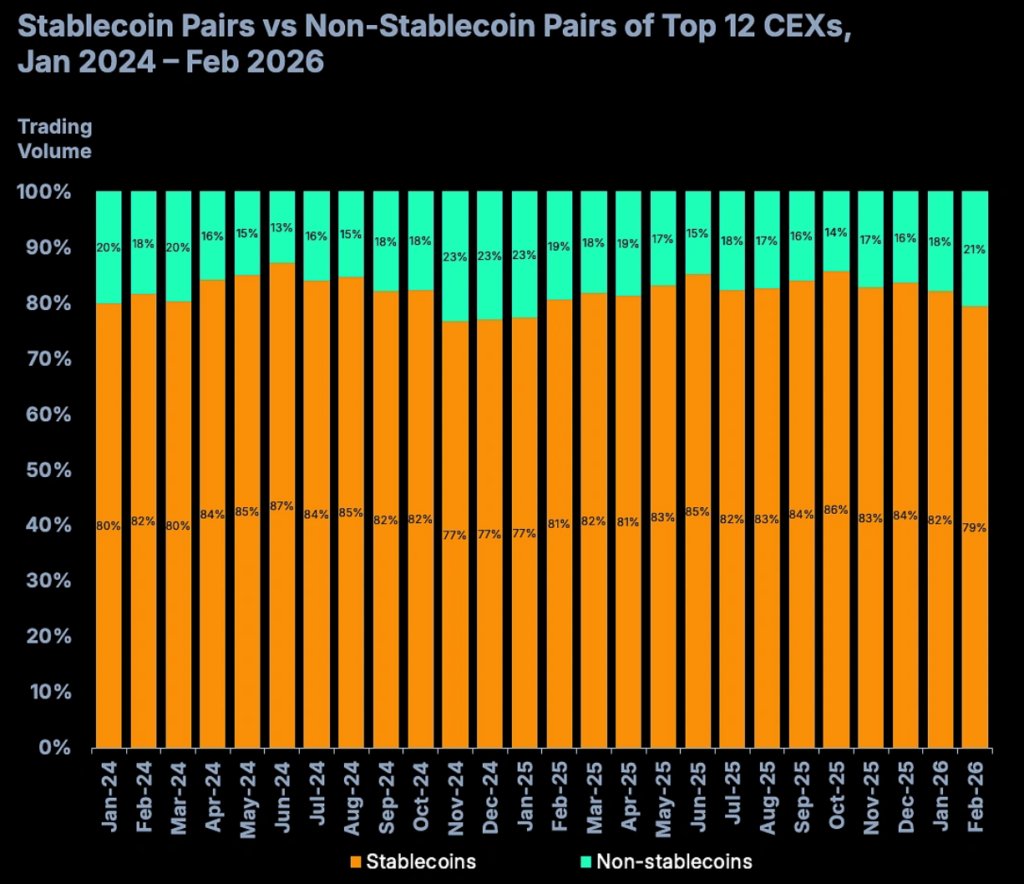
Stablecoin vs non stablecoin pairs / Source: Coingecko 2026 CEX ReportThe report confirms a central development in the crypto market. It is no longer listings or platform size that determine success, but the actual utilization of capital.