The non-fungible token (NFT) craze is in full swing. Dozens of new projects are created each day, which has resulted in record-breaking volumes for most marketplaces. The one gaining most traction recently is the Loot Project. A broad introduction to its ecosystem.
Some people claim the Loot Project is the first of its kind; others say similar projects are already out there. Either way, over the past few days, Loot seems to be getting everyone’s attention. I tried to dive into the project over the weekend, but quickly realised that I would only be able to scratch the surface. To me, the project is pretty abstract. But I do have a couple of ideas as to how Loot could play out in a future financial industry.
Here is a rough overview of what it is, and my thoughts on it.
What is the Loot Project?
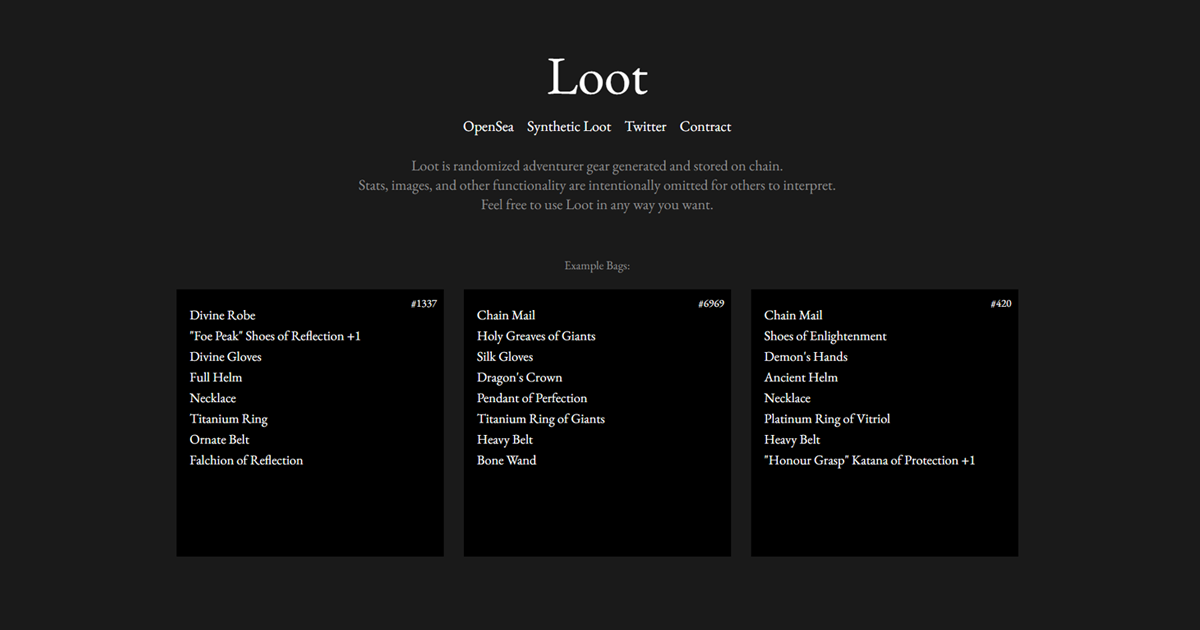
Loot is an on-chain non-fungible token (NFT) that contains just text. Just kidding, it is a list of adventure items as text. When you mint one, you get a set of items as text. See an example of a loot bag below:
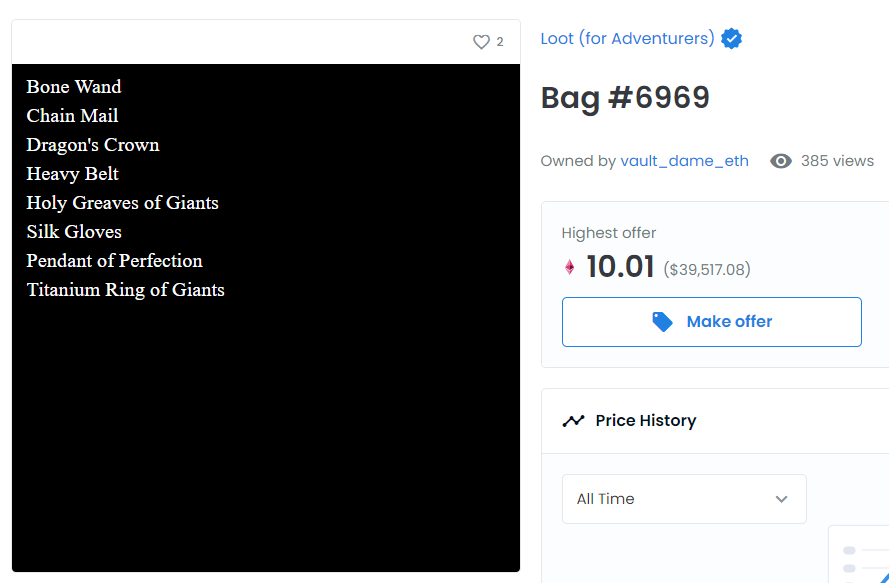
How were these bags distributed? The creator, Dom Hofmann, dropped them at the end of August. They were free; you just had to pay the transaction fee to mint one. However, there were no further details or information on them. Also, no Web3 application (at least initially). Now, as a little side note for you money-driven folk: the current floor (lowest) price is over 13 Ether (ETH)!
How the hell can an NFT that only consists of text as properties be worth 13 ETH?!?. I am not even trying to explain the price here, but I would like to give you my view after having browsed through many Twitter threads and Discord conversations. One fellow posted a very simple graphic that displayed the difference between ordinary NFTs and Loot Bag NFTs (see below).
This is what I have been SUPER EXCITED about...
It's @dhof and his creations: @blitmap @sugarthegame @supdrive, and most importantly @lootproject ❤️
Loot is something different. It's something that has never been done before ever.
It's a paradigm shift in NFT space.
Thread 👇 pic.twitter.com/vbaUF4uGNE
— tandavas.eth 🫡 (@tandavas) August 31, 2021
Ordinary or typical NFTs take the top-down approach. The creators create something like an ape or a cute cat profile picture, a game item, or digital art as an NFT. Then they expand the ecosystem around the NFT to bring more value to it. This will incentivise the collectors to hold, which increases scarcity, and ultimately the people who feel left out and absolutely want one will drive the price up. Basically, the creators sell a “finished product” like a house, and then make the neighbourhood better, or give you some extra furniture.
However, the loot approach is different. Taking a bottom-up approach, the value of the NFT is not tied to a single entity or person. To stay with the “house” analogy, the loot bags are in this case the bricks. You can decide if you want to build a house, a bridge, or a stadium.
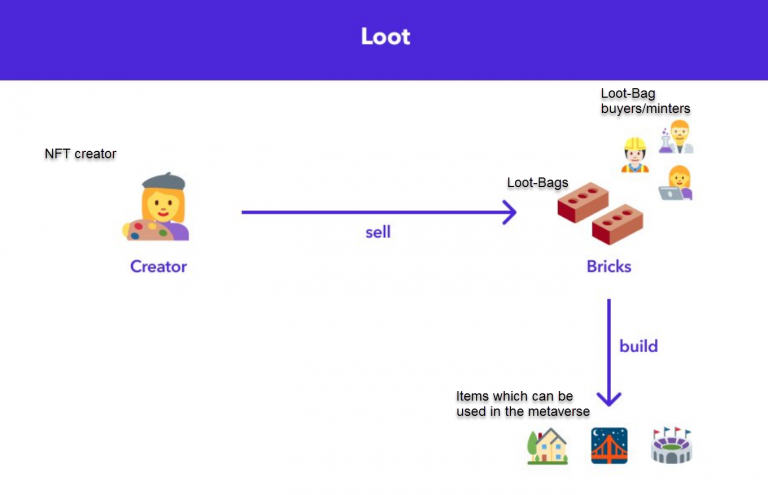
This means that the value of a loot bag is driven by the builders who bought or minted bags and are doing something with them. Are you, too, having trouble seeing “what exactly” they are able to build? Here are a few examples of projects:
Broad overview of Loot's ecosystem
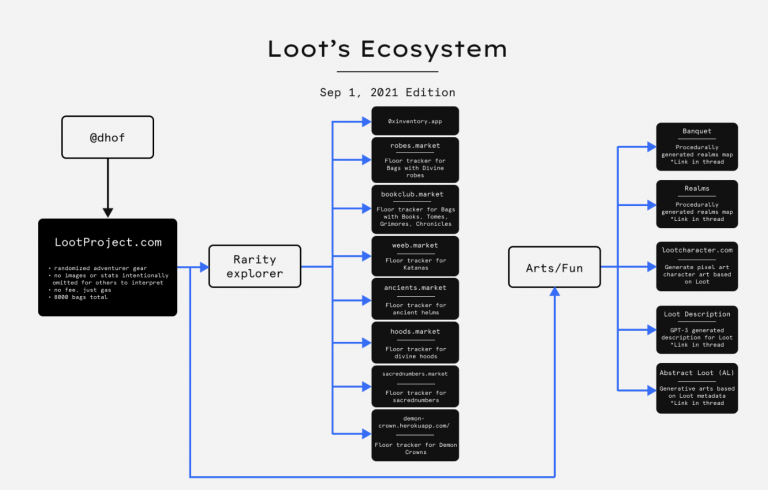
Luckily, the younger generation in our team politely pointed out to me that there are other projects out there like “More Loot”, which was also created by Dom Hofmann. There are also various derivative loot bags, e.g. cLoot (Chinese Loot) and ELoot (Extended Loot). Please do not ask me what exactly a loot bag derivative is, but the younger generation at our desk wold be more than happy to fill you in.
Now, let us imagine that the “new” financial system is built bottom-up. Currently, financial markets (the products) are top-down. Financial service companies create a product that “should” have some value or generate revenue. In my view, the bottom-up financial system has already started to take shape. Look at the decentralized finance (DeFi) sector and the way the ecosystem is developing via financial-bricks, or financial-Lego pieces, as they are referred to. You can buy tokens that have a very specific risk premium (profile), and you are free to combine them in your investment plan as you like. Another potential use case is the way a financial service provider (they can be centralised or decentralised, it does not matter) can build a product (loot bag) with different risk premiums, and the investor can choose to buy the entire bag or just the risk premium part (attribute) that they like.
I am certain that I have forgotten to mention many legal and compliance aspects in my rough overview. And I was also unable to take the technical details/coding into account. I may have also not chosen the best analogy, but it does help me to get a better picture of where all of this is heading. One thing is very clear – it is full steam ahead. Some sectors, such as the gaming sector, move a great deal faster and are more advanced. This is perfectly understandable, of course, since highly regulated industries, e.g. the financial sector, have much higher hurdles to clear before they are ready to do business in such a new way – and with such a new concept.
Copyright © 2021 | Crypto Broker AG | All rights reserved.
All intellectual property, proprietary and other rights and interests in this publication and the subject matter hereof are owned by Crypto Broker AG including, without limitation, all registered design, copyright, trademark and service mark rights.
Disclaimer
This publication provided by Crypto Broker AG, a corporate entity registered under Swiss law, is published for information purposes only. This publication shall not constitute any investment advice respectively does not constitute an offer, solicitation or recommendation to acquire or dispose of any investment or to engage in any other transaction. This publication is not intended for solicitation purposes but only for use as general information. All descriptions, examples and calculations contained in this publication are for illustrative purposes only. While reasonable care has been taken in the preparation of this publication to provide details that are accurate and not misleading at the time of publication, Crypto Broker AG (a) does not make any representations or warranties regarding the information contained herein, whether express or implied, including without limitation any implied warranty of merchantability or fitness for a particular purpose or any warranty with respect to the accuracy, correctness, quality, completeness or timeliness of such information, and (b) shall not be responsible or liable for any third party’s use of any information contained herein under any circumstances, including, without limitation, in connection with actual trading or otherwise or for any errors or omissions contained in this publication.
Risk disclosure
Investments in virtual currencies are high-risk investments with the risk of total loss of the investment and you should not invest in virtual currencies unless you understand and can bear the risks involved with such investments. No information provided in this publication shall constitute investment advice. Crypto Broker AG excludes its liability for any losses arising from the use of, or reliance on, information provided in this publication.