2 weeks ago, Amazon Web Services suffered a major failure at its Virginia data center, taking down large parts of the internet for more than 15 hours. Websites, apps, and even some crypto platforms went dark, not because blockchains stopped working, but because their front ends, APIs, and databases were hosted on AWS.
The main culprit: Centralization. When one company’s servers fail, the effects ripple across the web. Building a more resilient internet requires distributed storage and delivery systems like IPFS, Filecoin, and Arweave, which spread data across thousands of independent machines instead of a few corporate data centers.
How does decentralized storage work?
The InterPlanetary File System (IPFS) retrieves data by what it is rather than where it is. Each file has a unique content ID derived from its data and can be fetched from any node that stores it. If an AWS region goes down, IPFS can still deliver the same file from other nodes worldwide, removing a single point of failure.
Filecoin builds on IPFS with a global marketplace for storage. Providers earn tokens for hosting data and must prove they still hold it through cryptographic checks. Users can pay for faster access from nearby nodes, combining affordability with redundancy. If one provider fails, others can still serve the same files.
Another network, Arweave, focuses on permanent data storage. It is ideal for app front ends, public records, or documentation that must never disappear. Files uploaded to Arweave remain accessible indefinitely through a global peer network. Together, these systems make outages an inconvenience rather than a catastrophe.
A hidden weakness in crypto infrastructure
The outage exposed a hard truth: even “decentralized” systems often depend on centralized infrastructure. Wallets, decentralized apps, and exchanges rely on RPC nodes (gateways that connect to blockchain data), many of which are concentrated on AWS and Google Cloud.
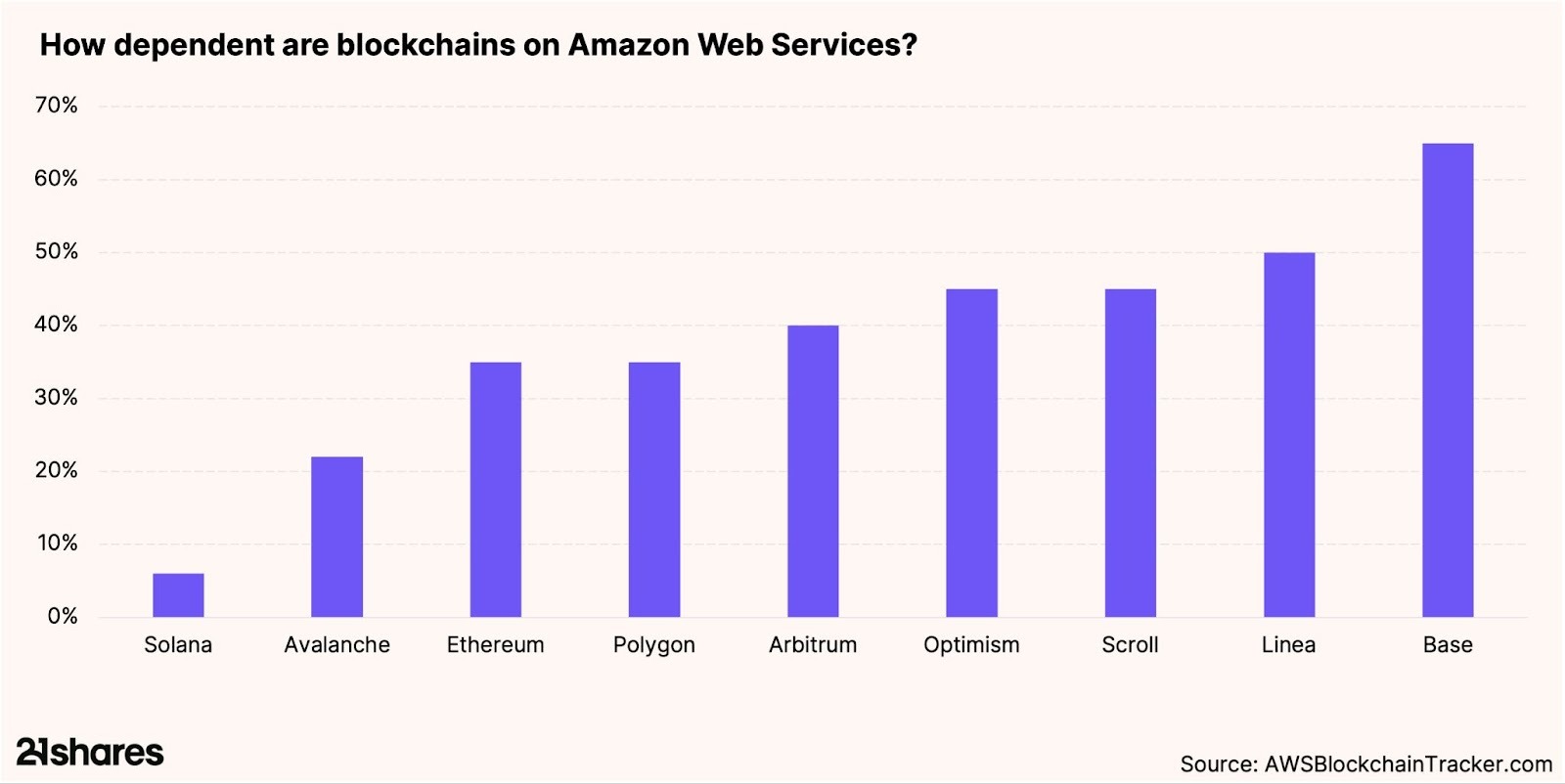
When AWS went down, networks such as Ethereum, Base, and Arbitrum suffered disruptions because their RPC providers were unreachable. Blocks kept producing, but users couldn’t interact with them. If the failure of one company can interrupt access to most crypto networks, the system isn’t truly decentralized.
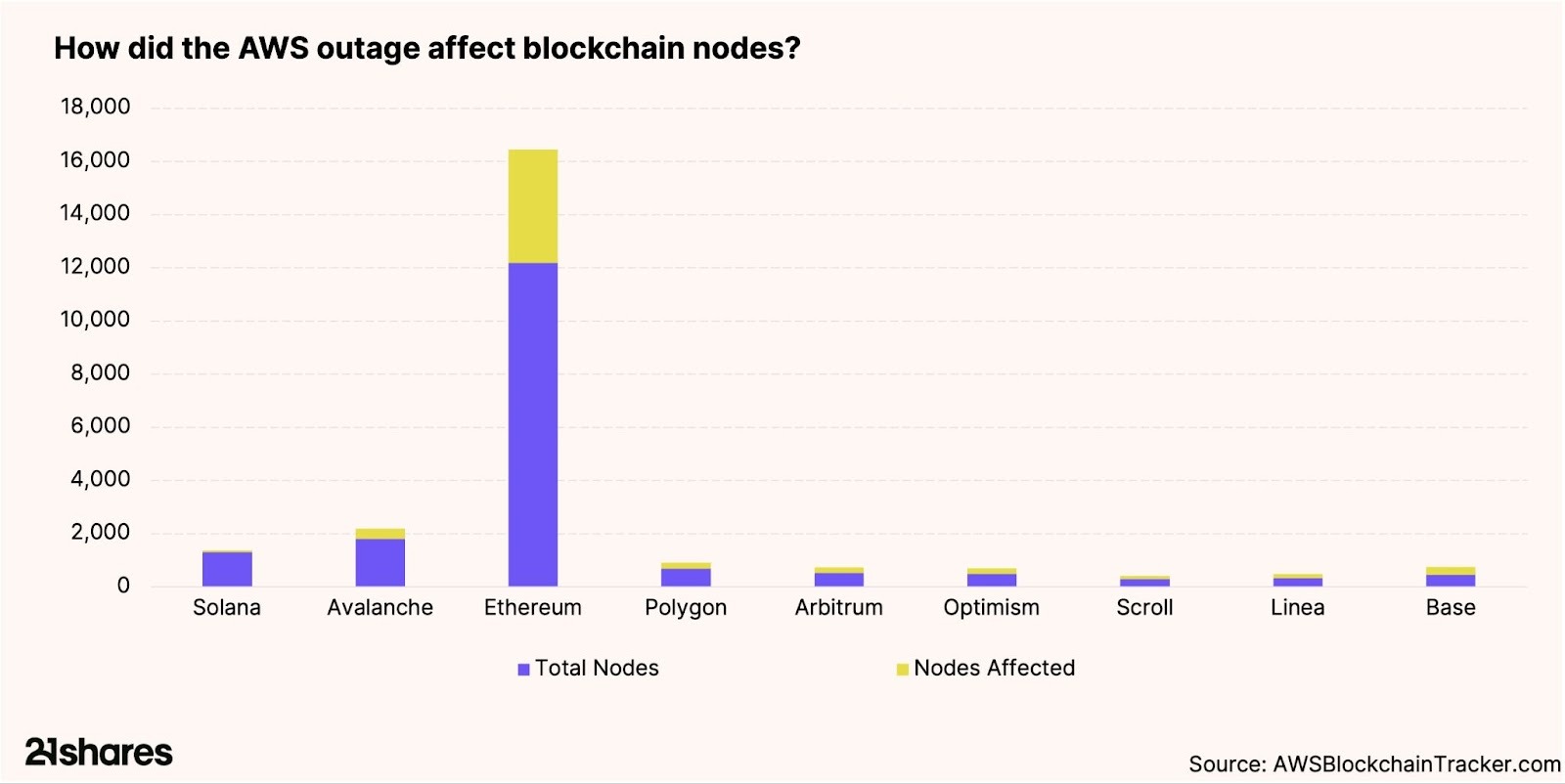
Decentralized storage networks like IPFS and Filecoin can mitigate this risk by hosting node data and access points across many independent providers.
What could have stayed online
If more apps had used decentralized storage, much of the web could have remained functional. Websites, metadata, and documentation hosted on IPFS or Arweave would still have loaded. Even if users couldn’t transact, they could still open apps, view cached data, and stay informed instead of being completely locked out.
These networks can also act as live backups. Apps can periodically store read-only snapshots or cached data on Filecoin or Arweave, allowing them to display balances, user profiles, or recent transactions even when databases fail. This does not replace traditional cloud infrastructure, but it turns total outages into manageable slowdowns.
Despite clear advantages, decentralized storage isn’t mainstream yet. Cloud platforms like AWS remain faster, cheaper for scale, and easier to manage. Decentralized networks can be slower for dynamic data, and developers face added complexity in managing content IDs, storage deals, and costs. Awareness is another barrier. Many crypto teams focus on smart contracts and tokens rather than on where their data lives. Evolving pricing models and token economics also make long-term planning difficult.
So, what’s the decentralized solution for this centralized problem?
Hybrid tools now combine the reliability of the cloud with the resilience of decentralized networks. Apps can publish to both cloud and decentralized networks at once, with automatic fallback if the cloud origin fails. Additionally, modern software adapters now let developers integrate IPFS or Arweave with just a few lines of code.
- Filebase offers S3-compatible uploads that automatically store files on IPFS.
- Cloudflare and the IPFS Foundation maintain high-performance gateways linking browsers to decentralized content.
- On Arweave, tools like Irys (formerly Bundlr) batch uploads for faster and cheaper permanent storage.
The October 2025 outage was a clear reminder that the internet remains too centralized. Filecoin, Arweave, and IPFS offer a practical path toward a stronger, more resilient web. IPFS ensures that data can come from many sources. Filecoin provides durable and verifiable storage. Arweave keeps critical data online permanently.
If hybrid tools mature and adoption grows, the next major outage should hopefully not take the web down with it. Apps will stay live, users will stay connected, and the decentralized web will finally live up to its name.