Close Menu
Crypto Valley Journal
    Facebook X (Twitter) Instagram
    Crypto Valley Journal
    • Hot Topics
      • News
      • Minds
    • Focus
      • Background
      • Blockchain
      • Legal & Compliance
      • Non-Fungible Token (NFTs)
    • Investing
      • Markets
      • Financial Products
      • Decentralized Finance (DeFi)
      • Exchange overview
    • Education
      • Basics
      • Glossary
      • Politicians on crypto
    • Statistics
      • Bitcoin-ETF-Flows
      • Ethereum-ETF-Flows
      • Crypto market data
      • On-chain data
    • Academy
      • Overview
      • Part 1: Blockchain
      • Part 2: Money
      • Part 3: Bitcoin
      • Part 4: Cryptocurrencies
      • Part 5: Decentralized Finance
      • Part 6: Investing
    • English
      • Deutsch
    Crypto Valley Journal
    You are at:Home » Focus » Background » BendDAO: first liquidation cascade in NFT markets?
    BendDAO: erste Liquidationskaskaden auf den NFT-Märkten?

    BendDAO: first liquidation cascade in NFT markets?

    By Editorial Office CVJ.CH on 26. August 2022 Background

    Thanks to decentralized lending services - analogous to DeFi lending protocols - it has been possible to borrow against non-fungible tokens (NFTs) for some time. Recent events surrounding one of the leading protocols revealed the dangers posed to NFT markets.

    BendDAO quickly became the number one topic of conversation in NFT circles, with its offering promising to bridge the gap between DeFi and NFTs. However, the recent price downturn revealed critical errors in the platform's mechanisms. With around 3% of all circulating Bored Apes deposited as collateral, the illiquid market was approaching a liquidation-driven downward spiral that has often been seen in the over-leveraged crypto markets.

    How does BendDAO work?

    Bend is a decentralized, NFT-powered credit protocol. It allows users to participate as lenders or borrowers. Lenders provide Ether liquidity to the Lending Pool to generate passive income, while borrowers can borrow ETH through the Lending Pool. The loan is thereby collateralized in the form of NFTs. Users can typically borrow between 30% and 40% of the minimum price (floor) of the NFT collection.

    But there lies the problem. Floor prices of NFTs have fallen significantly in recent months, while some "blue chip" collections are experiencing their first crypto bear market. Thus, at the beginning of the week, 45 of the 272 Bored Apes attached to BendDAO loans were in the "danger zone." This term is used when an NFT serving as collateral is about to be auctioned. In other words, $5.5 million worth of Bored Apes were about to be liquidated.

    Concerns about another cascading crash

    Concerns quickly rose that the auction of these Bored Apes could trigger even more liquidations. Indeed, a mass liquidation would have an impact on other NFT loan services, which have grown over the past year as the popularity of the NFT industry has exploded. Moreover, the Bored Ape Yacht Club (BAYC) is one of the largest collections, which means that cascading liquidations could have far-reaching consequences beyond the Bored Apes.

    Bend had to act quickly and submit an emergency proposal to the community in order to improve liquidity parameters. The adjustment included the auction period, interest rates and liquidation thresholds, as well as the intention to continue the dialogue on the treatment of bad debt.
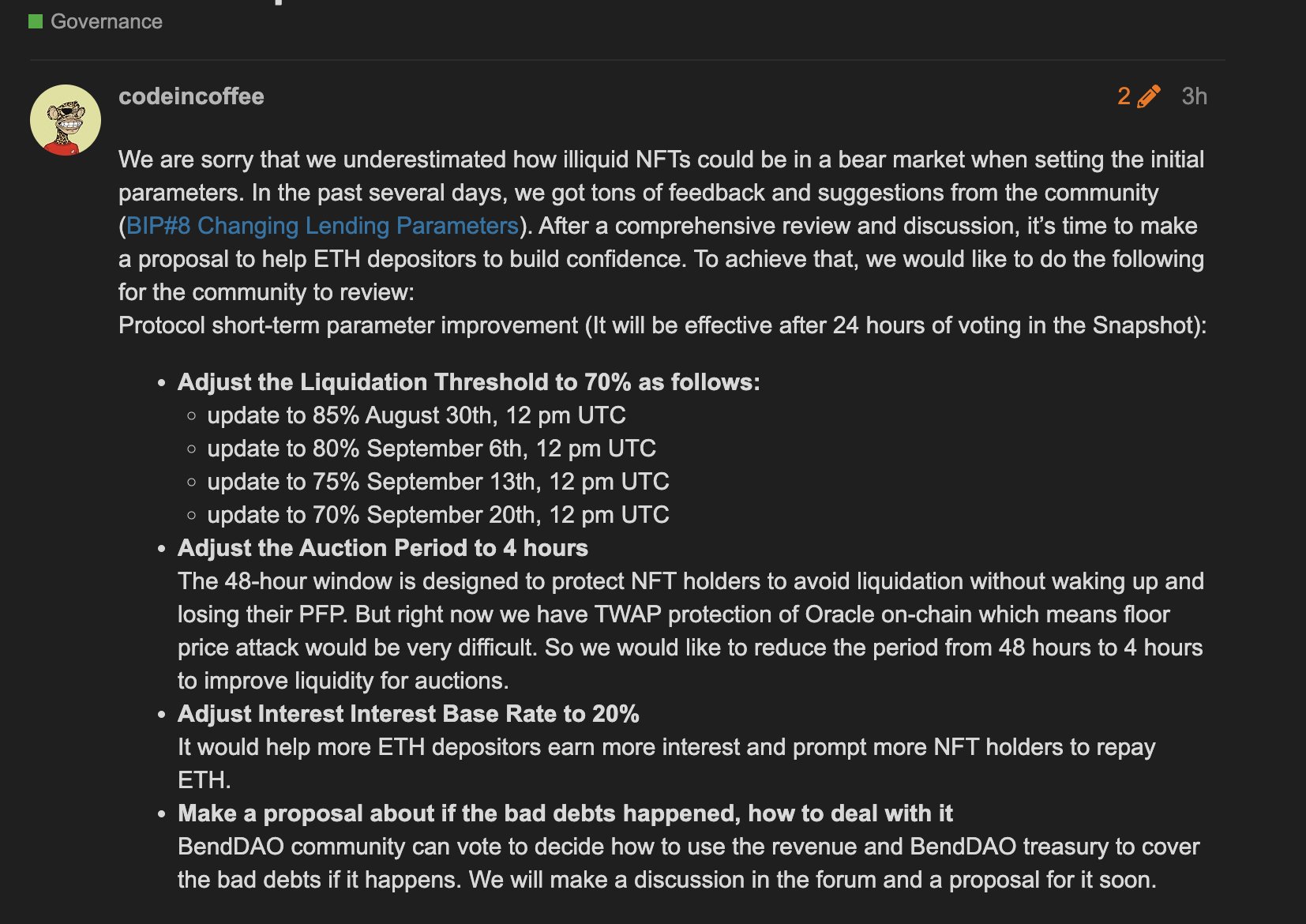
    BendDAO emergency changes
    The BendDAO emergency proposal / Source: Snapshot

    The proposal that the liquidation threshold for collateral be lowered from 85% to 70% was approved with a high level of support. Thus, the protocol has bought itself some time before further price collapses lead to catastrophic cascades. Another proposal reduced the auction duration from 48 hours to four, making the provision of liquidity more attractive.

    Situation defused for now

    The rapid adoption of the protocol has allowed proposals to adjust the mechanisms to refine the lending and liquidation process. This puts a mass cascade out of the question for now. But it underscores how young and fragile the NFT lending space still is. Another rapid price drop - not an all-too-rare occurrence in crypto bear markets - could once again push the protocol to its limits.
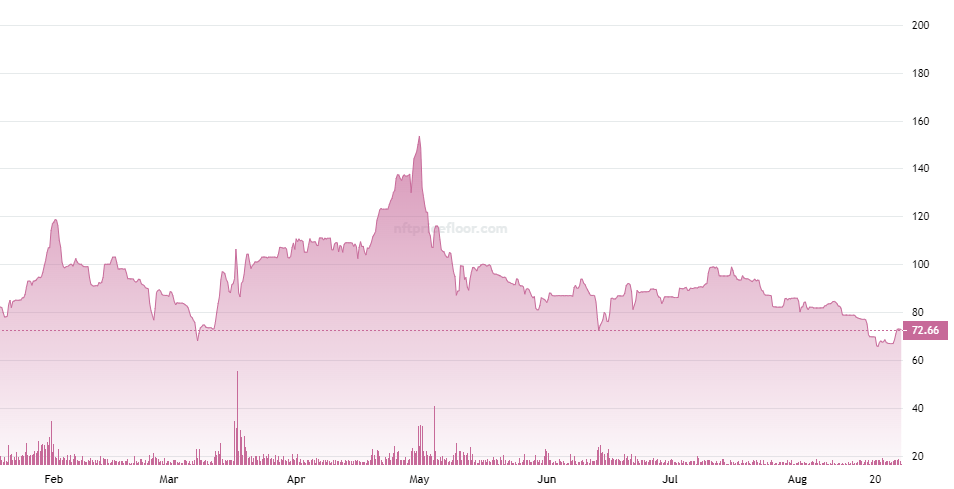
    Minimum price (floor) of the Bored Ape collection measured in Ether (ETH) / Source: NFT Price Floor

    Finally, a more efficient liquidation mechanism also leads to faster market movements. With an average of five buys per day, not even NFT heavyweight Bored Ape Yacht Club (BAYC) could withstand a mass auction. Again, the imperative is now to "stay away from leverage."


    Share. Facebook Twitter LinkedIn Email Telegram WhatsApp

    About the author

    Editorial Office CVJ.CH
    • Website
    • Twitter
    • LinkedIn

    Since 2018, the editorial team at Crypto Valley Journal has been reporting from Zug - the heart of Switzerland’s Crypto Valley - on Bitcoin, cryptocurrency, blockchain, and regulatory developments in digital assets. Behind the publication’s collective editorial voice is a team of writers with backgrounds in financial markets, law, and technology.

    Related Articles

    Strategy sold 32 Bitcoin in late May and rebought 1,550 a week later. What the move reveals about corporate Bitcoin treasury resilience.

    Strategy sells Bitcoin: What it signals for corporate treasuries

    More than 50% of the bitcoin supply now sits at a loss. K33 sees parallels to earlier bear market lows that followed within weeks.

    Crypto winter: More than 50% of bitcoin supply at a loss

    A Reuters analysis estimates the Trump family's crypto gains at $2.3 billion, while investors incurred book losses of the same amount.

    Trump family earns $2.3 billion from crypto projects

    US gaming associations want to ban sports prediction markets in the crypto bill Clarity Act. The CFTC is steering against this with its proposed rule.
    17. June 2026

    Clarity Act: Gaming associations demand ban on sports prediction markets

    Greece's HCMC plans to reject Binance's MiCA licence. Without approval by 1 July 2026, the crypto exchange faces exclusion from the EU market.
    16. June 2026

    Binance ban in the EU: Greece set to deny MiCA licence

    Ripple enters Africa: the firm takes a stake in Flutterwave's Series E and embeds the RLUSD stablecoin across 34 African countries."
    16. June 2026

    Ripple invests in Flutterwave for stablecoin payments in Africa

    twitter image button instagram image button linkedin image button youtube image button

    About Crypto Valley Journal
    About Crypto Valley Journal

    On the pulse of the movement

    • Academy
    • Contact
    • Advertising
    • About us
    • Partner
    • Imprint
    • Privacy
    • Disclaimer
    Search

    Type above and press Enter to search. Press Esc to cancel.