Cardano and Solana are testing their on-chain governance under real conditions. At Cardano, a blockade of the constitutional committee looms for lack of participation, while at Solana the first major vote collides with a contradictory quorum rule.
On-chain governance means that token holders or validators vote directly on protocol changes, publicly visible and without any detour through a core team. Cardano splits that decision across three separate bodies, Solana across the delegated stake of its validators. Since the Voltaire era, Cardano's model has followed the CIP-1694 standard. Moreover, most decisions there need the approval of at least two of the three bodies. Solana's version is comparatively young. It went live in July 2026, with an entry threshold of 100,000 SOL in stake for submissions. Approval among Cardano's DReps stands at 43.0%, and 67% is required. In Solana's count, 83.66 million SOL backed the most contested proposal. However, whether the quorum is met depends on which rule applies.
Cardano risks a governance blockade before the September 1 deadline
The proposal to renew the Constitutional Committee needs two independent majorities. On one side, the delegated representatives, or DReps, must reach 67% approval; on the other, the stake pool operators must reach 51%. DReps are elected representatives to whom ADA holders assign their voting rights. The SPOs run the pools through which the network produces its blocks. Most recently, the DReps stood at 51.7%, the SPOs at 10.8%. Both groups must clear their threshold separately. Therefore, strong turnout in one group cannot offset a shortfall in the other.
At first, the trend points upward. In mid-August, the DReps stood at 32.46% and the SPOs at 1.95%, four days later at 37.9% and 7.93%. By the latest reading, the figures had climbed to 51.7% and 10.8%. But the gaps remain wide: around 15 percentage points for the DReps, around 40 percentage points for the SPOs. Little time is left to catch up, because the replacement vote must take effect on-chain by September 1, 2026. The nominees have been set since an off-chain election, and the on-chain action has additionally been running since late July.
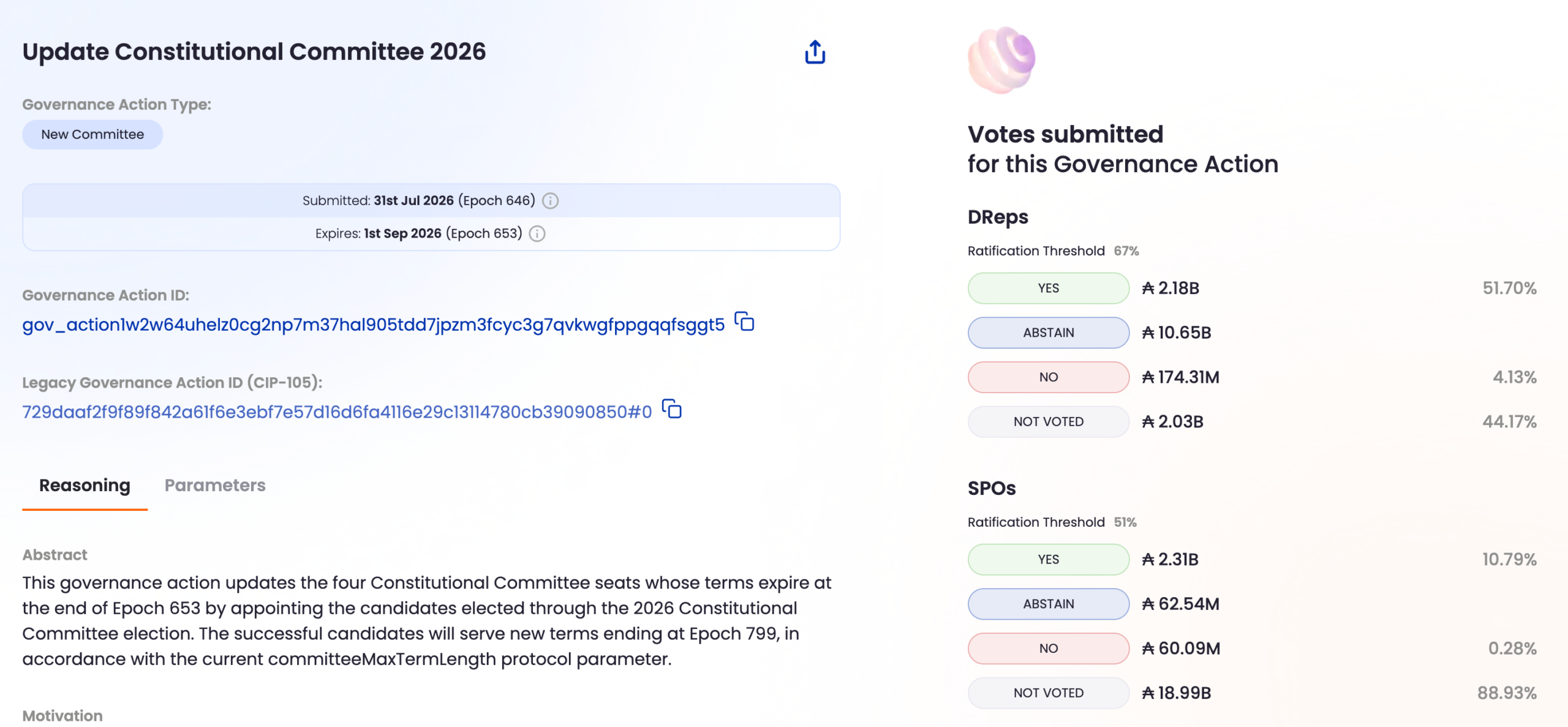
Four of the seven terms on the committee are expiring. If the vote fails, only three members stay in office. The body reviews whether governance actions comply with the Cardano constitution. Under the reported rules, that takes at least five active seats. Nevertheless, block production continues as normal, and the network processes transactions as before. Hard forks, changes to protocol parameters, constitutional amendments and treasury payouts would stall instead. Intersect, the membership organization behind Cardano's development, also warns of technical consequences. According to its weekly update, a missing ratification could hit the timeline of the Dijkstra hard fork.
Solana's quorum rule contradicts itself
Solana's first voting package covers three proposals: SGP-0001 on the constitution, SGP-0002 on disinflation and SGP-0003 on fees. The window runs until the end of epoch 1023 on August 27, 2026. In the previous day's snapshot, 83.66 million SOL went to approval and 12.01 million to rejection. Abstentions accounted for another 8.32 million, for a total of roughly 104 million SOL. Among the decisive votes, that works out to 87.45% approval.
The dispute is therefore not about the majority, but about the quorum. Solana's governance FAQ demands turnout of one third of the network stake, plus two thirds approval among the participating votes. Yet reports say the Solana Foundation's proposal repository on GitHub names no quorum at all. It defines the threshold as two thirds of yes plus no votes, excluding abstentions. Under the repository rule, SGP-0002 clears the threshold. Measured against the FAQ, however, turnout falls below the one-third line. Consequently, the first major test run ends in an open question of interpretation.
In substance, the issue is issuance. SGP-0002 would accelerate annual disinflation from 15% to 30%. The network would then reach the terminal value of 1.5% in around 2.8 years instead of 5.7. Over six years, that would cut issuance by roughly 18.9 million SOL, or about USD 1.91 billion at the current price. Nothing changes immediately, because the proposal only sets the direction. The technical implementation would have to follow later through SIMD-0550. In addition, 308 delegators overrode their validator's vote for their own stake account, a small volume measured against the total count.



Solana Company votes against its own revenue source
Solana Company holds SOL as a balance sheet reserve and runs its own validators at the same time. The company, listed on the Nasdaq as HSDT, disclosed its positions before the voting window opened. It voted against SGP-0002 and SGP-0003, and for SGP-0001. As a result, one of the most visible institutional holders opposes faster disinflation.
The reason sits in its own income statement. In the second quarter of 2026, USD 2.512 million of USD 2.526 million in total revenue came from staking. That amounts to roughly 99.4% of quarterly revenue. Accelerated disinflation lowers issuance, and with it the staking yield. So the company is deciding on a rule that directly affects its main revenue source. That is precisely where the structural conflict of interest in stake-weighted governance lies. Whoever controls the largest stake often also holds the largest economic interest in the status quo.
The operator bases its rejection not on the goal of lower issuance, but on the process. Reopening the already deterministically fixed issuance schedule would create uncertainty. The company further argues that the staking yield is an audited balance sheet item and, for many holders, operating cash flow. Solana Company laid out all three positions in its own statement.
"We strongly believe that institutional adoption is a key driver of Solana's growth, and institutions make decisions based on consistent, predictable structures." - Joseph Chee, Chairman and CEO, Solana Company
Cardano and Solana: two governance models, one shared weak spot
Architecturally, the two systems have little in common. At Cardano, DReps and SPOs vote by stake, while the Constitutional Committee votes by head count. Two of the three bodies must agree, which forces broad participation overall. Solana concentrates the decision in the hands of its validators, who by default vote with the stake delegated to them. Individual stakers can still override their validator's setting per stake account, and their share then drops out of the validator count.
Still, neither procedure fails because of the technology. Cardano simply lacks participation, even though the rules have been fixed for months and the deadline is known. Solana does have votes in relevant volume, yet a clear rule for when they suffice is missing. Classic shareholder democracy knows both patterns as well: apathy at the base, plus large voting blocs with their own interests. The packaging is new, the problem is not.