
Close Menu
Crypto Valley Journal
    Facebook X (Twitter) Instagram
    Crypto Valley Journal
    • Hot Topics
      • News
      • Minds
    • Focus
      • Background
      • Blockchain
      • Legal & Compliance
      • Non-Fungible Token (NFTs)
    • Investing
      • Markets
      • Financial Products
      • Decentralized Finance (DeFi)
      • Exchange overview
    • Education
      • Basics
      • Glossary
      • Politicians on crypto
    • Statistics
      • Bitcoin-ETF-Flows
      • Ethereum-ETF-Flows
      • Crypto market data
      • On-chain data
    • Academy
      • Overview
      • Part 1: Blockchain
      • Part 2: Money
      • Part 3: Bitcoin
      • Part 4: Cryptocurrencies
      • Part 5: Decentralized Finance
      • Part 6: Investing
    • English
      • Deutsch
    Crypto Valley Journal
    You are at:Home»Focus»Background»Blockchain and AI: Over 1 million crypto jobs by 2030?
    Blockchain and AI: Over 1 million crypto jobs by 2030?

    Blockchain and AI: Over 1 million crypto jobs by 2030?

    By Editorial Office CVJ.CH on 7. May 2025 Background

    While Artificial Intelligence (AI) already accounts for over one million open positions worldwide, the blockchain sector is still in its early stages. However, an industry study anticipates rapid growth.

    According to a recent report by the research arm of crypto exchange Bitget, titled “Blockchain vs. AI: Untapped Potential in Talent Attraction and Growth,” there are currently only around 15,000 to 20,000 active blockchain job postings globally. Nevertheless, the sector is experiencing an impressive average annual growth rate of 45%. If blockchain technology achieves a level of adoption comparable to AI, more than one million new jobs could be created by 2030.

    Subscribe to our newsletter

    The best articles of the week, directly delivered into your mailbox.

    Regional distribution and growth projections

    The demand for blockchain professionals is currently concentrated in North America (40%), the Asia-Pacific region (35%), and Europe (20%). Projections indicate that around 500,000 new blockchain jobs could be created by 2028. With accelerated adoption of the technology, the number could rise to over one million positions by 2030.
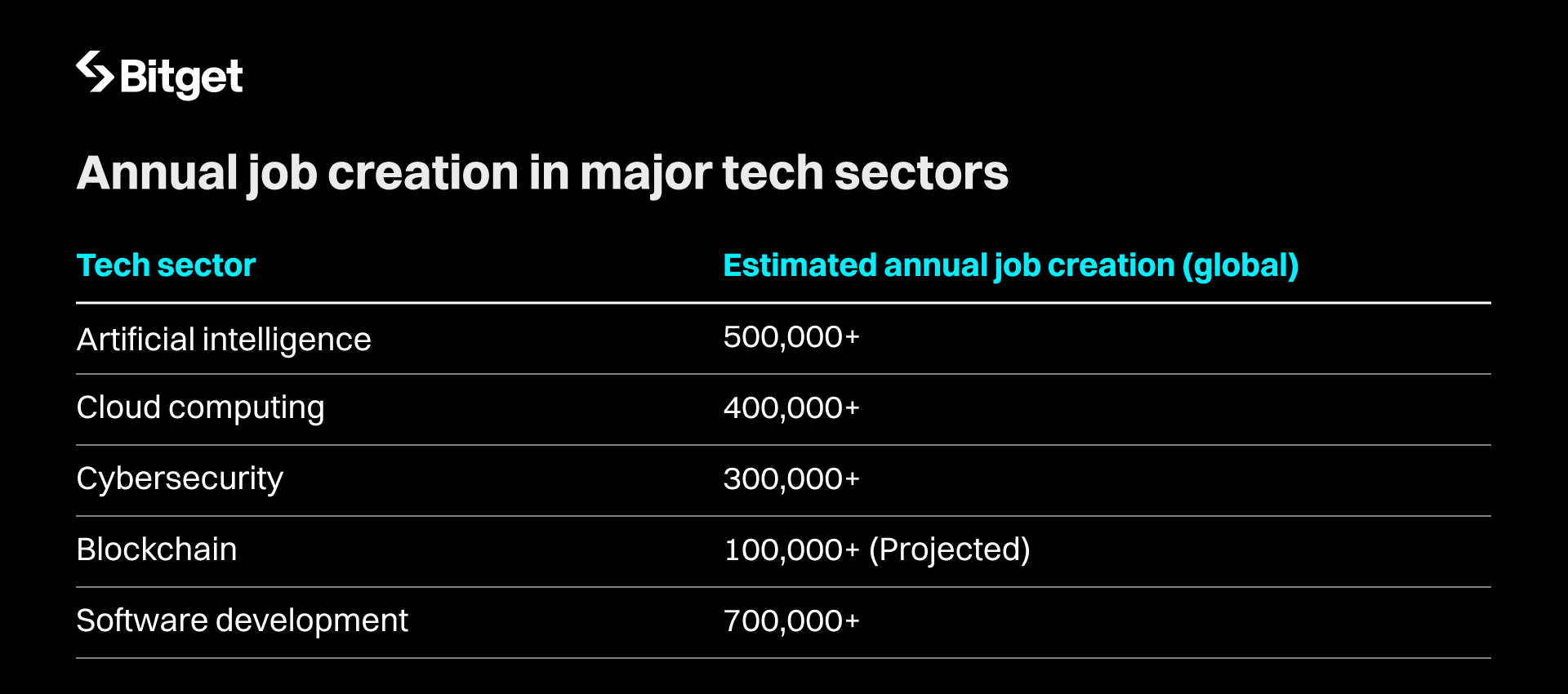
    Estimated annual jobs created by tech sector / Source: Bitget Research

    Challenges and necessary measures

    To unlock the full potential of blockchain technology, the report identifies several key factors:

    1. Regulatory clarity: Clear legal frameworks, such as the EU’s Markets in Crypto-Assets (MiCA) regulation, could boost corporate confidence and encourage investment.
    2. Enterprise integration: Broader use of blockchain technologies in industries such as finance, healthcare, and logistics could significantly increase the demand for professionals.
    3. Scalability and technological advancement: Improvements in transaction speed and cost-efficiency are crucial to enabling widespread blockchain adoption.
    4. Education and talent development: Incorporating blockchain topics into academic programs and offering specialized training could expand the talent pool.
    5. Financial support: Increased investment from venture capitalists and government funding programs could accelerate blockchain development and adoption.
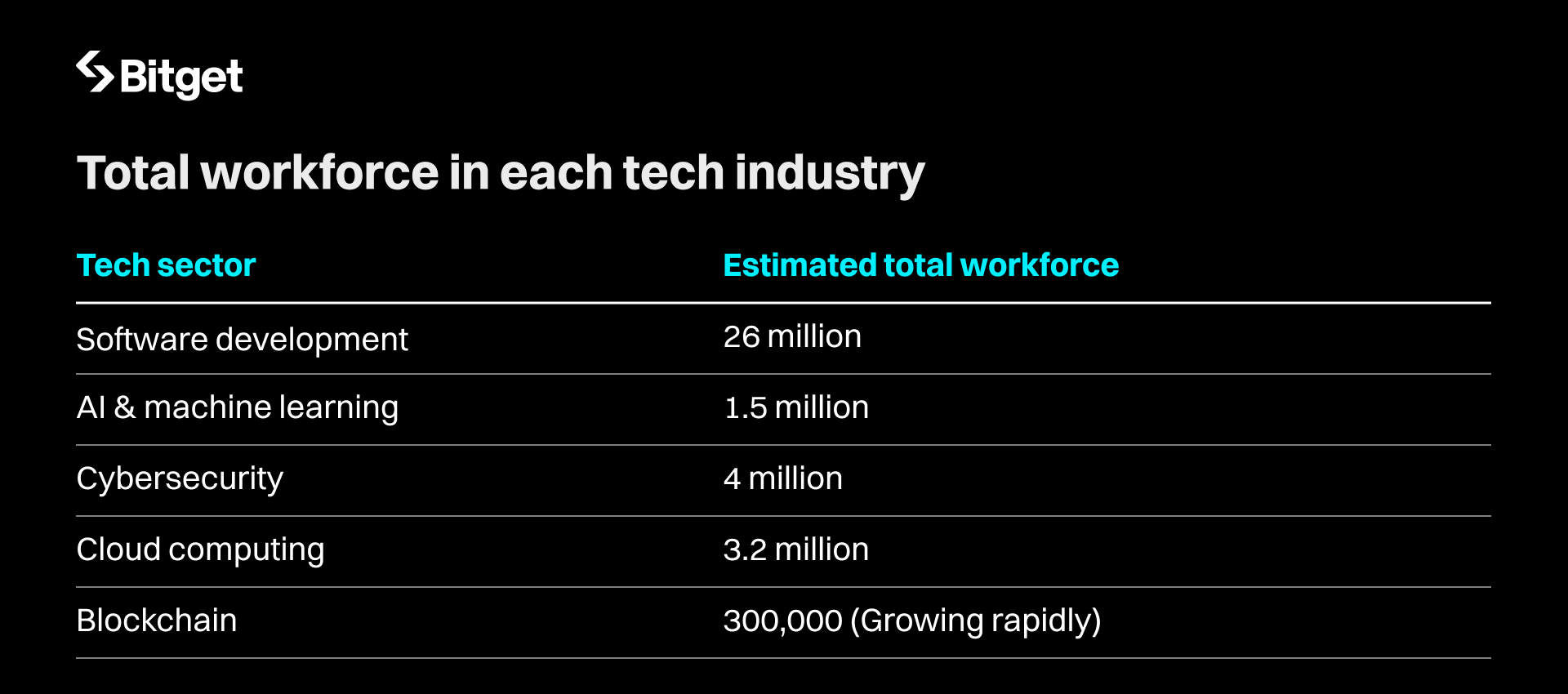
    Total workforce by tech sector / Source: Bitget Research

    While AI has seen explosive job growth in recent years, the blockchain industry still lags behind. Nevertheless, the report suggests that with appropriate support and integration, the sector has the potential to reach similar employment figures.


    Ray Dalio’s Bridgewater Associates Minds

    Star investor Ray Dalio considers Bitcoin inferior to gold

    Analysis by Bitget Research on Bitcoin quantum computing risks, ECDSA exposure, NIST post-quantum standards, and BIP-360 migration paths. Background

    Bitcoin quantum computing: What recent developments mean for network security

    JPMorgan warns: Recurring DeFi exploits and stagnant ETH-denominated TVL curb institutional engagement in the DeFi sector. DeFi

    JPMorgan: DeFi hacks and TVL losses weigh on institutional investors

    Basics

    Unit bias in crypto: Why cheap coins mislead investors

    Ray Dalio’s Bridgewater Associates Minds

    Star investor Ray Dalio considers Bitcoin inferior to gold

    Analysis by Bitget Research on Bitcoin quantum computing risks, ECDSA exposure, NIST post-quantum standards, and BIP-360 migration paths. Background

    Bitcoin quantum computing: What recent developments mean for network security

    Tech giants betting on blockchain

    Another key point highlighted by Bitget is the growing interest in blockchain technology among established tech companies. Firms such as OpenAI, Google, and IBM are increasingly investing in blockchain research and development—driving innovation and creating new roles in areas like smart contracts, DeFi, blockchain security, and supply chain management. This institutional involvement signals a clear trend toward the professionalization of the industry and could exponentially increase the demand for talent in the coming years. As a result, new opportunities are emerging for developers, project managers, and consultants willing to specialize early.


    Share. Facebook Twitter LinkedIn Email Telegram WhatsApp

    About the author

    Editorial Office CVJ.CH

      The CVJ editorial staff consists of a team of Blockchain experts and informs daily and independently about the most exciting news.

      Related Articles

      Analysis by Bitget Research on Bitcoin quantum computing risks, ECDSA exposure, NIST post-quantum standards, and BIP-360 migration paths.

      Bitcoin quantum computing: What recent developments mean for network security

      CV VC Top 50 Report 2026: Schweiz zieht 47% des europäischen Blockchain-Risikokapitals an. 1'766 Firmen, 728 Mio. USD Investitionen.

      Crypto Valley attracts 47 percent of European blockchain venture capital

      XRPL validator analyzes quantum risk: only 0.03% of XRP supply is exposed, compared to up to 35% for Bitcoin. Google sets 2029 deadline.

      Quantum risk: Is XRP more secure than Bitcoin?

      FalconX and Sygnum open institutional access to tokenized credit via the Desygnate platform and the FalconX Credit Vault.
      6. May 2026

      FalconX and Sygnum open regulated access to tokenized credit

      FINMA tightens consumer protection in crypto, grants first DLT license to BX Digital, and plans new license categories for stablecoin issuers.
      5. May 2026

      FINMA tightens crypto supervision and warns of consumer risks

      Coinbase backs the CLARITY Act compromise on stablecoin rewards, now the Senate committee markup path opens, with passage likely.
      4. May 2026

      Crypto industry backs down: Coinbase accepts CLARITY Act compromise

      twitter image button instagram image button linkedin image button youtube image button

      About Crypto Valley Journal
      About Crypto Valley Journal

      On the pulse of the movement

      • Academy
      • Contact
      • Advertising
      • About us
      • Partner
      • Imprint
      • Privacy
      • Disclaimer
      Search

      Type above and press Enter to search. Press Esc to cancel.