
Close Menu
Crypto Valley Journal
    Facebook X (Twitter) Instagram
    Crypto Valley Journal
    • Hot Topics
      • News
      • Minds
    • Focus
      • Background
      • Blockchain
      • Legal & Compliance
      • Non-Fungible Token (NFTs)
    • Investing
      • Markets
      • Financial Products
      • Decentralized Finance (DeFi)
      • Exchange overview
    • Education
      • Basics
      • Glossary
      • Politicians on crypto
    • Statistics
      • Bitcoin-ETF-Flows
      • Ethereum-ETF-Flows
      • Crypto market data
      • On-chain data
    • Academy
      • Overview
      • Part 1: Blockchain
      • Part 2: Money
      • Part 3: Bitcoin
      • Part 4: Cryptocurrencies
      • Part 5: Decentralized Finance
      • Part 6: Investing
    • English
      • Deutsch
    Crypto Valley Journal
    You are at:Home » Focus » Background » Overview of US states with Bitcoin reserves
    Overview of US states with Bitcoin reserves

    Overview of US states with Bitcoin reserves

    0
    By Editorial Office CVJ.CH on 30. June 2025 Background

    A race for digital state reserves: Several U.S. states are planning or have already enacted Bitcoin reserves - with Texas being the latest example. Here is an overview of the various measures.

    The movement to establish state-level Bitcoin reserves in the U.S. is gaining strong momentum. According to bitcoinlaws.io, more than 26 states are currently pursuing related legislative initiatives, several of which are already in effect - including New Hampshire, Arizona, and Texas. The aim is typically to allocate up to 5% of public funds to Bitcoin, ideally sourced from seized or specially acquired holdings.

    Subscribe to our newsletter

    The best articles of the week, directly delivered into your mailbox.

    New Hampshire and Arizona: pioneers of reserve initiatives

    New Hampshire made history in May 2025 by becoming the first U.S. state to pass legislation establishing a strategic Bitcoin reserve. This allows the state treasury to invest up to 5% in digital assets with a market capitalization exceeding USD 500 billion - which currently applies exclusively to Bitcoin. Shortly after, Arizona followed suit with a reserve funded by seized cryptocurrencies and unused state property.

    Governor Greg Abbott then signed Texas SB 21, officially making Texas the third state to set up a formal Bitcoin reserve. The legislation permits the State Comptroller to build a reserve financed through tax revenue, airdrops, or confiscated crypto assets and mandates regular evaluation and transparency.


    Ray Dalio advises 10 to 15% gold and a small Bitcoin position, because he expects a US debt crisis within about three years. Minds

    Star investor Ray Dalio considers Bitcoin inferior to gold

    Bitcoin in 2026 trades around USD 84,000, while US spot ETFs hold about USD 102 to 104 billion and listed companies 1.27 to 1.29 million BTC. Background

    Bitcoin in 2026: what the numbers actually say

    Financial Products

    Memecoins on Robinhood Chain distort tokenized stock prices

    Basics

    Unit bias in crypto: Why cheap coins mislead investors

    Ray Dalio advises 10 to 15% gold and a small Bitcoin position, because he expects a US debt crisis within about three years. Minds

    Star investor Ray Dalio considers Bitcoin inferior to gold

    Bitcoin in 2026 trades around USD 84,000, while US spot ETFs hold about USD 102 to 104 billion and listed companies 1.27 to 1.29 million BTC. Background

    Bitcoin in 2026: what the numbers actually say

    Nationwide movement

    Beyond individual states, bitcoinlaws.io reports that Texas alone has 14 Bitcoin-related bills in progress, several of which relate to reserve-building. Nationwide, there are now 47 legislative proposals across 26 states, from Florida to North Carolina to Alabama. While some have been implemented, others have been rejected or remain under committee review.
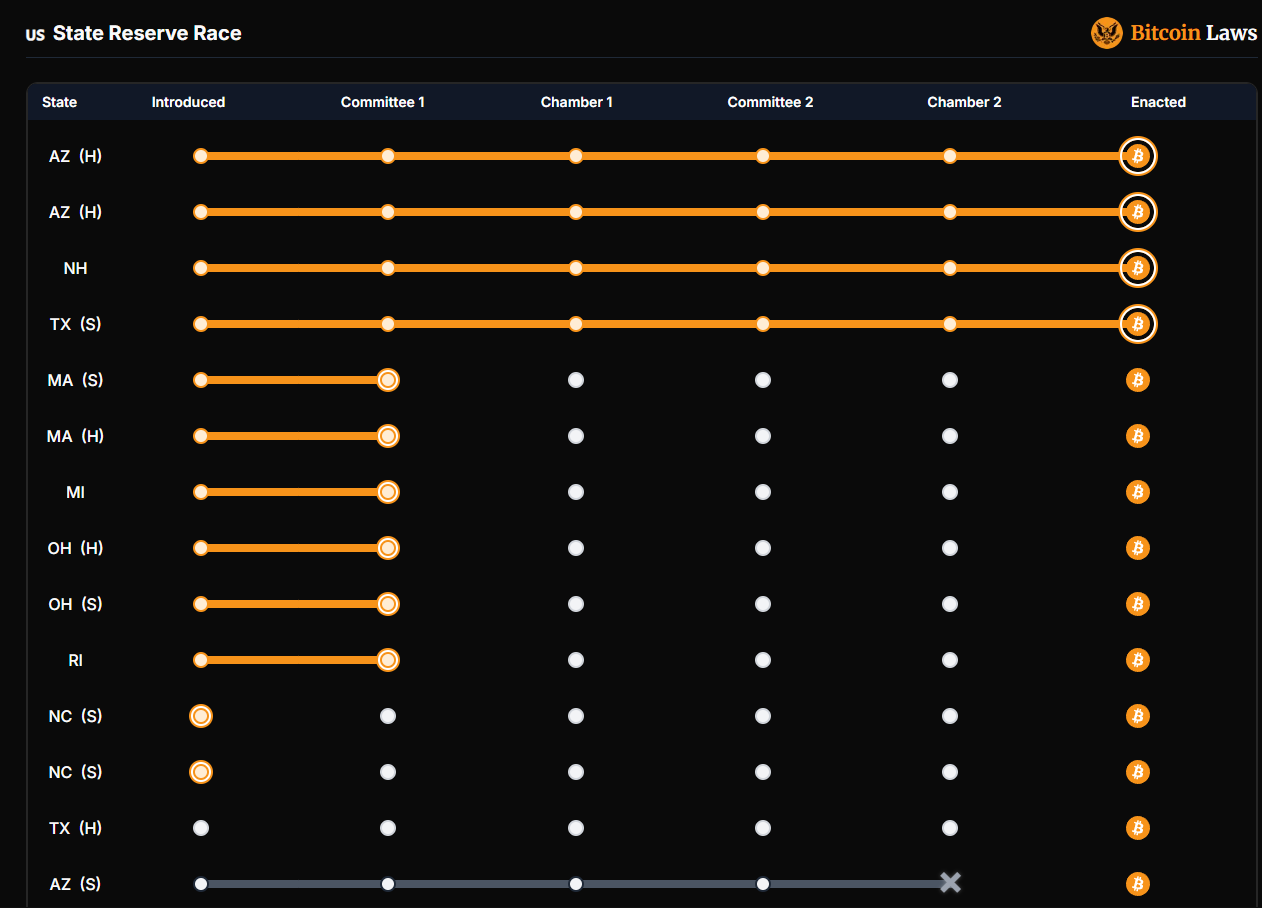
    Progress on state Bitcoin reserves across U.S. states / Source: Bitcoinlaws.io

    Assessing the momentum

    These developments fit into a broader national dynamic. New Hampshire and Arizona have not only sent symbolic messages but also led the way in demonstrating that states can leverage Bitcoin as a fiscal tool and hedge against inflation. Texas recently followed suit with clearly defined budget rules.

    If this trend continues, we could see a partial decentralization of the national Bitcoin strategy: states would become more than mere observers and could actively contribute to building digital currency reserves. In the future, coordinated purchasing actions and pilot reserve programs are likely - potentially establishing Bitcoin as a lasting component of public financial planning.


    Share. Facebook Twitter LinkedIn Email Telegram WhatsApp

    About the author

    Editorial Office CVJ.CH
    Editorial Office CVJ.CH
    • Website
    • X (Twitter)
    • LinkedIn

    Since 2018, the editorial team at Crypto Valley Journal has been reporting from Zug - the heart of Switzerland’s Crypto Valley - on Bitcoin, cryptocurrency, blockchain, and regulatory developments in digital assets. Behind the publication’s collective editorial voice is a team of writers with backgrounds in financial markets, law, and technology.

    Related Articles

    Bitcoin in 2026 trades around USD 84,000, while US spot ETFs hold about USD 102 to 104 billion and listed companies 1.27 to 1.29 million BTC.

    Bitcoin in 2026: what the numbers actually say

    The Trezor data breach at fulfillment provider ShipMonk exposed names, addresses and phone numbers of 13,689 customers.

    Hardware wallet comparison 2026: Ledger vs. Trezor – new models, new risks

    The Ethereum Foundation's Protocol Cluster rated 62 EIPs and set December 2029 as the target for a quantum-safe Ethereum base layer.

    Ethereum targets a quantum-safe blockchain by 2029

    Comments are closed.

    CVJ Weekly review
    3. October 2026

    Weekly review: SEC launches crypto offensive without Clarity Act

    The SEC plans to permit crypto custody by investment advisers and funds through state trust companies and, in narrow cases, on their own.
    2. October 2026

    SEC proposes crypto custody rules for investment advisers

    Large stablecoins outside the banking system could weaken the effect of monetary policy, according to SNB Governing Board member Petra Tschudin.
    1. October 2026

    SNB sees stablecoins as a burden on monetary policy

    twitter image button instagram image button linkedin image button youtube image button

    About Crypto Valley Journal
    About Crypto Valley Journal

    On the pulse of the movement

    • Academy
    • Contact
    • Advertising
    • About us
    • Partner
    • Imprint
    • Privacy
    • Disclaimer
    Search
    © 2026 ThemeSphere. Designed by ThemeSphere.

    Type above and press Enter to search. Press Esc to cancel.