
For the first time since the last bear market, more than 50% of circulating bitcoin sits at a loss. More than 10 million BTC were last moved or bought at prices above the current market level.
K33 Research is a Norwegian crypto research firm that analyzes on-chain data and market structure. Its "supply in loss" metric measures the share of circulating supply that was last transferred at a higher price than the current market price. Beforehand, bitcoin fell from a yearly high of around 82,000 USD to roughly 60,000 USD, a decline of about 28% within a month. The price now trades at around 61,000 USD. Just four weeks earlier, the share of supply at a loss stood at roughly 30%, which means the figure rose by about 20 percentage points. However, in every prior bear market the 50% threshold was reached only near major lows.
Bitcoin supply at a loss: What the 50% threshold meant in earlier cycles
The 50% mark serves as a proxy for bear market lows because, by K33's reading, it effectively carries an upper limit. A substantial portion of the oldest coins simply does not move, whether through lost keys or through long-term holders with no intention to sell. Consequently, such holdings never fall into the "at a loss" zone. The maximum reachable value therefore sits historically at around 50% to 56% and was reached in each cycle only near major lows.
"A large share of old coins simply does not move, either because they have been lost or because their owners never plan to sell them, and therefore they never fall into the 'at a loss' zone. In all previous bear markets, this has set a natural upper limit for supply trading at a loss of around 50% to 56%." - Vetle Lunde, Head of Research, K33
In the bear markets of 2011, 2018 and 2022, bitcoin formed a low within 31 days of first crossing the 50% mark. According to K33's report, however, a final sell-off of about 15% to 26% below the level at the threshold crossing preceded each low. This last downward move exhausts the selling pressure from holders still in profit, whose holdings also slip into a loss at lower prices. The twelve-month returns afterward turned out historically strong, ranging between 69% and 359%. Thus, in these cycles the threshold marked a late phase of the downturn.
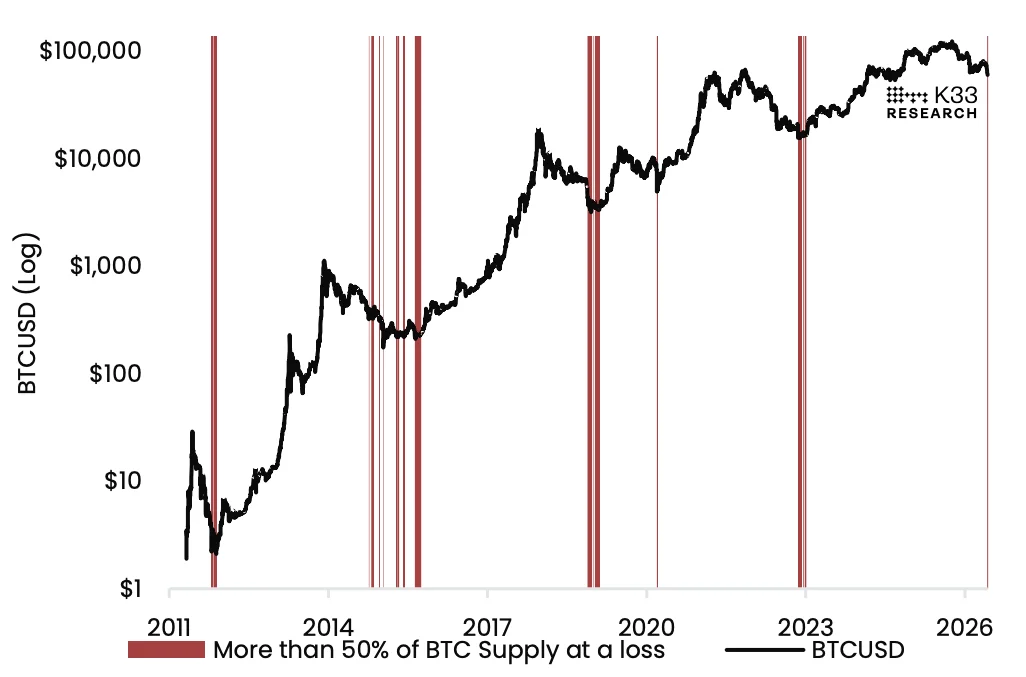
Nevertheless, the pattern is not a law of nature. In the 2014 cycle, by contrast, bitcoin needed 101 days to reach its low and lost a further 46% after crossing the threshold. This exception shows that the convergence of signals delivers no guaranteed timing.
Record outflows from bitcoin ETPs accelerate the sell-off
Institutional capital outflows turned out exceptionally high recently. Within four weeks, 85,643 BTC left exchange-traded bitcoin products, the largest four-week outflow ever recorded. On average, that amounted to roughly 4,108 BTC per day between May 7 and June 8, 2026. Additionally, 22,840 BTC flowed out in the most recent week alone. Already at the end of May, a drop below 73,000 USD had triggered an initial wave of heavy liquidations.
The picture sharpened further at the spot bitcoin ETFs. These US-listed funds form a subset of the broader ETP category. From May 20, 2026, investors pulled a net total of more than 40,000 BTC from these funds across ten consecutive trading days. From May 30, ten consecutive outflow days followed, with total outflows of around 2.97 billion USD. The monthly net outflow of 2.43 billion USD was likewise the largest of 2026. Consequently, institutional capital withdrew at a pace that structurally reinforces the price decline.
As a possible driver, K33 points to a capital rotation into high-conviction growth opportunities, among them the planned SpaceX IPO, AI firms and mega-cap tech stocks. Furthermore, a move by Strategy, formerly MicroStrategy, stands out. The company sold 32 BTC, carrying out its first bitcoin sale since 2022.



Technical indicators reach extremes of the last bear market
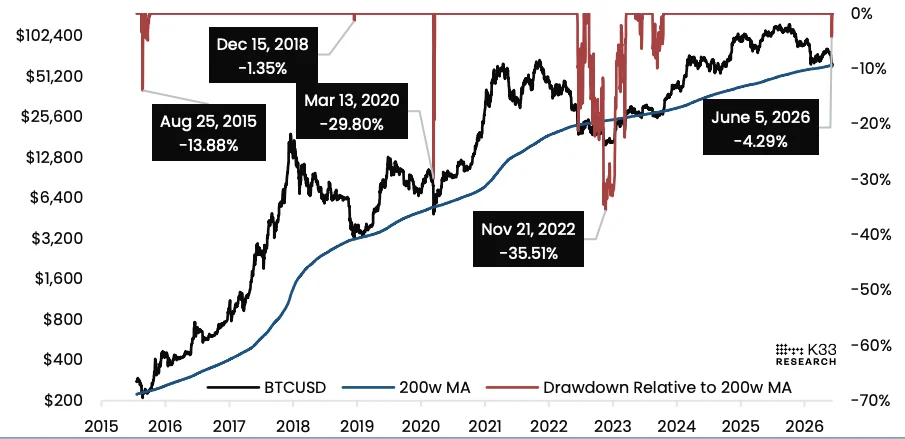
The 200-week moving average counts as a reliable low criterion, since no major bear market in bitcoin's history ended without a touch of this line. The metric averages the price over four years and thus serves as a long-term support line. In 2015, 2018 and 2022, the price fell to or below this four-year average in each case. Lunde notes that the current cycle is no exception either. During the recent slump, bitcoin briefly fell below this average, with a maximum drawdown of 4.29% relative to the four-year average price.
Further metrics show a similar picture. The daily RSI fell to its lowest level since November 2018, while the Fear & Greed Index sank to an extreme reading of 8 and later recovered slightly to 10. At the same time, open interest in CME bitcoin futures dropped to a two-and-a-half-year low. In early June, falling prices additionally triggered long liquidations of around 1.5 billion USD, according to K33, as the price slid below 62,000 USD and thus to its lowest level since October 2024.
Nevertheless, one countervailing detail stands out. Daily spot market volume exceeded the 5 billion USD mark for the first time since February 2026. Historically, elevated trading activity often appears at potential turning points.
K33 sees limited downside
The research firm holds to its base case, under which 60,000 USD marks the cycle low or at least represents an attractive long-term accumulation zone. The current drawdown, however, amounts to around 53% over roughly eight months, whereas earlier larger declines lasted around a year and wiped out 76% to 85%. Measured against these historical lows, the ongoing slump therefore turns out milder and shorter. Ultimately, Lunde points out that the setup suggests limited downside relative to the possible upside in the coming year, without calling it a guarantee.
Against this stands a markedly more cautious voice. Market maker Wintermute warned against calling a bottom as long as no signs of returning inflows are visible. For this reading, the finding on supply at a loss alone remains no buy signal as long as fresh capital does not measurably return. Thus, the tension between the contrarian-bullish reading and a wait-and-see stance remains open for now.