The story of a programmer who lost access to his Bitcoins, worth over 250 million Swiss francs, is making headlines. In order to better understand such incidents, it is worth taking a trip into the price history and the unique properties of Bitcoin.
The case of the programmer Stefan Thomas, which was published this week by the New York Times, is impressive. Accordingly, the case has been passed on numerous times by media outlets, sometimes with sensational headlines: German loses password over 200 million Bitcoin assets! The reactions that followed stated that this was proof of an insecure cryptocurrency and how one could be so negligent investing such a high amount in a cryptocurrency like Bitcoin.
If we look at the price history of Bitcoin, it becomes clear that over the years, a few hundred dollars quickly became millions. This is exactly the case in this particular example. The gentleman in question did not invest 250 million dollars in Bitcoin and then forget his password. He received 7001 Bitcoins in 2011 as payment for creating a video. In early 2011, Bitcoin was trading largely below one dollar. The exponential rise in price over the years, combined with the unique structure of the underlying Bitcoin network, ultimately led to numerous similar cases.
From a few cents to 40,000 USD in 10 years
In 2009, the Bitcoin network was launched by Satoshi Nakomoto and the first block (Genesis Block) of the Bitcoin blockchain was created. The block rewards ( remuneration for mining) in the form of 50 Bitcoins per block did not represent any value at that point in time. Accordingly, mining was done by a few "nerds" on a voluntary nature on their personal ordinary PCs. As a comparison: today, mining represents a professionalized multi-billion dollar business and is carried out with specifically developed hardware.
The first trade of Bitcoins for dollars is said to have taken place in July 2010. Sources refer to trading ranges between 0.0008 USD - 0.08 USD. This was followed by the first documented Bitcoin transaction for a tangible value in the form of two pizzas. 10,000 Bitcoins were paid for the baked goods. The then equivalent value of 41 dollars would have a present-day value of around CHF 340 million.
Over the years, Bitcoin noticeably increased in value. For example, the 2013 bull run took it from $10 to over $1100. However, in the low of the subsequent consolidation phase, the price temporarily fell below 200 USD one more time. Only at the beginning of 2017 the high reached in 2013 was surpassed. This 2017 bull run catapulted Bitcoin to the 20,000 USD mark and brought the cryptocurrency to the attention of a broader audience.
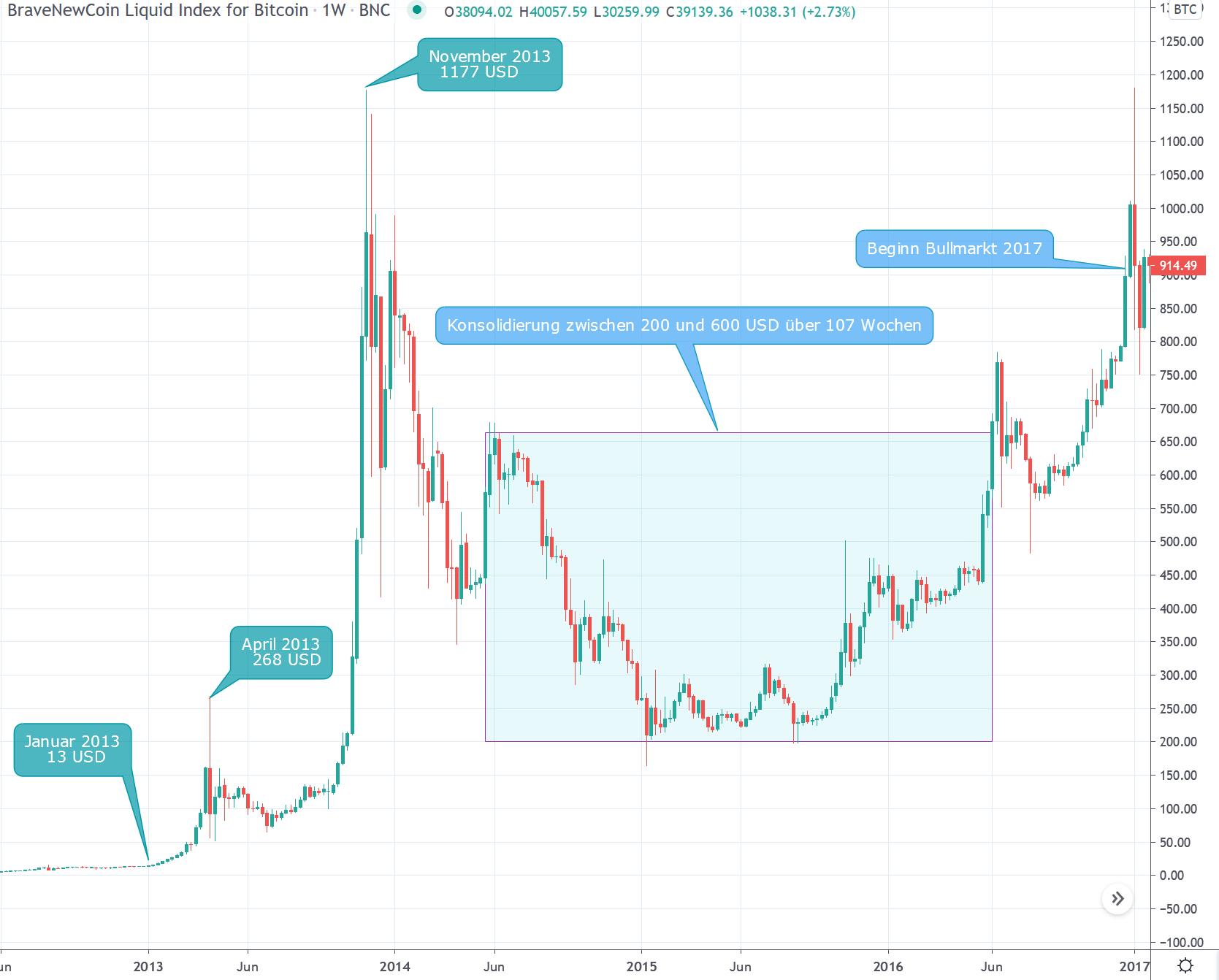
Bitcoin's price history illustrates that in its early years before 2013, a few hundred or even a few thousand Bitcoins did not yet represent a substantial value and owners were correspondingly negligent with their safekeeping. Trading Bitcoins was also in completely different spheres than nowadays.
I wish I had kept my 1,700 BTC @ $0.06 instead of selling them at $0.30, now that they're $8.00! #bitcoin
— Greg Schoen (@GregSchoen) May 16, 2011
At the time, hardly anyone would have thought that Bitcoin would be trading at 40,000 USD per unit a few years later. And so many early Bitcoin owners ended up in the same situation as the programmer Stefan Thomas. People who know that they should have a few hundred Bitcoins somewhere, but don't have access to it because the value was negligible back then and they didn't pay enough attention to its safekeeping.
Up to 20% "lost" bitcoins
According to various studies, as many as 4 million Bitcoins could be "locked away" forever. A considerable number of Bitcoins have been in the same wallet addresses for years. A large part of this share can be considered lost. A study by Delphi Digital specifically analyzed the "Unspent Transaction Output (UTXO) data. Every time a portion of a Bitcoin is spent, a new UTXO entry results. This allows to determine how long Bitcoins have been in the same wallet address.
Bitcoins that have not been moved for more than 5 years have a high chance that the owners have lost access to their private keys and thus to their Bitcoins. It is also possible that they have passed away by now. A significant portion over 980,000 Bitcoins is stored on wallet addresses assigned to Satoshi Nakomoto from the beginning.
Unique features of the Bitcoin protocol
The problem of lost or stolen Bitcoins arises from the negligent handling of the owners and cannot be attributed to the overall security of the Bitcoin network. Stefan Thomas stored the private keys that grant access to his Bitcoins on a password-protected external hard drive, whose password he had forgotten over time. All Bitcoin transactions are kept in a decentralized ledger (blockchain). Owners have a wallet address (comparable to a bank account) and the corresponding private key. This private key, which is only revealed to the person who created the wallet, can be used to access the owner's Bitcoins. If the private keys are lost, the Bitcoins in the corresponding wallet addresses are also lost.
This deliberately chosen structure enables a disintermediated, censorship-resistant transfer of value over the Internet. The electronic payment system is based on cryptographic evidence instead of trust in a third party. Anyone with Internet access can therefore open their own Bitcoin "bank account" and become the sole owner of their assets. A powerful combination, as envisioned by the payment network's inventor. As a consequence, the responsibility for controlling the digital assets lies solely with its owner. A responsible task, with a few points to bear in mind. If the private keys are lost, no third party will be able to help.
Over time, a large business area has developed surrounding the custody of digital assets. Third-party providers offer a wide range of solutions. The owner of crypto assets often has to manage the balancing act between absolute sovereignty over the assets and the involvement of a third party.