
Close Menu
Crypto Valley Journal
    Facebook X (Twitter) Instagram
    Crypto Valley Journal
    • Hot Topics
      • News
      • Minds
    • Focus
      • Background
      • Blockchain
      • Legal & Compliance
      • Non-Fungible Token (NFTs)
    • Investing
      • Markets
      • Financial Products
      • Decentralized Finance (DeFi)
      • Exchange overview
    • Education
      • Basics
      • Glossary
      • Politicians on crypto
    • Statistics
      • Bitcoin-ETF-Flows
      • Ethereum-ETF-Flows
      • Crypto market data
      • On-chain data
    • Academy
      • Overview
      • Part 1: Blockchain
      • Part 2: Money
      • Part 3: Bitcoin
      • Part 4: Cryptocurrencies
      • Part 5: Decentralized Finance
      • Part 6: Investing
    • English
      • Deutsch
    Crypto Valley Journal
    You are at:Home»Focus»Background»Is Bitcoin’s four-year halving cycle broken?
    Is the Bitcoin four-year cycle broken?

    Is Bitcoin’s four-year halving cycle broken?

    By 21Shares Research on 7. November 2025 Background

    For more than a decade, Bitcoin’s price has followed a familiar rhythm. Every four years, a halving event cuts new supply in half, typically triggering a powerful bull run, a sharp correction, and a long recovery, almost like clockwork. As we approach the end of 2025, that rhythm appears to be changing.

    Understanding these changes is essential for anyone trying to navigate the next phase of Bitcoin’s evolution, where macroeconomic forces and institutional capital are rewriting the old playbook.

    Subscribe to our newsletter

    The best articles of the week, directly delivered into your mailbox.

    What is Bitcoin’s old playbook?

    Historically, each halving sparked a new cycle of growth and decline.

    • 2012: Bitcoin rose from 12 to 1'150 USD before dropping 85%
    • 2016: From 650 to 20'000 USD, then down 80%
    • 2020: From 8'700 to 69'000 USD, followed by a 75% correction

    These predictable waves became a roadmap for smart traders. Yet the post-2024 halving period has broken the pattern. Eighteen months after the April 2024 event, Bitcoin remains above 110'000 USD with subdued volatility. Momentum indicators like the monthly relative strength index (RSI) point to controlled rather than euphoric growth. The usual “blow-off top” is missing.
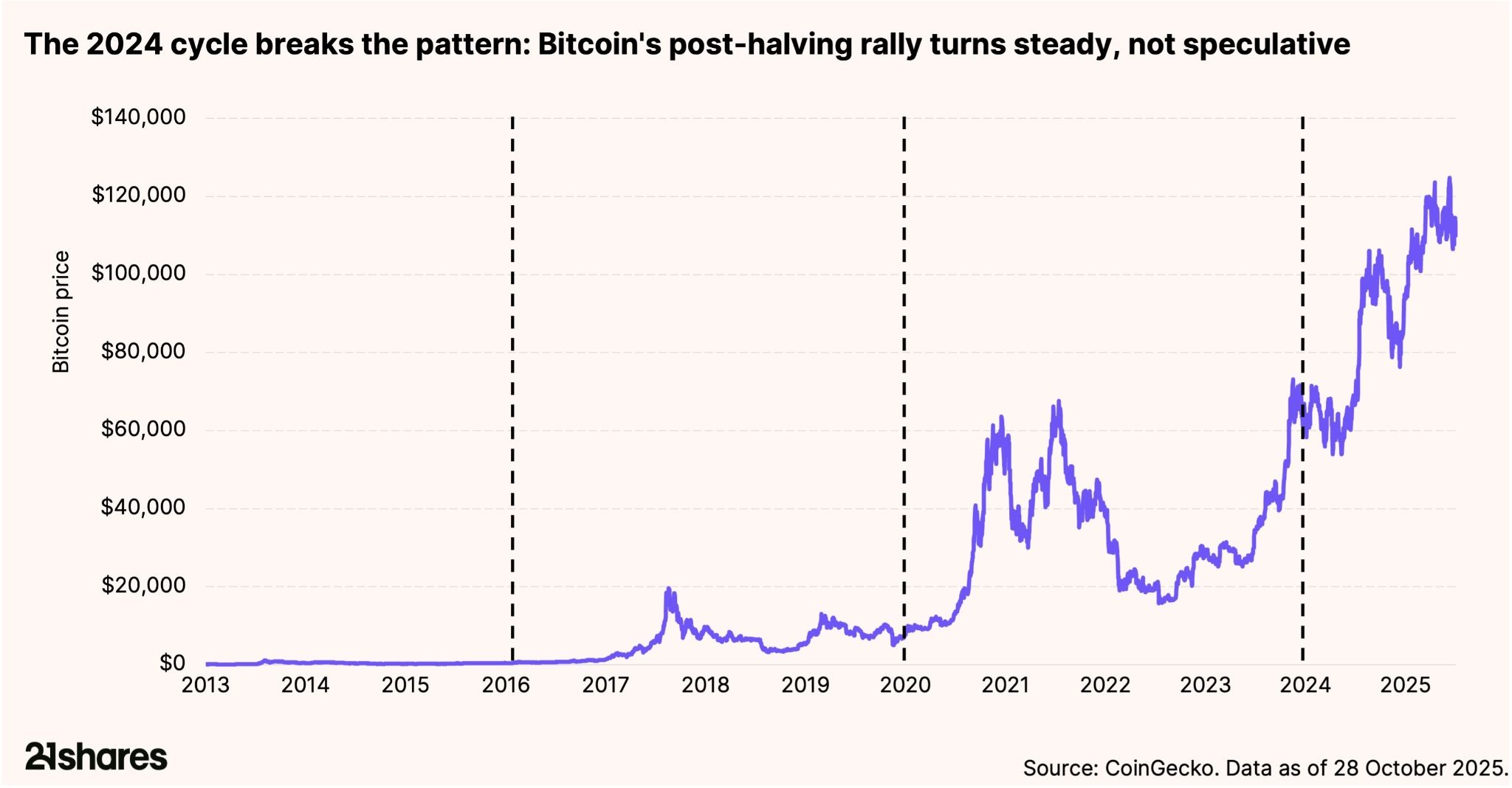

    The 2024 cycle breaks the pattern: Bitcoin's post-halving rally turns steady / Source: 21Shares, Coingecko

    Ray Dalio’s Bridgewater Associates Minds

    Star investor Ray Dalio considers Bitcoin inferior to gold

    CLARITY Act DeFi Background

    CLARITY Act: The year’s most important crypto deal heads for a decision

    JPMorgan warns: Recurring DeFi exploits and stagnant ETH-denominated TVL curb institutional engagement in the DeFi sector. DeFi

    JPMorgan: DeFi hacks and TVL losses weigh on institutional investors

    Basics

    Unit bias in crypto: Why cheap coins mislead investors

    Ray Dalio’s Bridgewater Associates Minds

    Star investor Ray Dalio considers Bitcoin inferior to gold

    CLARITY Act DeFi Background

    CLARITY Act: The year’s most important crypto deal heads for a decision

    What changed in Bitcoin’s cycle?

    The market structure. Bitcoin is no longer dominated by retail speculation. The launch of US spot ETFs in January 2024 opened access to regulated, long-term capital: pension funds, asset managers, and corporate treasuries. These institutional investors tend to hold through volatility rather than react to headlines, resulting in steadier, more persistent demand than the initial retail investor base.

    For the first time, Bitcoin hit a new all-time high before a halving. This shift from short-term trading to institutional demand has smoothed out the once-violent price swings.

    Halvings matter less, macro matters more

    Earlier halvings sharply reduced Bitcoin’s inflation rate, reinforcing its scarcity. But in 2024, supply growth only fell from roughly 1.7% to 0.85%. With nearly 94% of total Bitcoin already mined, the supply effect is now marginal.

    Meanwhile, macro forces have taken the wheel. Bitcoin fell with equities during the 2022 rate-hike cycle and rallied as global liquidity improved between 2023 and 2025. With rates now declining and quantitative tightening ending, liquidity conditions remain supportive. Bitcoin increasingly trades like a macro asset sensitive to real yields, liquidity flows, and risk appetite.
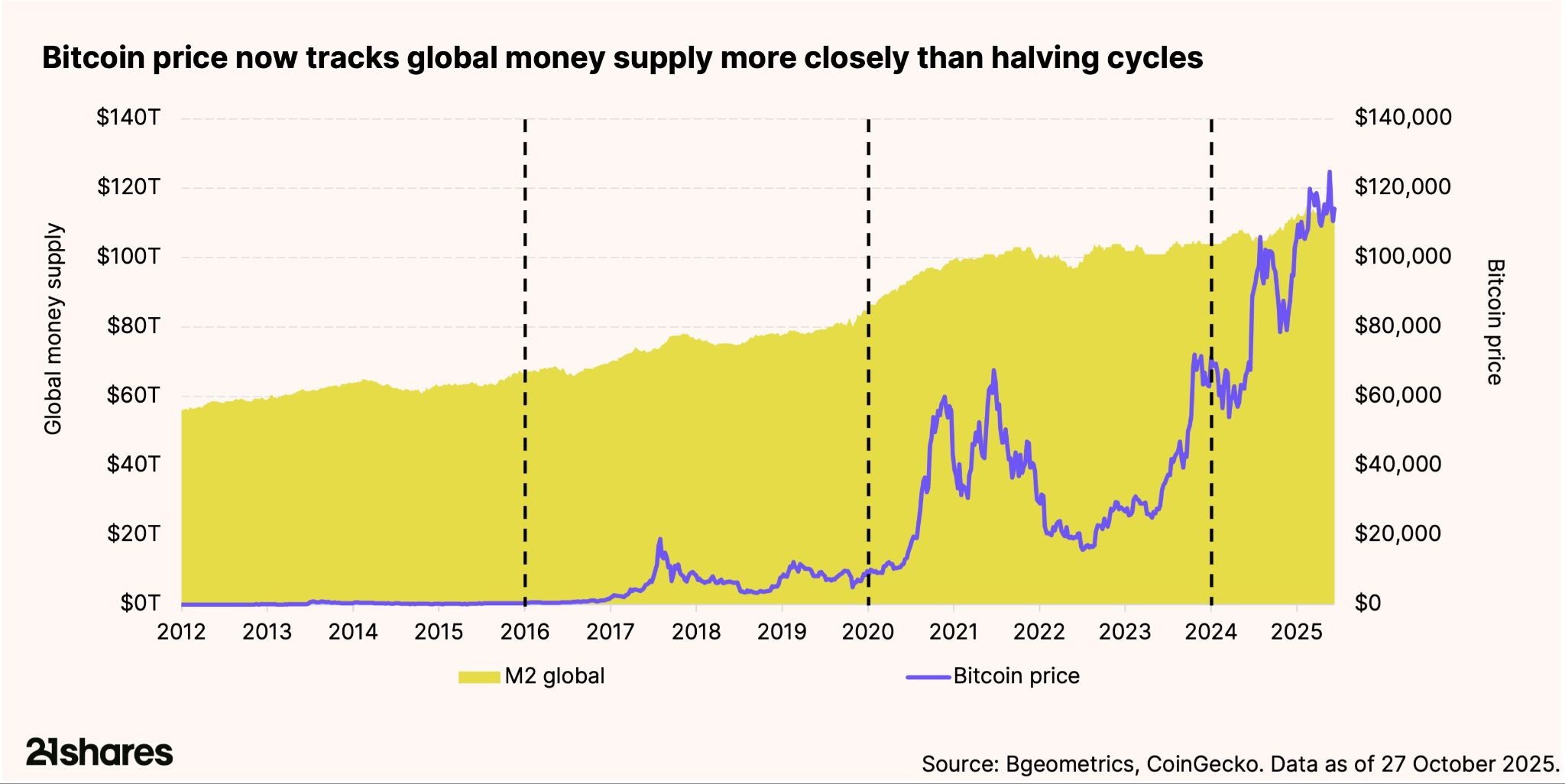
    Bitcoin price now tracks global money supply more closel than halving cycles / Source: 21Shares, Bgeometrics

    The takeaway? Bitcoin’s market structure is evolving

    Some analysts now argue that Bitcoin’s four-year cycle is stretching to five as liquidity waves lengthen and institutional participation deepens. Post-halving gains of just 18% so far may signal a slower but more sustainable uptrend, with the peak potentially extending into 2026.

    The halving still holds psychological weight, but its influence is fading amid stronger macro and liquidity dynamics. The familiar boom-and-bust pattern may be giving way to a new era, one defined by steadier growth, institutional maturity, and global macro trends rather than retail euphoria.


    Share. Facebook Twitter LinkedIn Email Telegram WhatsApp

    About the author

    21Shares Research
    • Website

    The 21Shares Research team provides world-class, data-driven insights into the crypto asset market. Our mission is to improve the professionalism, transparency, and accountability of actors and institutions within the industry whilst helping educate investors. To do this we produce monthly institutional-grade research on the most important topics within the industry.

    Related Articles

    Bitcoin regime shift in question as April rally pushes BTC above $80k, with $2.4 billion in ETF inflows and patient capital building support.

    Spring cleaning: Bitcoin tests the regime shift above $80k

    CLARITY Act DeFi

    CLARITY Act: The year’s most important crypto deal heads for a decision

    CNB Governor Michl argues in Las Vegas for a 1% Bitcoin allocation in central bank reserves - despite rejection by his own Bank Board.

    Czech National Bank CNB advocates for Bitcoin as a reserve asset

    JPMorgan sees Bitcoin ahead of gold in the debasement trade: GLD loses 2.7% AUM, IBIT gains 1.5% AUM since Iran war outbreak.
    8. May 2026

    JPMorgan: Bitcoin overtakes gold in the debasement trade

    Bitcoin regime shift in question as April rally pushes BTC above $80k, with $2.4 billion in ETF inflows and patient capital building support.
    8. May 2026

    Spring cleaning: Bitcoin tests the regime shift above $80k

    CLARITY Act DeFi
    7. May 2026

    CLARITY Act: The year’s most important crypto deal heads for a decision

    twitter image button instagram image button linkedin image button youtube image button

    About Crypto Valley Journal
    About Crypto Valley Journal

    On the pulse of the movement

    • Academy
    • Contact
    • Advertising
    • About us
    • Partner
    • Imprint
    • Privacy
    • Disclaimer
    Search

    Type above and press Enter to search. Press Esc to cancel.