
Close Menu
Crypto Valley Journal
    Facebook X (Twitter) Instagram
    Crypto Valley Journal
    • Hot Topics
      • News
      • Minds
    • Focus
      • Background
      • Blockchain
      • Legal & Compliance
      • Non-Fungible Token (NFTs)
    • Investing
      • Markets
      • Financial Products
      • Decentralized Finance (DeFi)
      • Exchange overview
    • Education
      • Basics
      • Glossary
      • Politicians on crypto
    • Statistics
      • Bitcoin-ETF-Flows
      • Ethereum-ETF-Flows
      • Crypto market data
      • On-chain data
    • Academy
      • Overview
      • Part 1: Blockchain
      • Part 2: Money
      • Part 3: Bitcoin
      • Part 4: Cryptocurrencies
      • Part 5: Decentralized Finance
      • Part 6: Investing
    • English
      • Deutsch
    Crypto Valley Journal
    You are at:Home » Focus » Background » Michael Saylor: When does Strategy become a systemic risk for Bitcoin?
    Strategy reports a $14.5 billion unrealized Bitcoin loss in Q1 2026 - yet still added 88,594 BTC to its treasury holdings.

    Michael Saylor: When does Strategy become a systemic risk for Bitcoin?

    By 21Shares Research on 11. April 2025 Background

    The company founded by businessman Michael Saylor in 1989, formerly known as MicroStrategy, now goes by the simpler name Strategy – but one thing has not changed under the new brand: the company’s aggressive acquisition of Bitcoin.

    Its new logo even features the Bitcoin symbol, making the founder’s strong commitment to the crypto asset unmistakably clear. In this report, we explain the rationale behind this intensification of their strategy and assess it from a risk analysis perspective.

    Subscribe to our newsletter

    The best articles of the week, directly delivered into your mailbox.

    The strategy behind the Bitcoin purchases

    Strategy pursues a unique approach by acquiring large amounts of Bitcoin using a mix of equity and debt. The company currently holds 528,185 BTC – which accounts for approximately 2.5 percent (!) of Bitcoin’s maximum supply. With a total value of around $43 billion at a Bitcoin price of $81,000, Strategy is by far the largest corporate holder of Bitcoin.

    What’s particularly noteworthy is that Strategy not only uses its own capital but also borrows funds to expand its Bitcoin position. A significant portion of this financing is done through so-called convertible notes. These financial instruments give investors the option to convert their bonds into company shares under certain conditions, rather than demanding traditional cash repayment. This reduces the immediate pressure on Strategy to repay its debt from operating income or by selling Bitcoin.

    In addition to convertible notes, Strategy also finances its Bitcoin purchases through preferred shares and traditional debt. Under the so-called “21/21 Plan,” the company intends to raise an additional $42 billion between 2025 and 2027 – split evenly between equity and fixed-income instruments – primarily to acquire more Bitcoin. Part of this includes perpetual preferred shares with a 10 percent coupon, which are being actively marketed to retail investors.


    Ray Dalio’s Bridgewater Associates Minds

    Star investor Ray Dalio considers Bitcoin inferior to gold

    Strategy and BitMine are deep in the red: around USD 21 billion in unrealized losses. The Digital Asset Treasury (DAT) sector is wobbling. Background

    Strategy and BitMine underwater: USD 21 billion unrealized loss

    VanEck lists VBNB, the first US spot BNB ETF on Nasdaq. Sponsor fee 0.39%, custody at Anchorage Digital, no staking at launch. Financial Products

    VanEck launches first US BNB ETF (VBNB) on Nasdaq

    Digital finance transparency relies on Proof of Reserves, Merkle trees, MPC custody and 24/7 monitoring to verify solvency and user assets. Basics

    Transparency as the foundation of security in digital finance

    Ray Dalio’s Bridgewater Associates Minds

    Star investor Ray Dalio considers Bitcoin inferior to gold

    Strategy and BitMine are deep in the red: around USD 21 billion in unrealized losses. The Digital Asset Treasury (DAT) sector is wobbling. Background

    Strategy and BitMine underwater: USD 21 billion unrealized loss

    The big question for investors: How risky is Saylor’s strategy?

    On one hand, using convertible notes for purchases provides the company with high flexibility. Since these are not directly backed by Bitcoin, there is no immediate risk of liquidation if the Bitcoin price crashes. Moreover, Strategy is not solely a Bitcoin purchaser – it still operates a profitable software division that generates about $463 million in annual revenue. This contributes to the company’s stability, as it can cover its annual interest and dividend obligations of around $228 million.

    At the same time, Strategy’s business model is clearly heavily dependent on the price of Bitcoin. Should there be a severe crash in value, the company might be forced to sell parts of its holdings to meet its liabilities. However, a full liquidation to repay all debts would only be required if the Bitcoin price were to fall to approximately $20,143 – a drastic drop from current levels, though not entirely out of the question.

    For comparison: In the summer of 2024, waves of sales from several major institutions placed significant downward pressure on Bitcoin’s price. When crypto exchanges Mt. Gox and Genesis, along with the German government, sold Bitcoin worth $16 billion, the asset lost over 11 percent of its value in just one month. History, however, shows that Bitcoin has always managed to recover from such shocks. So, while a forced sale of large holdings by Strategy could exert short-term pressure, it’s unlikely to trigger a lasting market crisis.
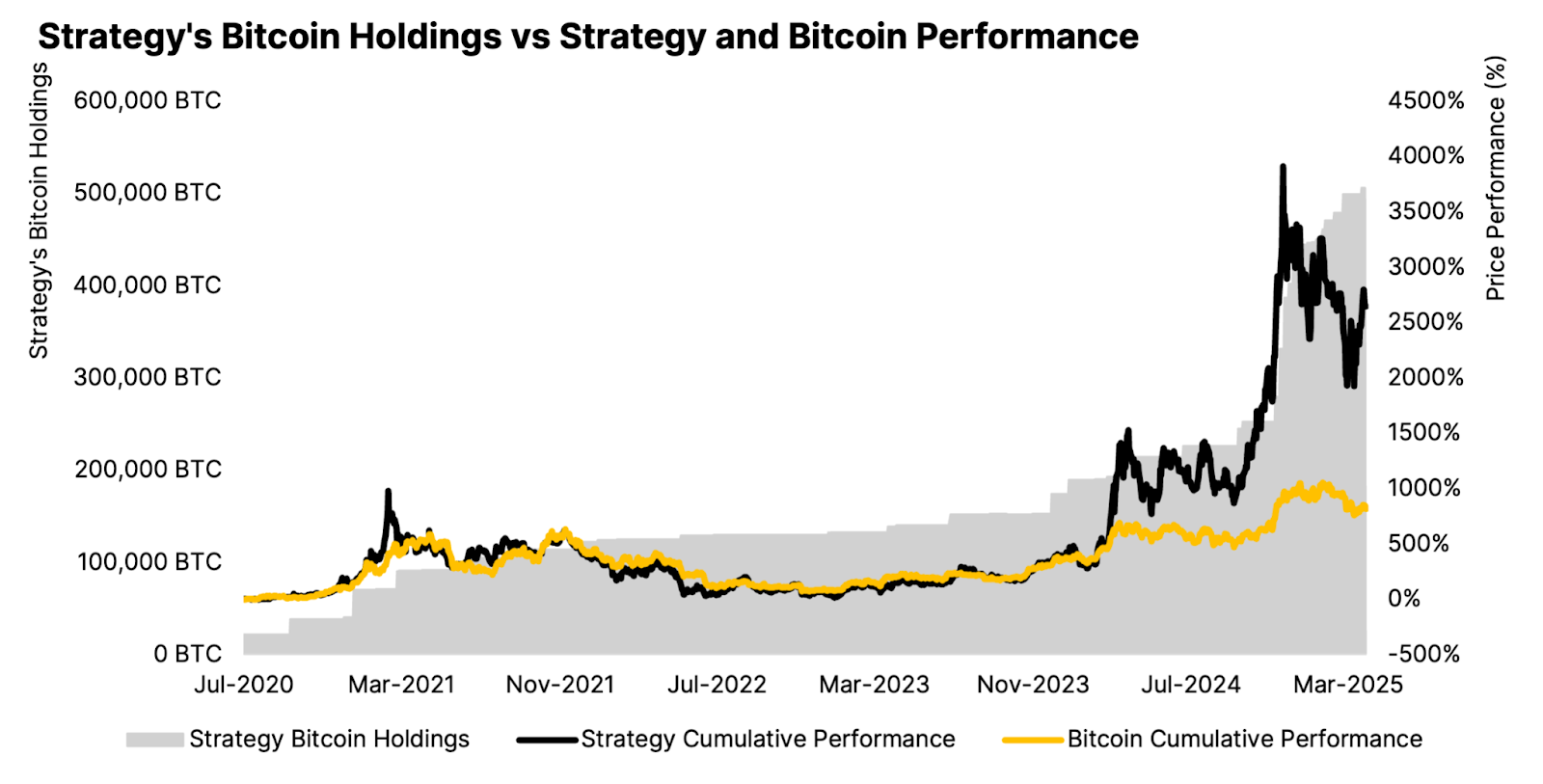
    Comparison of Bitcoin price, Strategy share price, and the company’s Bitcoin holdings / Source: 21Shares

    Conclusion: A bold, but not irrational bet

    With its aggressive Bitcoin purchases, Strategy is betting on a long-term appreciation of the asset – mirroring the growing interest of governments and central banks in holding Bitcoin as a strategic reserve in anticipation of future gains. As a participant in a so-called “reserve race,” the company is relying on innovative financing structures that reduce its liquidation risk. Still, the model carries inherent dangers: a dramatic drop in Bitcoin’s price could increase the debt burden and place downward pressure on the company’s valuation.

    For investors, this represents a risky but potentially highly profitable bet: those who believe in the long-term appreciation of Bitcoin might see Strategy as one of the most important players in the space – with all the opportunities and risks that come with it.


    Share. Facebook Twitter LinkedIn Email Telegram WhatsApp

    About the author

    21Shares Research
    • Website

    The 21Shares Research team provides world-class, data-driven insights into the crypto asset market. Our mission is to improve the professionalism, transparency, and accountability of actors and institutions within the industry whilst helping educate investors. To do this we produce monthly institutional-grade research on the most important topics within the industry.

    Related Articles

    JPMorgan urges Strategy to rebuild its dollar reserves after the first Bitcoin sale since 2022 and grades digital assets as cautious.

    JPMorgan: Strategy (MSTR) must build up dollar reserves

    Strategy and BitMine are deep in the red: around USD 21 billion in unrealized losses. The Digital Asset Treasury (DAT) sector is wobbling.

    Strategy and BitMine underwater: USD 21 billion unrealized loss

    Crypto VC deals fell to around 50 in May 2026, a five-year low. Mega-rounds like Kalshi's Series F keep the dollar volume elevated.

    Crypto VC deals fall to five-year low in May 2026

    XRP Ledger 3.2.0 renames the core software rippled to xrpld. Node operators must update; the release is planned for around 15 June.
    8. June 2026

    XRP upgrade: Version 3.2.0 changes naming convention

    JPMorgan urges Strategy to rebuild its dollar reserves after the first Bitcoin sale since 2022 and grades digital assets as cautious.
    8. June 2026

    JPMorgan: Strategy (MSTR) must build up dollar reserves

    CVJ Weekly review
    6. June 2026

    Weekly review: Strategy sells Bitcoin and shakes up the market

    twitter image button instagram image button linkedin image button youtube image button

    About Crypto Valley Journal
    About Crypto Valley Journal

    On the pulse of the movement

    • Academy
    • Contact
    • Advertising
    • About us
    • Partner
    • Imprint
    • Privacy
    • Disclaimer
    Search

    Type above and press Enter to search. Press Esc to cancel.