In the past, numerous surveys have examined the distribution of cryptocurrencies. It has been noted that the figures often diverge widely, that different survey designs make direct comparisons difficult, and that reports rarely go beyond descriptive statistics.
Based on a representative population survey of 3,864 German internet users, we explored the relevance of cryptocurrencies. The aim of our survey was to obtain a detailed picture of what cryptocurrencies are used for and what factors determine users' ownership, knowledge, and trust assessments.
Adoption parameters for cryptocurrency
The adoption of cryptocurrencies does not represent a uniformly defined term. It rather attempts to describe the state of social acceptance through social and economic parameters. In this context, societal parameters include, for example, ownership rates in the population and economic parameters include, for example, the number of merchants accepting cryptocurrencies as a means of payment or the transaction volume. In our study, we focused on the analysis of parameters with societal relevance. Since many parameters were still largely unknown at the time of the analysis or had only been studied indirectly to date, we used the literature available at the time to categorize important metrics such as awareness, knowledge, ownership, trustworthiness, socioeconomic characteristics of users, motives for ownership, and usage.
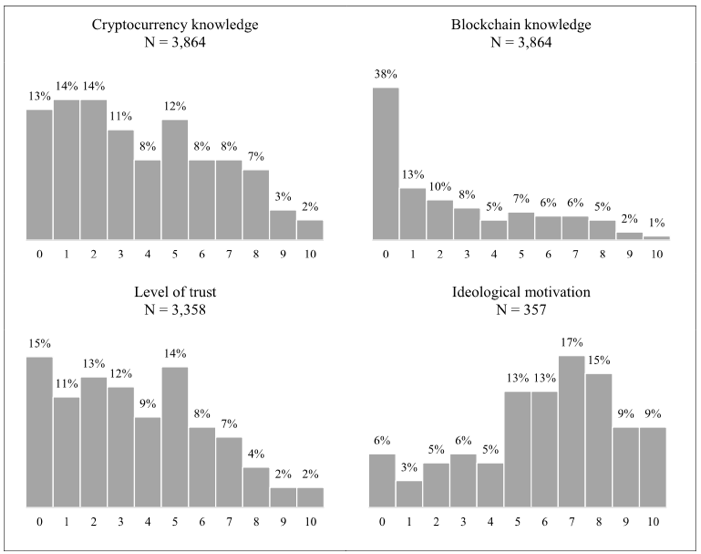
While various surveys indicated a prevalence of between 3% and 8% for Germany, our study found that 9.2% of respondents owned cryptocurrencies at the time of the survey. Another 9.1% had owned cryptocurrencies in the past. The level of awareness of cryptocurrencies in Germany is high: 83% of respondents said they had taken note of cryptocurrencies. In our study, we also measured knowledge on a scale from 0 (no knowledge) to 10 (pronounced knowledge). Across all respondents, we determined an average score of 3.76, while the score for cryptocurrency owners was 6.68. In addition, we asked respondents to rate their trust in cryptocurrencies on a scale of 0 to 10. Result: The general trust level among all users was 3.62, and among cryptocurrency owners even 6.73. The following figure shows the distribution of responses across the respective scales.
Furthermore, we were able to create a demographic and socioeconomic profile of cryptocurrency users based on the representative sample. For example, cryptocurrency owners in Germany at the time were on average 38 years old and 74% of them were male. Current holders are on average about 10 years younger and more often male than non-holders. From the results, it can be concluded that the high volatility of cryptocurrencies has mainly prompted young men to get into them, who are generally considered to have a higher affinity for risk. In terms of socioeconomic analysis of cryptocurrency holders, our study captured respondents' net monthly household income, education, and relationship status. The average income of cryptocurrency owners at the time was €2,850, that of former owners was €2,620, and that of non-owners was €2,150. Accordingly, cryptocurrency owners had a comparatively high average income.
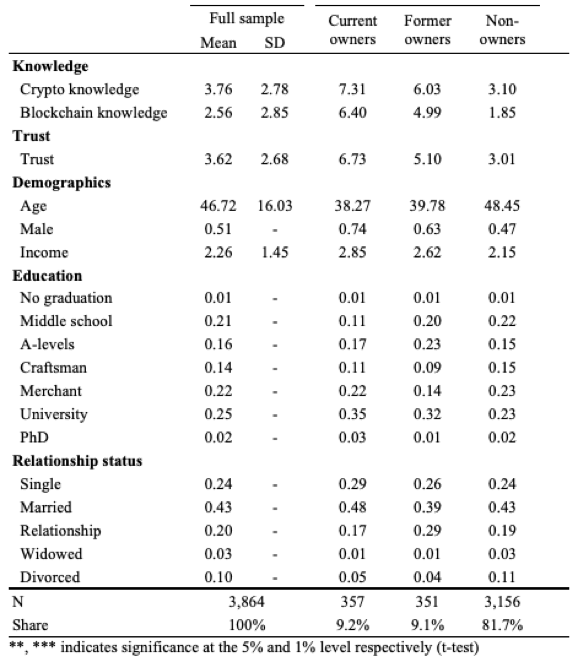
The high income of cryptocurrency holders is related to their educational status. Thus, 38% of the then owners had a university degree and 3% of them held a PhD. Similar to the income distribution, the educational degrees of the then owners were higher than those of the former owners (32% university degree; 2% PhD). The second most common education reported was business management training (22% of former owners; 14% of former owners), followed by high school diploma (17% of former owners; 23% of former owners). The results raise a variety of questions and consequently leave room for different interpretations, especially regarding the correlations between education and the attractiveness of cryptocurrencies.
Determinants of crypto-knowledge, ownership and trust
The obvious next step in our study was to determine what factors influence ownership of, knowledge about, and trust assessments of cryptocurrencies. In the figure below, we looked at the correlations between each variable. Correlations that exceed a 5% significance level are highlighted in bold. Thus, important relationships could be identified between the ownership variables (at the time and in the past), the knowledge variables (cryptocurrency and blockchain) and trust. Owners of cryptocurrencies at that time tended to report high levels of trust and knowledge. Intuitively quite suggestive, but no demonstrable evidence, which is why the relationship was empirically investigated and validated in our study.
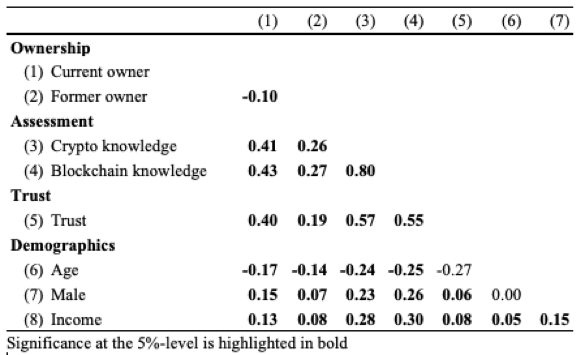
With the aim of determining the determinants for certain variables, such as the ownership of cryptocurrencies, the assumption regarding the triangular relationship of ownership, knowledge and trust was tested in detail using specific regression models. Based on this, it was shown that not only knowledge and trust are significant predictors of cryptocurrency ownership, but also knowledge and ownership are significant predictors of trust in cryptocurrencies. Nonetheless, it should be noted at this point that the exploratory analysis approach adopted does neither allow us to determine the direction of influence of each variable on the other nor to interpret them. Consequently, it can only be conjectured whether and to what extent the ownership of cryptocurrencies, along with the accompanying financial and mental commitment, may have influenced respondents' assessments of their own knowledge or trust. On the other hand, it is conceivable that a high level of knowledge may have positively influenced subsequent owners' perceptions of trust, and that they viewed cryptocurrencies as beneficial or promising based on this, and ultimately decided to purchase them.
Conclusion
This study exposes the demographic and socioeconomic profile of cryptocurrency users in Germany and reveals important dynamics of individual adoption of cryptocurrencies. Cryptocurrency users are mostly young, male, affluent, and well-educated. The self-assessed level of knowledge and confidence plays an important role in the process of acquiring cryptocurrencies. The triangular relationship between knowledge, trust, and ownership was revealed in our study and empirically validated by using a representative sample of users.
The results of our study show the relevance that cryptocurrencies have now achieved in the social context. Studies such as this one help to create objective data bases in order to be able to answer the diverse questions of business, politics and society that arise from the widespread use of cryptocurrencies. However, the highly dynamic nature of the industry shows that new products and innovations bring about constant changes, which must be taken into account through regular representative surveys and research.