Fantom, despite its longevity in the blockchain space, has faced challenges and setbacks since the previous market cycle. While key metrics such as active users and Total Value Locked (TVL) have declined, the network's upcoming upgrade presents a promising opportunity for revitalization.
In December 2019, Fantom’s Opera mainnet launched as a compatible blockchain with Ethereum Virtual Machine (EVM). This means it’s interoperable with Ethereum and other EVM-compatible chains, such as Polygon, and Ethereum-scaling solutions like Arbitrum. With a mission to solve the blockchain trilemma, Fantom aims to create a secure and efficient global app store. The newest "Sonic" upgrade is supposed to further realize this vision.
Fantom: a scalable blockchain network
The Lachesis consensus mechanism is what makes Fantom’s blockchain fast and scalable. Its asynchronous and leaderless design enables validators to process transactions concurrently without waiting for prior block confirmations. This parallel processing architecture is what allows Fantom to achieve near-instant transaction finality.
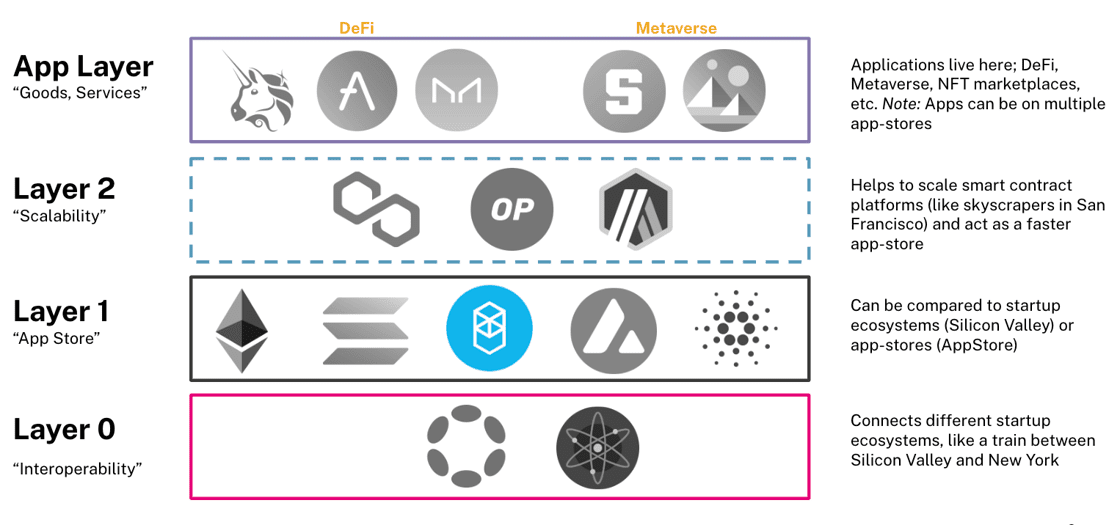
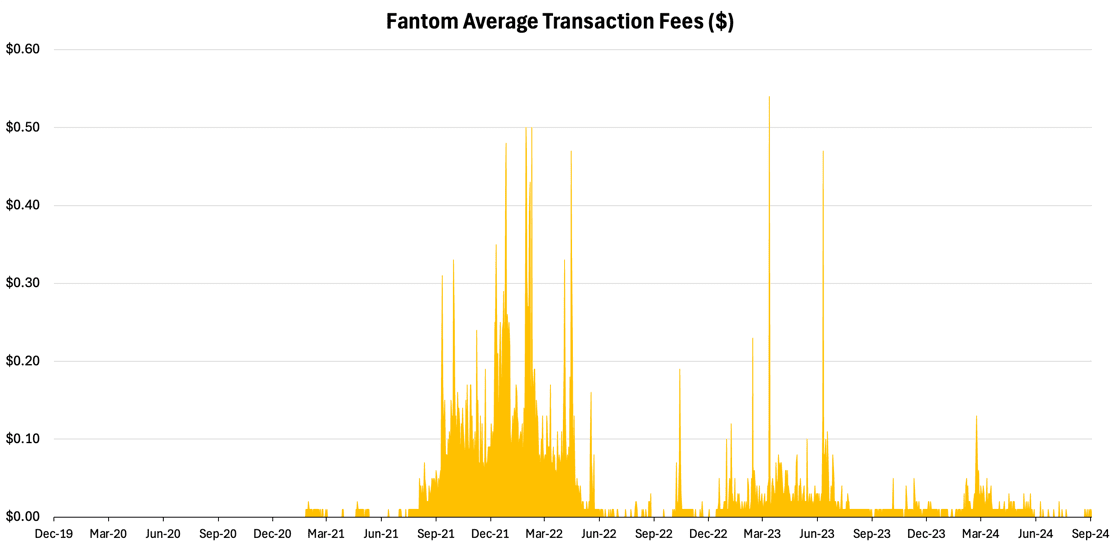
With over 400 projects deployed on its network, Fantom’s adoption is mainly driven by its transaction throughput, 30 transactions per second (TPS), coupled with low fees, as shown below.
Offering faster settlement than Ethereum (1-2 seconds) along with its EVM compatibility, meaning that developers can migrate their applications seamlessly from Ethereum, made Fantom grow to attract a total of over 179M unique addresses. At the peak of Fantom’s activity, it had almost $8B in Total Value Locked (TVL), as shown below.
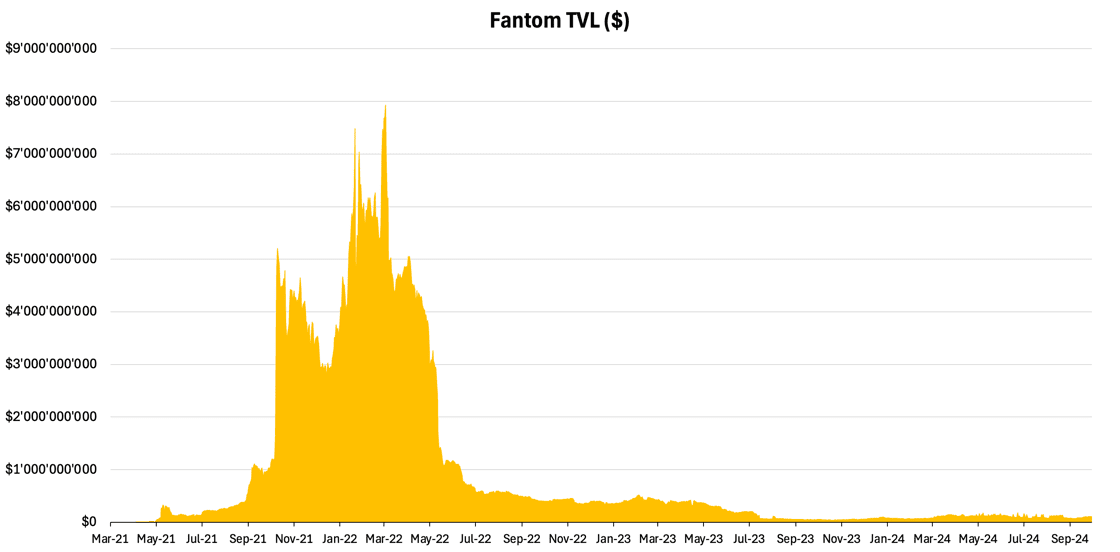
However, Fantom’s TVL took a deep dive in April 2022 and has been sluggish ever since, suffering from several headwinds including the Terra Luna and FTX collapse in 2022 and the Multichain bridge hack in 2023.
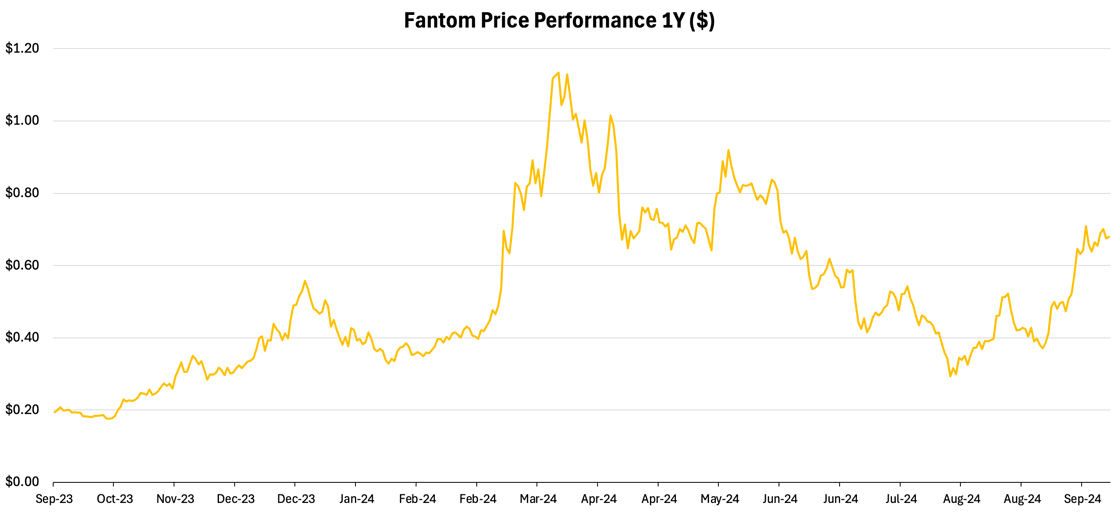
Fantom's price increase despite security breach
On July 7, 2023, Multichain cross-chain bridge protocol experienced a significant security breach, resulting in unusually large and unauthorized withdrawals. The exploit led to losses exceeding $125M, with nearly $120M of that total coming from Multichain’s Fantom bridge. On its part, Fantom learned from its hard-learned lesson and has been working on a decentralized solution for that problem, which we’ll explore later in this report.
While the hack did not permanently cripple Fantom, the FTM token price fell by around 10-15% in the immediate aftermath, causing the TVL to drop by 30%, as users flocked away from the ecosystem. The anticipation for the new Sonic upgrade has catalyzed investors to start preparing for the new iteration of the network, which will upend blockchain’s capabilities by offering improvements across performance, scalability, and efficiency.
So, what is Sonic?
In December 2023, Fantom launched Sonic Labs, an incubator aimed at empowering developers to create innovative dApps with enhanced performance, in preparation for the launch of the Sonic mainnet, slated for December 2024. On the token side, $FTM will turn into $S following the mainnet deployment later in the year. Users will be able to swap both tokens at a rate of 1:1.
On a technological level, the rebranding aims to replace the old Opera blockchain with Sonic, which is focused on significantly increasing the network’s speed and settlement time, in addition to making it more decentralized. It also offers an attractive environment that tempts developers to migrate from competing ecosystems. While Opera will remain operational in the short term, Sonic's compelling rewards and advanced features are poised to catalyze a mass migration, ultimately establishing it as Fantom's new dominant network, which will then be known as Sonic. Key Enhancements accomplished by Sonic:
- Transaction speed: close to 2,000 transactions per second, almost a 100x improvement from its old benchmark.
- Transaction finality: expected to occur in under 700 ms, rivaling high-throughput blockchains like Solana and catering to a broader segment of high-velocity applications.
- Storage optimization: 65% reduction in node storage requirements, promoting network decentralization as it democratizes access to participating in the blockchain’s security by reducing the hardware requirements.
- Sonic gateway: a decentralized bridge connecting Ethereum and Sonic, utilizing both networks' validators to eliminate single points of failure. It also features a 14-day fail-safe mechanism, allowing users to recover assets on Ethereum if the gateway fails. The new L2 network will address previous security vulnerabilities that were associated with the previous multibridge hack.
- Gas monetization: up to 90% of gas fees from qualifying dApps will be allocated back to their developers. This encourages applications with high usage to consider migrating from other ecosystems to generate more revenue via this gas-rebate program.
- For transactions related to applications that aren’t eligible under this model: 50% of fees will be burned with 45% distributed to validators, and 5% allocated to the ecosystem vault.




Improved security and developer incentives
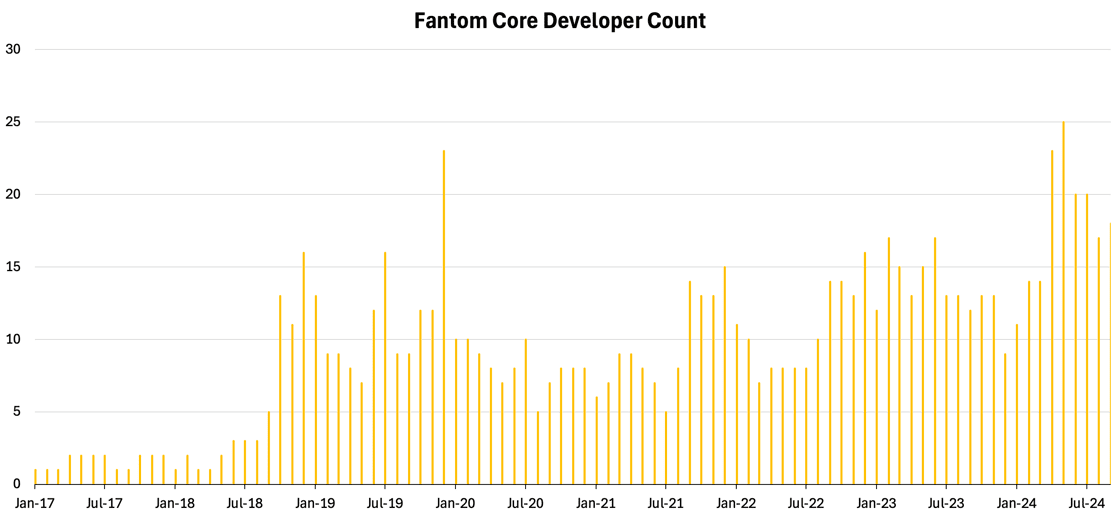
The new developer incentive program has already catalyzed a surge in application deployments on Fantom. Recent data indicates a significant uptick in the number of active developers on the platform, reaching new heights, as seen in Figure 5.
The amount of commits on the network, a concept referring to how many changes a particular app deployment has undergone, has also increased significantly since the announcement in May. In fact, the number of commits has reached a new high - a figure that is almost double the peak of 2021.
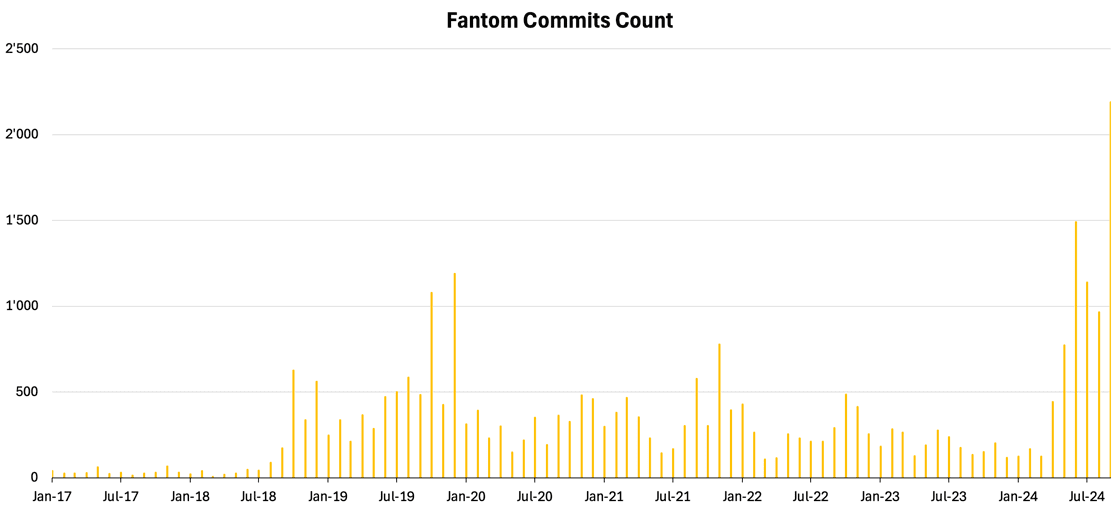
Both metrics are crucial, as developer activity often precedes wider adoption. As more developers build on a network, they create new use cases and applications, driving user growth and enhancing the blockchain’s overall utility and value proposition.
DeFi ecosystem boost
Introduction of a canonical USDC version. Fantom, in partnership with Circle and Wormhole, introduced USDC.e, a bridged version of the widely trusted USDC stablecoin. This strategic move enhances the ecosystem’s security by providing a reliable, trust-minimized bridging solution for the stablecoin. It also mitigates the depegging risks associated with lesser-known stables, addressing vulnerabilities exposed by incidents like the Multichain hack where compromised collateral led to a severe devaluation of bridged assets.
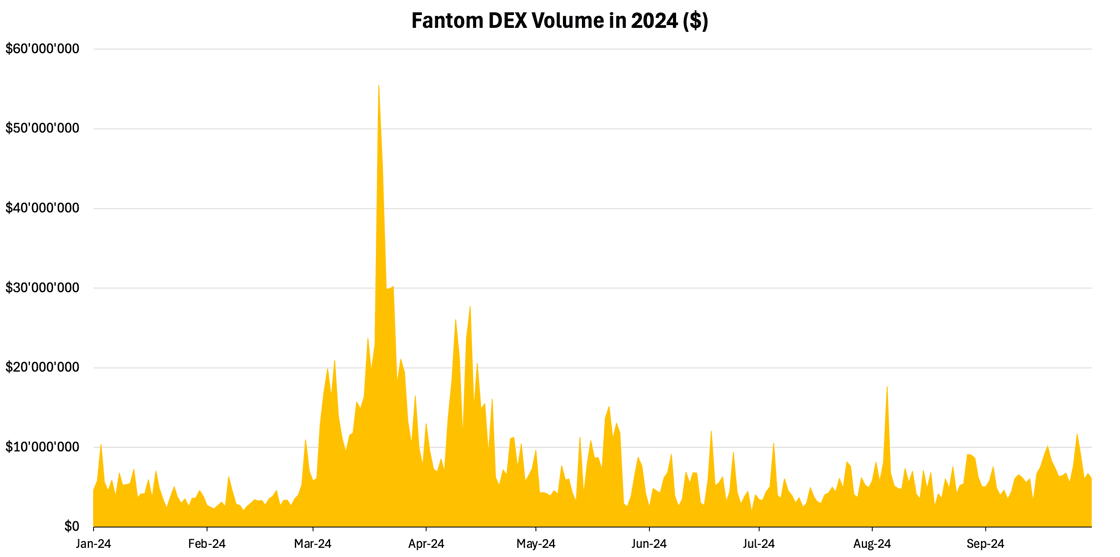
The integration of UDSC.e also lends credibility to the ecosystem, catalyzing a network effect. As high-quality protocols and assets deploy on the platform, it's likely to attract other reputable DeFi projects, creating a virtuous cycle of ecosystem growth and adoption. Since Sonic's announcement in May, Fantom's ecosystem has shown signs of revival. DEX trading volume has nearly doubled from its lows, despite only $7M in USDC.e being bridged so far. This uptick suggests growing interest, even as the wider DeFi ecosystem on Fantom has yet to emerge.
Revolutionizing DeFi: Financial primitives and blockchain credit scores
The network’s financial landscape isn’t only receiving a boost via its enhanced stablecoin integration, but also through a series of innovative primitives proposed by Andre Cronje, the network’s co-founder, to help the blockchain stand out. His most remarkable proposal revolves around introducing credit scores:
These are being developed on the back of a system that extracts, transforms, and integrates data across blockchains. So far, the foundation has processed over 54B transactions to create a wallet-scoring model without KYC or personal data.
The goal is to tap into the $11T unsecured lending market, bringing products like payday and personal loans to the DeFi space, while supporting underbanked populations who lack access to conventional credit histories and help in decreasing interest rates.
However, Cronje also has been sitting on multiple other primitives including:
- Advanced oracle: an improved mechanism for robust validation of external data, enabling applications to seamlessly integrate diverse off-chain information sources while minimizing on-chain storage requirements and associated costs.
- Protection markets: an on-chain insurance framework that provides coverage for diverse claims. This system leverages collateralized vaults, strategically deploying assets into yield-generating strategies to create a robust and self-sustaining protection marketplace.
- Leveraged spot market: allowing users to deposit arbitrary margin assets to gain access to leveraged investments directly on-chain without relying on centralized parties – all whilst enjoying the trust-minimal aspect of smart-contracts for automatic risk management.
- FX swap: a DEX inspired by Curve Finance’s trading model which is optimized for low volatility correlated assets focused on tokenized fiat currencies.
Where is Fantom/Sonic going?
Sonic's impending launch presents a compelling opportunity for growth, despite current market conditions. The platform's strategic alignment with Ethereum through the Sonic Gateway, coupled with substantial financial resources ($500M in treasury) and innovative incentive programs, positions it for potential resurgence:
- Sonic Boom: A tiered airdrop program rewarding applications based on their ecosystem contributions. Exclusive protocols receive enhanced allocations.
- Sonic Gems: Users can earn points towards a 190,500,000 $S token airdrop, with 37.5% allocated to Sonic Gem holders.
This leads us to believe that Sonic will likely be able to attract a growing number of developers from across the Ethereum ecosystem. It will be driven by offering enhanced revenue opportunities while contributing to a superior network with high transaction throughput and user-friendly features. For instance, Sonic’s native account abstraction can help onboard new entrants to the blockchain ecosystem.
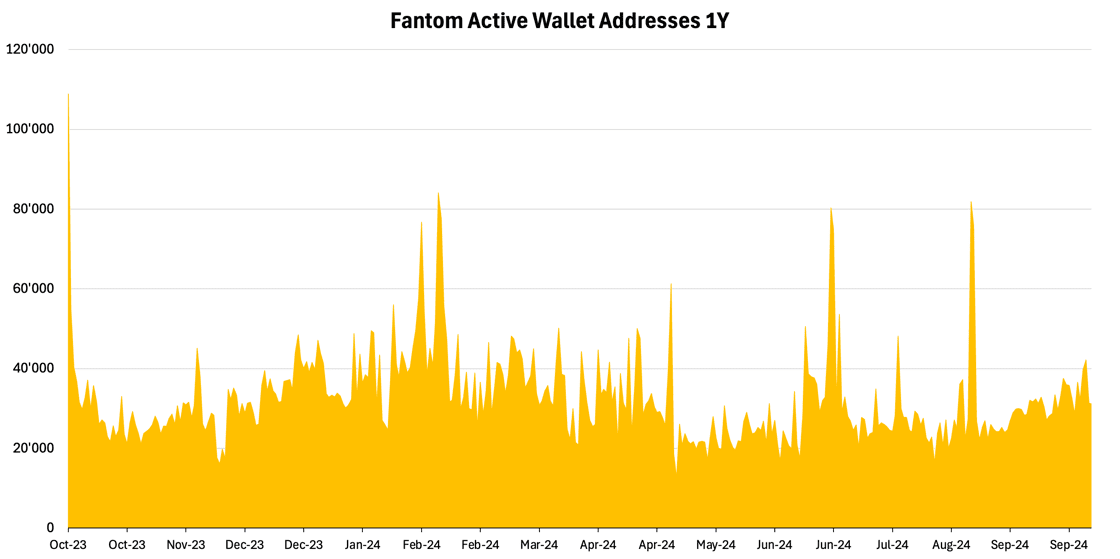
Finally, Fantom's user base is currently exceeding the average of approximately 35K recorded over the past year, as depicted below. Thus, we expect the network to continue its growth trajectory over the next few months going into the upgrade.