
In Latin America, two personalities stand out for their preference for Bitcoin: El Salvador's President Nayib Bukele and Argentina's libertarian economist Javier Milei. Although both have shown a fondness for Bitcoin, their approaches and motivations are an interesting study in contrasts.
Some see Argentina as the start of a dangerous social experiment, as the newly elected President Javier Milei could transform the country into a model libertarian state. The self-proclaimed anarcho-capitalist is an outspoken libertarian and despises the state. The economist represents a classic libertarian economic stance and shows corresponding admiration for the economic theorist Ludwig von Mises. Similar to other representatives of libertarian ideology, Javier Milei would like to see the abolition of the central bank and a return to private money, either via physical or digital gold; Bitcoin. Will the new president of Argentina use cryptocurrency to dollarize the country?
Radical change to the status quo
The politician with radical views strives for a complete transformation of the state. His declared aim is to destroy the conventional state. He plans to achieve this by attacking what he has identified as the greatest evil: the central bank. After all, Latin America's second-largest economy has been plagued by economic instability and currency devaluation bordering on hyperinflation for almost a decade.
“With legal tender, they scam you with the inflationary tax… #Bitcoin is the natural reaction against central bank scammers; to make money private again.” - Javier Milei, President of Argentina 🇦🇷🇦🇷pic.twitter.com/Rs2yXFo4e7
— Dylan LeClair 🟠 (@DylanLeClair_) November 19, 2023
Milei sees Bitcoin as a potential means of escaping state control of the economy and protecting the financial sovereignty of the individual. His support for Bitcoin stems from a criticism of central banking systems and a belief in the principles of the free market economy. For Milei, Bitcoin is not only a financial asset, but also a potential tool for political and economic reform to decentralize monetary power and challenge the status quo.
Bitcoin as a national strategy
Two years ago, El Salvador's President Nayib Bukele took the unprecedented step of introducing Bitcoin as legal tender. This bold decision was aimed at modernizing the economy, attracting foreign investment and reducing the number of unbanked people. However, unlike Milei, Bukele takes a state-led approach and sees Bitcoin as a tool for national economic growth. Although some critics sees potential risks to the country's financial stability, Bukele's pro-Bitcoin stance can be seen as a forward-looking experiment in national economic policy.
Of course, there are risks and opportunities associated with the introduction of Bitcoin. For Milei, the challenge is to convince the population and the political system to accept a decentralized currency in a country with strict currency controls. For Bukele, the risk is tying a country's economic fate to a notoriously volatile digital asset. But the potential benefits - economic autonomy for Argentinians and greater financial empowerment for Salvadorans - are considerable. After all, Bitcoin's anti-inflationary properties are evident when you look at its price against the Argentine peso.
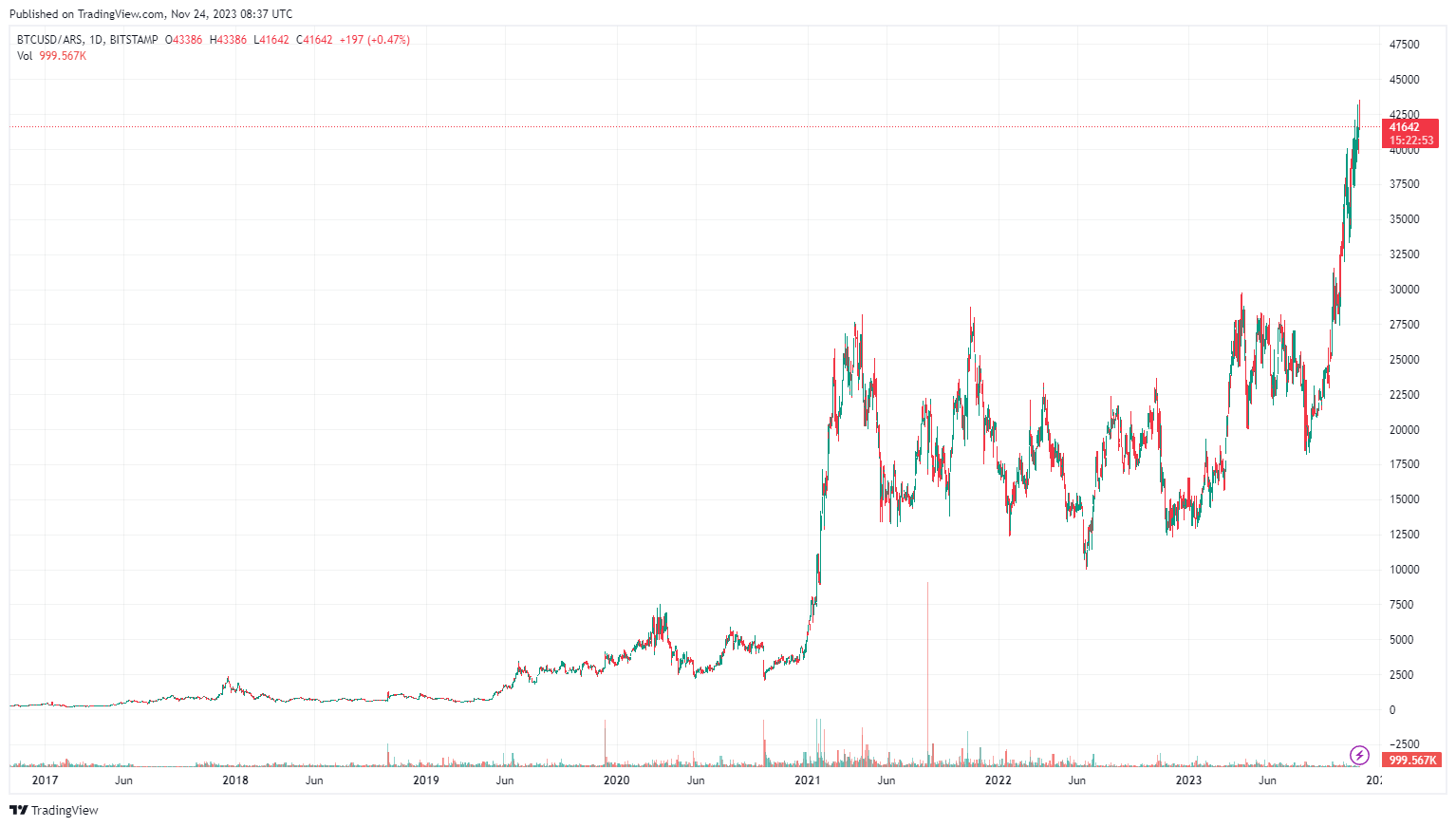
Significant hurdles for "Bitcoinization" in Argentina
Whether and how Milei wants to promote Bitcoin as Argentina's new president remains uncertain. He does sympathize with the vision of cryptocurrency thanks to his ideological principles. But the libertarian has never formulated a concrete plan. Bitcoin is unlikely to play a central role in the country's top priority of dollarization. The introduction of a "Bitcoin standard" would be a radical and unexpected step, even for Milei.
It is more likely that the new president of Argentina could follow the example of El Salvador and introduce the cryptocurrency as legal tender. The most significant obstacle would be resistance from the International Monetary Fund (IMF). Argentina is currently by far the largest borrower and owes the IMF over USD 31 billion. An explicit condition of the last credit line a year ago was to discourage the already high crypto adoption in Argentina. In order to strongly promote Bitcoin, Milei would therefore have to go against the country's largest lender.