
Strategy has unveiled the Digital Credit Capital Framework, a five-part structure designed to strengthen its preferred stock vehicles. The Digital Credit Framework anchors a USD reserve of 2.55 billion USD. It also authorizes the sale of Bitcoin of up to 1.25 billion USD.
Strategy is a publicly traded Bitcoin treasury investor with the ticker MSTR on the Nasdaq. The company has, however, pushed its original software business into a secondary role in favor of a Bitcoin accumulation strategy. The STRC, STRF, STRK and STRD classes are structured preferred stock products that are collectively known as Digital Credit Securities. They additionally grant their holders fixed dividend claims, backed by the Bitcoin holdings as an implicit buffer. Since August 2020, the firm has systematically accumulated Bitcoin. It now holds 847,363 BTC, the largest position of any publicly traded company worldwide. The preferred classes were added later, in 2024 and 2025. Through a Form 8-K filed with the SEC, the company has now announced the framework. The markets reacted immediately. MSTR shares rose roughly 6 percent in pre-market trading, while STRC gained 9 percent.
2.55 billion USD as a fixed liquidity buffer for preferred dividends
A formally defined USD reserve forms the core of the framework. As of the end of June 2026, it amounts to roughly 2.55 billion USD. This figure includes not-yet-settled proceeds from the at-the-market program. Against this stand annual obligations from preferred stock dividends and interest payments of about 1.76 billion USD. As a result, the reserve coverage works out to 17.4 months. Thus, the company can service its fixed cost of capital for more than a year without fresh funding.
As a binding floor, the board set a minimum coverage of twelve months. The current ratio therefore sits above that threshold. The company may use the reserve solely for preferred dividends and interest payments; any other use requires board approval. Furthermore, the framework adds the capacity of the Bitcoin monetization program. This lifts the total liquidity buffer to roughly 3.80 billion USD. That corresponds to coverage of 25.9 months. For the first time, it gives the company a clearly quantified reserve cushion for its credit obligations. As a result, its dependence on short-term capital market windows declines.
STRC dividend rises to 12 percent and is repriced monthly
As a second lever, Strategy additionally raises the dividend rate on STRC shares from 11.5 to 12.00 percent annually. This takes effect for semi-monthly distribution periods with record dates from 1 July 2026. STRC is formally a Variable Rate Series A Perpetual Stretch Preferred Stock with a par value of 100 USD. Management aims for trading close to that par value, namely in the range of 99 to 100 USD. The higher rate increases the ongoing distribution obligations, yet it targets a more stable price. Before the announcement, however, the security traded at roughly 72.30 USD, about 28 percent below par.
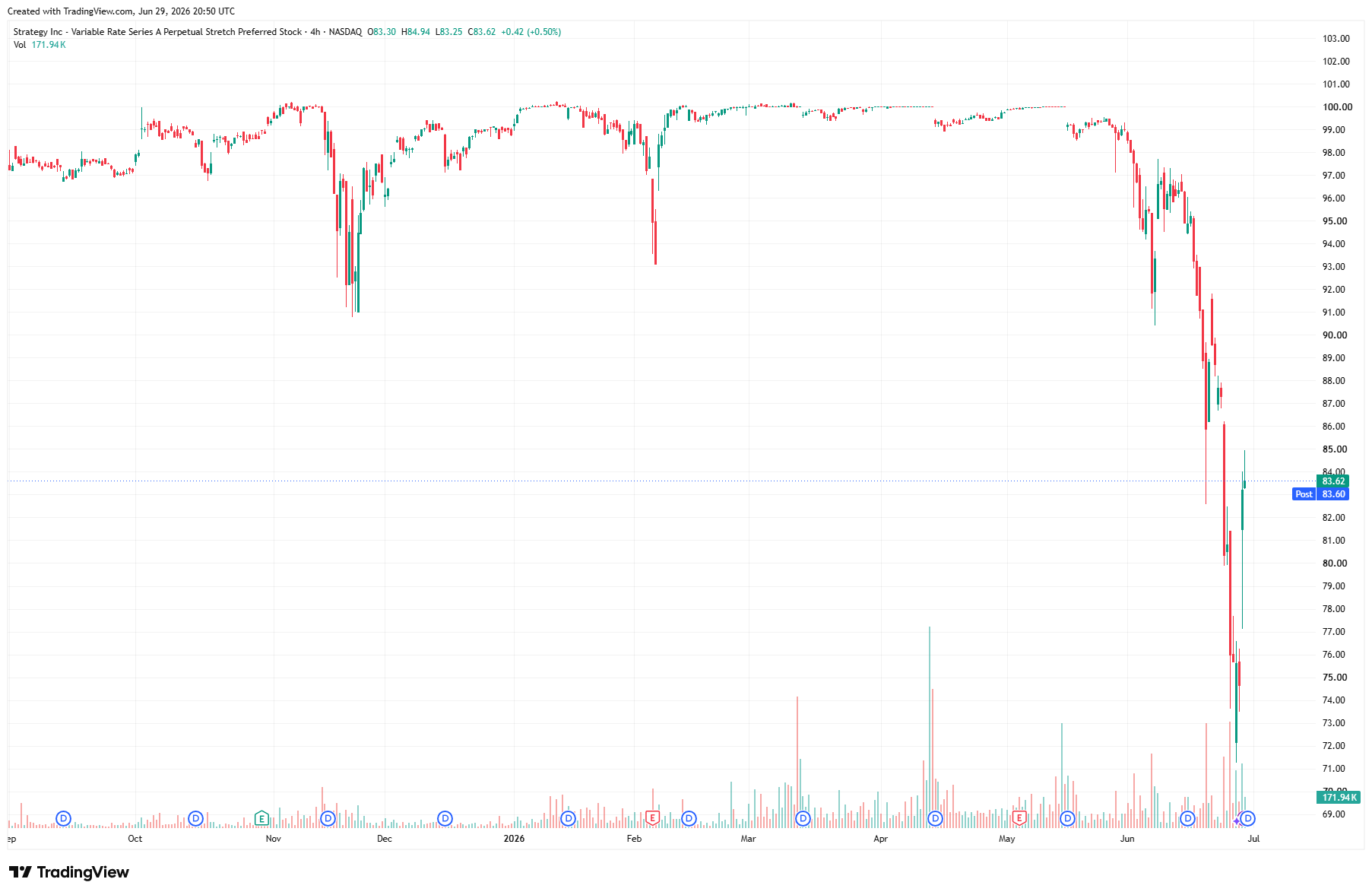
Moreover, the board will reprice the STRC dividend rate monthly going forward. The relevant inputs are trading prices, market yields and credit spreads. They also include the Bitcoin price and its volatility, as well as reserve coverage. Comparatively high yields are meant to attract new buyers and narrow the discount to par. Thus, the dividend becomes an active steering instrument intended to guide the price back toward par. At the same time, the framework allows the board to lower the expected preferred dividends. This applies as soon as that proves advantageous. In Strategy's logic, STRC serves as an amplifier for MSTR investors. Conversely, MSTR acts as an asset buffer for STRC holders.




Board approves Bitcoin sales to replenish the reserve
The most sensitive component is the Bitcoin monetization program. In it, the board authorizes sales for three clearly defined purposes. These include building up the USD reserve to a maximum of 1.25 billion USD. In addition, they cover dividends and interest payments as well as the funding of buybacks. The program, however, has no fixed expiration date and can be adjusted, suspended or terminated at any time. The company thereby explicitly does not enter into any obligation to sell Bitcoin.
Strategy currently holds 847,363 BTC at total investment costs of 64.10 billion USD. That corresponds to an average entry price of 75,651 USD per coin. At a market price of around 59,910 USD, this results in an unrealized book loss of roughly 13 billion USD. The book loss illustrates the pressure under which the previous buying strategy has recently come. In the week through the end of June 2026, the company additionally made no new Bitcoin purchases. This underscores the shift in capital allocation.
Furthermore, the board approved two buyback programs of 1.0 billion USD each. The first targets the Digital Credit Securities STRC, STRF, STRD and STRK, the second targets MSTR Class A common shares. These buybacks are intended to occur preferably below par value or below the modified net asset value. Below net asset value in particular, such buybacks count as value-accretive for the remaining shareholders.
Strategy's Digital Credit Framework demands active capital management
The framework marks a shift in the company's funding logic. Until now, Strategy fed its dividend and interest payments primarily from at-the-market proceeds, that is, from issuing new MSTR shares. Going forward, however, the focus shifts toward cash reserves, selective Bitcoin sales and buybacks. The framework thus formalizes the transition from opportunistic capital market issuance to a plannable, rule-based deployment of capital. Nevertheless, Bitcoin remains the primary reserve asset, according to the company. Back in May 2026, the firm had sold 32 BTC for the first time in years. This was seen as the first sign of a departure from Michael Saylor's "Never Sell" philosophy.
"Strategy remains committed to Bitcoin as its primary treasury reserve asset. At the same time, Digital Credit requires liquidity, discipline and active capital management." - Michael Saylor, Founder & Executive Chairman, Strategy
The market reaction suggests that investors read the framework as a signal of strengthened credit quality. MSTR shares subsequently rose roughly 6 percent, while STRC gained as much as 9 percent. For holders of the preferred classes, the additional liquidity improves the security of their dividends. Ultimately, the framework shifts the burden away from pure share dilution toward a mixed capital model.