
Bitcoin slid to a low of around USD 75,000 within two trading days. A failed Clarity Act vote in the US Senate and the Fed's first rate hike in over three years triggered the fall.
The Clarity Act is meant to separate the responsibilities of the securities regulator SEC and the futures regulator CFTC. It would also give the industry a binding legal framework. A central bank rate hike makes credit more expensive and lifts the yield on dollar balances. That makes yield-free assets such as Bitcoin relatively less attractive. On September 15, however, the Senate missed the required 60 votes by 49 to 50. Senator Thom Tillis filed for reconsideration, yet the bill counts as dead for 2026. One day later, the FOMC raised the federal funds rate unanimously by 25 basis points to 3.75 to 4.0%. Before the vote, Bitcoin traded at around USD 77,200. The price first fell to USD 74,910 to 75,038. After the Fed decision, a low of USD 74,985 followed the next day. Coinbase and Circle dropped by double digits on the day of the vote.
The sell-off hits Bitcoin and crypto stocks alike
Coinbase operates the largest crypto exchange in the US, and Circle issues the stablecoin USDC. Both business models therefore depend directly on how Washington classifies digital assets. Coinbase closed the day of the vote at USD 172.11, down 10.10% or USD 19.34 per share. During the session, the stock fell as far as USD 168.07. Circle likewise lost 11.41% and closed at USD 86.30, after a low of USD 84.80. Across two trading days, the losses added up to around 16% at Coinbase. At Circle, they reached around 20%, according to Bloomberg.
The sell-off did not stay limited to those two stocks. Robinhood Markets meanwhile lost 3.39% to USD 110.45, Galaxy Digital around 8%. MicroStrategy, which holds Bitcoin as a corporate reserve, gave up around 5.36% to USD 129.60. Miners came under pressure as well: Riot, MARA, CleanSpark and Core Scientific shed between 3 and 6%. Ark Invest had sold Coinbase and Circle shares worth around USD 20.8 million shortly before.
The Democrats had tied their approval to an enforceable ban. It bars the president and senior government officials from profiting personally from crypto regulation. Ultimately, no agreement materialized. After years of lobbying, the Clarity Act was the industry's central hope for regulatory tailwind. So its failure removed an expected support from the market. The prediction market Polymarket, where users bet on the outcome of political events, had priced the result in early. At the start of the week, the probability of a signing in 2026 stood at 29.5 to 34%. It later fell to 6 to 7%. Part of the disappointment thus sat in the price before the Senate even voted.
Bitcoin's weak record around Fed rate hikes
Overall, the rate decision was unanimous at twelve votes to zero. Banks in the US use the federal funds rate to lend each other money overnight. The new target range now stands at 3.75 to 4.0%. Before this step, the central bank had not raised rates for more than three years. One basis point equals one hundredth of a percentage point. In its statement on the rate decision, the Fed pointed to inflation that remains elevated. The move should support a more timely return to the 2% mark. According to the central bank, the economy is expanding solidly while the labor market stays stable. Uncertainty nevertheless remains elevated, the statement says, among other things because of geopolitical developments. By contrast, the Fed describes domestic demand as robust.
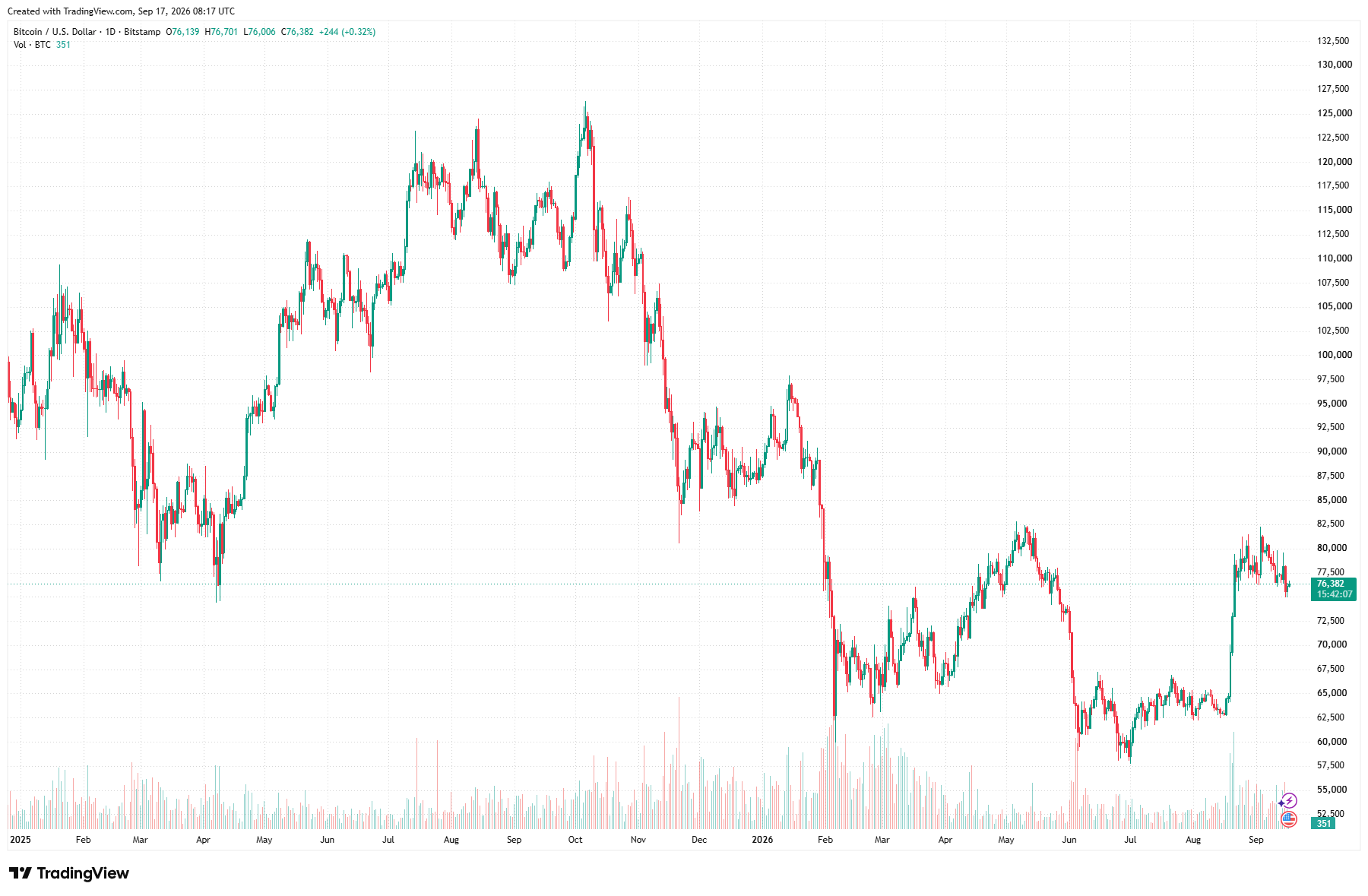
Bitcoin lost as much as 1.2% after the decision, down to USD 74,985. For Bitcoin, the rate path is no sideshow. Of the last ten Fed rate hikes, the cryptocurrency traded higher one month later in only two cases. Bloomberg compiled the figures. The sample is small, but the pattern is one-sided. Further out, the FOMC's dot plot maps the rate expectations of the individual members. Overall, 16 of 18 members expect at least one more hike this year, four of them two steps. Higher short-term rates raise the opportunity cost of an asset that pays no running yield. Consequently, further steps would shift the choice between interest-bearing dollar assets and Bitcoin once again.




The real weakness runs deeper than the trigger
The double blow hit a market whose demand had already faded beforehand. Glassnode names several demand channels that are failing at the same time. US spot Bitcoin ETFs recorded net outflows of around USD 334 million in the week from September 8 to 14. At the start of the month, the same products had still taken in almost USD 1 billion. These products bundle Bitcoin into an exchange-traded wrapper and serve regulated investors as a route of access. As a result, the reversal hits the very channel through which institutional capital flows into the market. Meanwhile, the on-chain side turned as well, ending a run of 27 consecutive days of growing inflows.
Glassnode's latest weekly analysis puts the market capitalization of all stablecoins at around USD 301 billion. Stablecoins serve as the primary means of payment on crypto exchanges. Their supply thus counts as a measure of available buying capital. Still, the figure did not move over the week. It also sits around 4% below the high from April 2026. No new high has arrived for five months. If that supply does not grow, exchanges lack purchasing power. Fresh capital barely reaches the market.
Balances on the trading venues still show net outflows on a 30-day basis. So coins keep leaving the exchanges, while the capital that bought them until now is on pause. Bitcoin also trades below the True Market Mean of USD 76,700, the average entry price of active investors. Below that line, the typical market participant sits at a loss. Ultimately, that dampens the willingness to buy more. Retail interest had already cooled before the vote.
Equity markets handle the rate hike better than crypto assets
On the day of the Fed decision, the S&P 500 gained 0.4% and the Nasdaq 0.8%. Equity markets apparently read the tightening as confirmation of a solid economy. At the same time, crypto stocks extended their losses. The crypto market lost on two fronts at once. Regulation delivered the blocked bill, while monetary policy added the rate step. The weakness consequently does not belong to a broad risk-off move across markets. Monetary policy alone does not explain the slide in Bitcoin.
By the following day, Bitcoin had stabilized at USD 76,417, a gain of 0.87% within 24 hours. The price remains just below the True Market Mean. The market has absorbed the immediate shock, but not the demand weakness underneath. Moreover, the House of Representatives is unlikely to act again before the midterm elections in November. The industry therefore lacks a legal framework this year, while the FOMC signals further steps.