The crypto derivatives exchange BitMEX has announced its permanent shutdown. Trading operations will cease on 23 September 2026 at 04:00 UTC. The date falls eleven years after its founding by Arthur Hayes, Ben Delo and Samuel Reed. The platform already halted new registrations on 23 July 2026 with immediate effect.
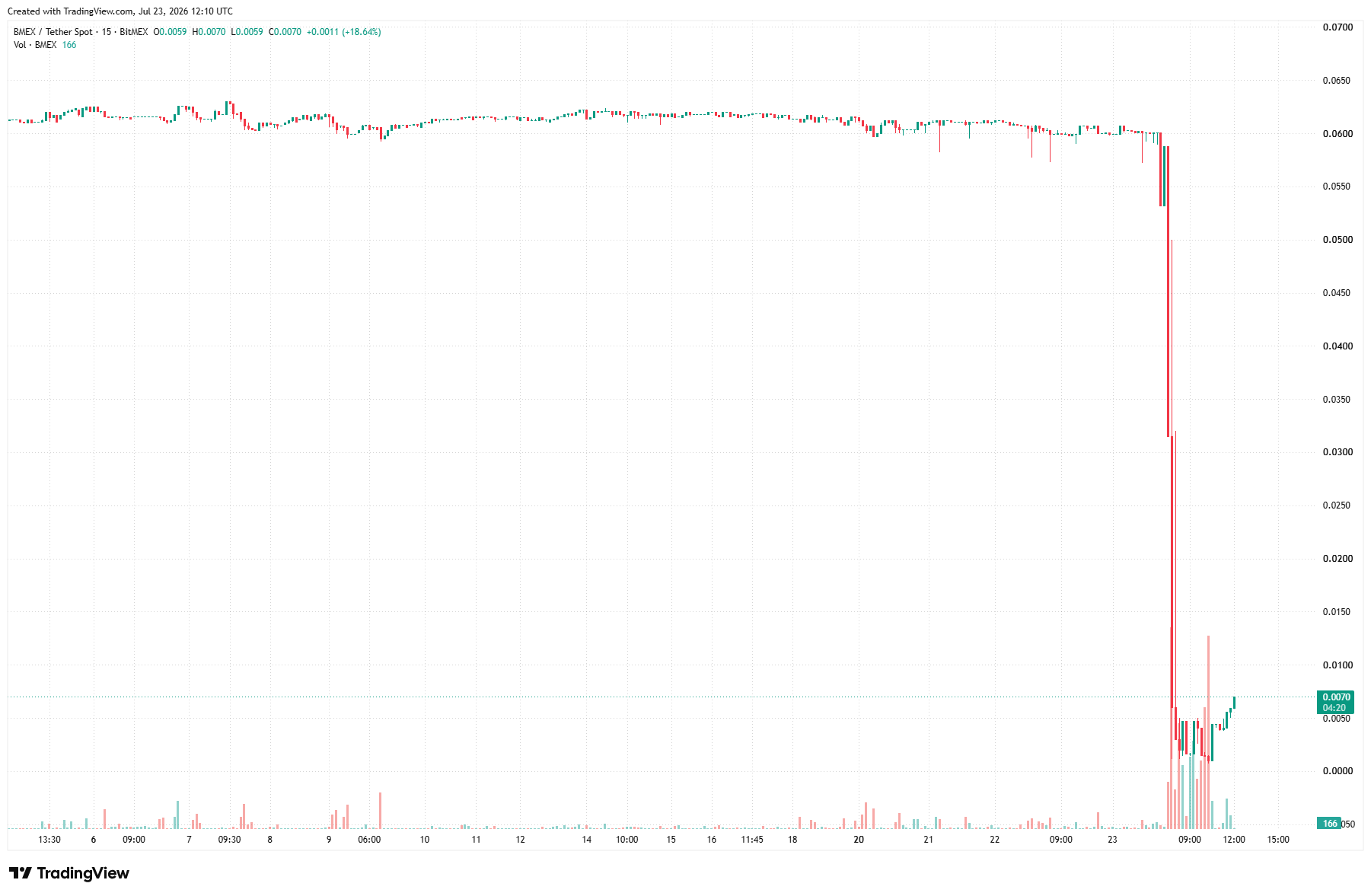
BitMEX is a crypto derivatives exchange that made professional trading in leveraged futures contracts accessible to retail traders. Its core product is the perpetual swap with up to 100x leverage, which became an industry standard. The format today runs on thousands of trading venues. HDR Global Trading Limited has operated the exchange since its founding in 2014. Its board of directors reached the closure decision after a strategic review of the business and the wider industry. From 26 August 2026, risk limits take effect. The final wind-down follows on 23 September, with forced liquidation of open positions. The exchange's own token, BMEX, collapsed by more than 97 percent after the announcement.
The timeline for BitMEX users until the shutdown
For existing users, a clearly staged countdown begins. First, the platform halted all new registrations on 23 July 2026 with immediate effect. From 26 August 2026 at 04:00 UTC, the exchange will then block new positions entirely. From that point onward, therefore, the exchange permits only reducing trades, allowing users to wind down existing exposure. The exchange liquidates remaining open positions beforehand in an orderly, forced manner. Anyone still holding open positions at the final shutdown loses them through immediate forced closure.
The company disclaims responsibility for trading losses arising from missed deadlines. Users should therefore settle their holdings in good time. Withdrawals, however, continue to function even after the closure date, and login access to account balances remains in place. At the same time, the exchange has removed all staked BMEX tokens from staking and returned them to user accounts.
The waiting period is not free, however. KYC-verified users who withdraw nothing before the shutdown will in future pay a monthly account fee. This amounts to USD 50 equivalent or 1 percent per year on the remaining balance, whichever is higher. Moreover, the fee may rise further with advance notice. On withdrawals themselves, the platform warns of possible delays. The reason lies in Bitcoin block confirmation times. These can take up to an hour and limit throughput from a fixed address pool. The exchange does not offer an accelerated or prioritised withdrawal service.
A sale process without a buyer preceded the closure
The closure did not come out of nowhere. BitMEX had been looking for a buyer since February 2025. The company mandated the investment bank Broadhaven Capital Partners to run a sale process. Nevertheless, no one publicly confirmed a buyer or a completed sale. The closure thus apparently takes place instead of a sale. Over more than a year, the owner failed to achieve that sale.
The board of directors of HDR Global Trading made the formal decision after a strategic review. However, the company did not disclose its concrete findings, nor whether the sale process produced any bidder at all. A far-reaching leadership change preceded the step. At the end of June 2026, CEO Stephan Lutz, CFO Ina Steiner and Chief Growth Officer Raphael Polansky stepped down. Peter Wilkinson, previously the exchange's COO and Global General Counsel, became the new CEO.
Financially, by contrast, the departing platform is on solid footing according to its own statements. Based on its proof-of-reserves-and-liabilities page, its assets exceed its liabilities. Furthermore, across its entire operating history BitMEX recorded no customer funds lost to hacks, a rare record in the industry. The closure therefore takes place from a position of operational stability, not because of insolvency or a security incident.



Regulatory pressure shaped the final years of operation
A decade in which regulatory conflicts shaped operations preceded the closure. In 2020, US authorities filed charges against the exchange over inadequate money laundering prevention. The three co-founders therefore withdrew from their operational roles. Four years later, the operating company HDR Global Trading pleaded guilty to violating the Bank Secrecy Act. The reason was an inadequate anti-money-laundering program.
The legal reckoning dragged on for years. In January 2025, the authorities finally imposed an additional fine of USD 100 million on the company. Only weeks later, in March 2025, US President Donald Trump pardoned the three co-founders. The pardon covered Arthur Hayes, Ben Delo and Samuel Reed. As a result, observers considered the exchange's criminal past largely cleared.
Precisely this sequence makes the closure notable. The company had paid the fine, and the courts had legally rehabilitated the founders. Yet the platform is disappearing from the market a good year later. The retreat therefore does not look like an immediate consequence of regulatory pressure. Instead, it appears more like a business decision in an increasingly contested derivatives market.
The perpetual swap outlasts the exchange that invented it
What BitMEX leaves behind is ultimately a product that will outlast the exchange's operations. The platform developed the perpetual swap, a futures contract without an expiry date. This product today counts as the most traded in the crypto industry. Practically every major derivatives exchange has adopted the format, which runs on thousands of trading venues. In its official announcement, the exchange itself pointed to this legacy.
At its peak in the late 2010s, BitMEX originally ranked among the dominant venues in the crypto derivatives market. Market data from that period at times placed its annual trading volume above USD 1 trillion. Its market share stood at around 57 percent. The platform never reached this scale again, as new competitors and regulatory pressure reshaped the field.
The market, by contrast, met the closure announcement with a total collapse of the exchange's own token. BMEX plunged by more than 90 percent within 24 hours and subsequently traded at around USD 0.007. Its fully diluted market capitalisation thus shrank to roughly USD 3 million.
This ends the operational history of an exchange that decisively shaped crypto derivatives trading. The perpetual swap, however, remains, long since detached from its inventor. It endures as the structural foundation of a market that BitMEX once led.