
Close Menu
Crypto Valley Journal
    Facebook X (Twitter) Instagram
    Crypto Valley Journal
    • Hot Topics
      • News
      • Minds
    • Focus
      • Background
      • Blockchain
      • Legal & Compliance
      • Non-Fungible Token (NFTs)
    • Investing
      • Markets
      • Financial Products
      • Decentralized Finance (DeFi)
      • Exchange overview
    • Education
      • Basics
      • Glossary
      • Politicians on crypto
    • Statistics
      • Bitcoin-ETF-Flows
      • Ethereum-ETF-Flows
      • Crypto market data
      • On-chain data
    • Academy
      • Overview
      • Part 1: Blockchain
      • Part 2: Money
      • Part 3: Bitcoin
      • Part 4: Cryptocurrencies
      • Part 5: Decentralized Finance
      • Part 6: Investing
    • English
      • Deutsch
    Crypto Valley Journal
    You are at:Home » Hot Topics » News » Major European banks jointly launch euro stablecoin

    Major European banks jointly launch euro stablecoin

    By Redaktion cvj.ch on 29. September 2025 News

    Nine leading European banks have announced the creation of a new company headquartered in Amsterdam to issue a regulated euro stablecoin. This move marks a major disruption in the payments sector and highlights how traditional financial institutions are increasingly adopting digital assets.

    Until now, US dollar stablecoins and American providers have clearly dominated the market – but European major banks are now bringing momentum to the euro area. The launch is planned for the second half of 2026. Participants include ING, UniCredit, DekaBank, KBC, CaixaBank, SEB, Raiffeisen, Banca Sella and Danske Bank.

    Subscribe to our newsletter

    The best articles of the week, directly delivered into your mailbox.

    A european response to Dollar stablecoins

    The stablecoin market is almost entirely dominated by US dollar tokens such as USDT or USDC. Euro stablecoins have so far played only a minor role – their circulation currently stands at only around USD 400 million according to Cryptoslate data, less than one percent of the total market. The consortium therefore aims to create a regulated and trustworthy alternative to reduce reliance on the dollar and strengthen Europe’s position in digital payments.
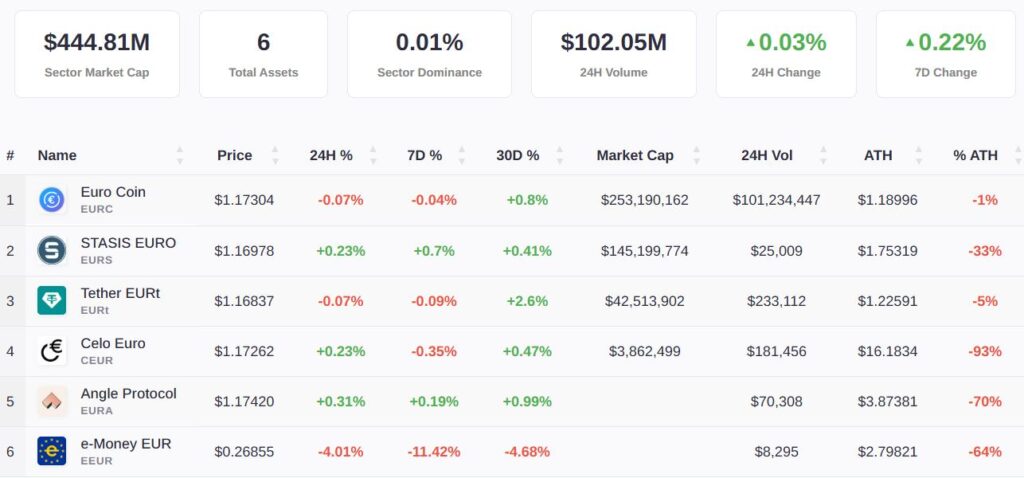
    Market capitalization EUR stablecoins / Source: Cryptoslate.com

    The company is to be licensed as an e-money institution under the supervision of the Dutch central bank and operate in line with the new MiCA regulation. The banks are also responding to concerns from the ECB, which has repeatedly classified stablecoins as a potential risk to monetary policy and financial stability.

    Between opportunity and risk

    A bank-backed euro stablecoin could make cross-border payments faster and cheaper while offering institutional players a regulated gateway to DeFi and Web3. However, its success will depend on whether it gains acceptance beyond the institutional circle. Only if it is integrated into DeFi protocols, e-commerce and payment providers can it establish itself as a standard in the euro area. Otherwise, it risks remaining marginal compared to dollar stablecoins.


    Ray Dalio’s Bridgewater Associates Minds

    Star investor Ray Dalio considers Bitcoin inferior to gold

    Most crypto cards hide who issues them. After mapping the licensed issuers, here is why Switzerland's self-issuing model reads differently. Background

    The bank you never chose: who really issues Switzerland’s crypto cards

    Robinhood Perpetual Futures in Europe now cover commodities and currencies, and the broker plans a crypto launch in the United Kingdom. Financial Products

    Robinhood Perpetual Futures expand to commodities in Europe

    Digital finance transparency relies on Proof of Reserves, Merkle trees, MPC custody and 24/7 monitoring to verify solvency and user assets. Basics

    Transparency as the foundation of security in digital finance

    Ray Dalio’s Bridgewater Associates Minds

    Star investor Ray Dalio considers Bitcoin inferior to gold

    Most crypto cards hide who issues them. After mapping the licensed issuers, here is why Switzerland's self-issuing model reads differently. Background

    The bank you never chose: who really issues Switzerland’s crypto cards

    Strategic positioning

    The initiative underscores the pressure on the ECB to move faster on the digital euro. If the banks succeed in building trust and ensuring interoperability, the euro stablecoin could become a strategic cornerstone of a digital financial infrastructure “made in Europe” – and bridge the gap between traditional finance and Web3.

    A key success factor will be the interoperability of the euro stablecoin. If it can be used not only in the banking environment but also in DeFi protocols, with payment providers and in e-commerce, it could quickly establish itself as a standard in the European market. At the same time, the initiative could increase pressure on central banks to accelerate the digital euro in order not to be overtaken by private sector solutions.

    The introduction of a euro stablecoin backed by major banks marks an important step toward a digital financial infrastructure “made in Europe.” If trust can be built and widespread adoption achieved, the project could not only strengthen Europe’s position in global crypto and payments, but also act as a bridge between traditional finance and the Web3 ecosystem.


    Share. Facebook Twitter LinkedIn Email Telegram WhatsApp

    About the author

    Redaktion cvj.ch
    • Website
    • Twitter
    • LinkedIn

    Die Redaktion des Crypto Valley Journal berichtet seit 2018 aus Zug, dem Sitz des Schweizer Crypto Valley, über Bitcoin, Krypto, Blockchain und die regulatorische Entwicklung digitaler Vermögenswerte. Hinter der kollektiven Redaktionsstimme steht ein Team aus Autoren mit Hintergrund in Finanzmarkt, Recht und Technologie.

    Related Articles

    CVJ Weekly review

    Weekly review: 80mn bank customers in Germany gain access to crypto

    The US banking regulator OCC grants Circle National Trust final approval to operate as a federal trust bank for digital assets.

    OCC grants Circle National Trust a bank license

    JPMorgan ranks Strategy's sales below the bigger Bitcoin risk and names tokenization beyond public chains as the real threat.

    JPMorgan sees biggest Bitcoin risk beyond Strategy

    CVJ Weekly review
    11. July 2026

    Weekly review: 80mn bank customers in Germany gain access to crypto

    The US banking regulator OCC grants Circle National Trust final approval to operate as a federal trust bank for digital assets.
    10. July 2026

    OCC grants Circle National Trust a bank license

    JPMorgan ranks Strategy's sales below the bigger Bitcoin risk and names tokenization beyond public chains as the real threat.
    10. July 2026

    JPMorgan sees biggest Bitcoin risk beyond Strategy

    twitter image button instagram image button linkedin image button youtube image button

    About Crypto Valley Journal
    About Crypto Valley Journal

    On the pulse of the movement

    • Academy
    • Contact
    • Advertising
    • About us
    • Partner
    • Imprint
    • Privacy
    • Disclaimer
    Search

    Type above and press Enter to search. Press Esc to cancel.