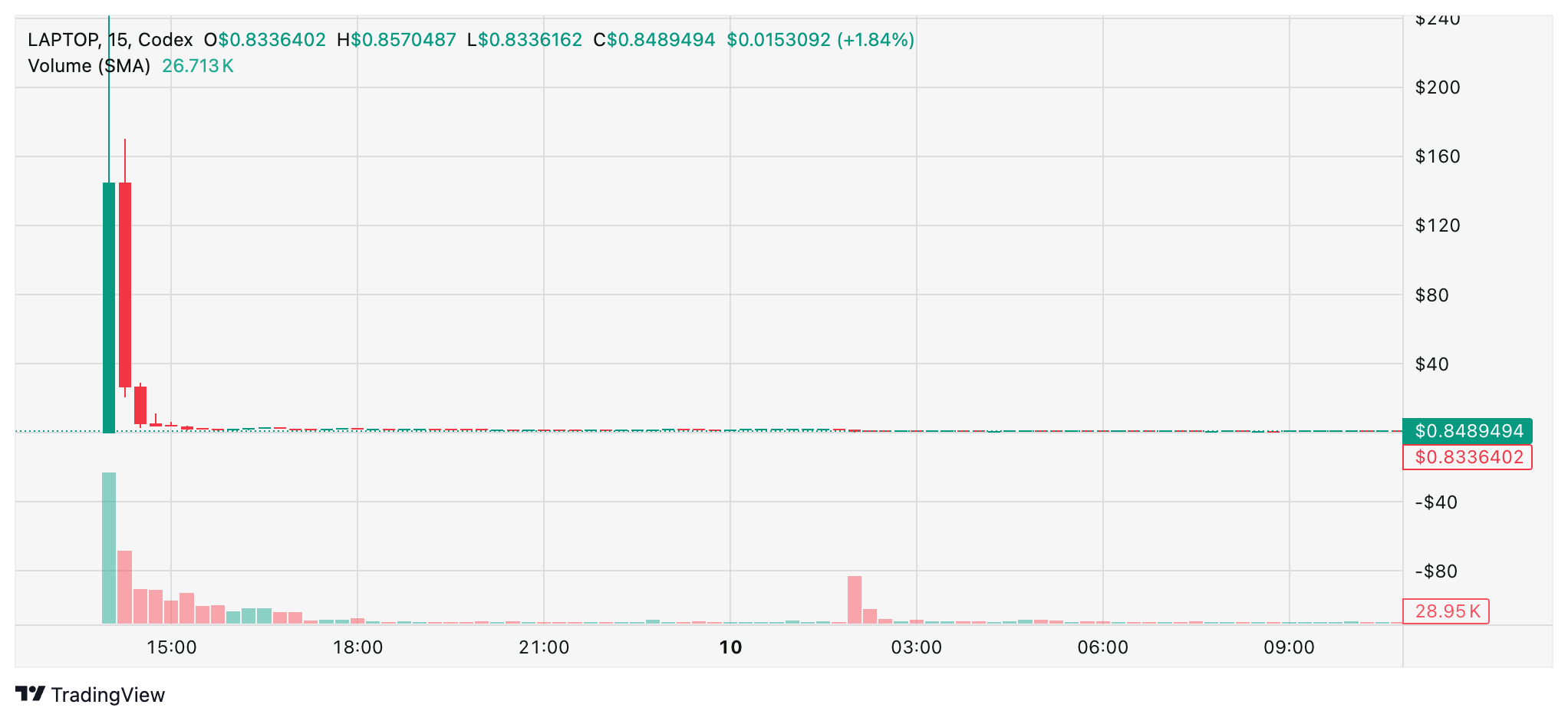
Hunter Biden's memecoin LAPTOP lost more than 95 percent of its value within one hour of trading opening on Base. A wallet analysis by Bubblemaps shows that 12,151 of 15,206 buyers lost money.
A memecoin is a token without its own utility. Its price rests entirely on attention and early speculation. Donald Trump's TRUMP coin had already carried that pattern into the political arena. LAPTOP runs on Base, the Layer-2 network operated by Coinbase. The Wall Street Journal reported on the plans first, and Biden then confirmed the ticker in a post on X. Shortly before launch he also positioned his project against the TRUMP coin, which he called a "grift". Trading began on 09.09.2026 shortly after 08:00 ET. The peak came two minutes later. Meanwhile the fully diluted valuation briefly reached roughly USD 144 billion.
How losses from the Hunter Biden memecoin spread across 15,206 wallets
Bubblemaps reviewed every address that bought the token after launch. In total, 12,151 of the 15,206 wallets ended up under water, or roughly 80 percent. Another 3,026 addresses turned a profit, while 29 sat at break-even or resisted assessment. For the large majority, however, the losses stayed small. In fact, 11,311 wallets lost less than USD 1,000 each.
Larger amounts were far rarer. Some 726 addresses lost between USD 1,000 and USD 10,000, and 112 lost between USD 10,000 and USD 100,000. Two wallets lost between USD 100,000 and USD 1 million. On the other side stand 88 addresses with combined gains of roughly USD 5.57 million. Ten of them took home between USD 100,000 and USD 1 million each. A further 78 landed between USD 10,000 and USD 100,000 each. Fewer than 0.6 percent of buyers therefore split that USD 5.57 million among themselves.
Across all 15,206 wallets, the aggregate balance comes to roughly plus USD 178,000. So a clear majority of losers still leaves a slight net gain. That figure describes no market profit, however. It describes redistribution. The many small losses of late buyers financed the few very large gains of the first minutes.
Freshly funded wallets bought before the launch
The origin of the largest holders stands out. Around 60 percent of them used addresses that received money only in the ten days before the launch. In addition, most of those wallets got their capital on the day trading opened. Nevertheless, that does not force the conclusion of coordinated insider dealing. Only the clustering immediately before the start carries weight.
At the same time, market depth was extremely thin at launch. The official pool on Aerodrome held roughly 83,000 USDC, and a second pool on Uniswap around USD 380,000. Yet only about USD 48,000 of that was effectively available when trading opened. Both pools therefore carried far more nominal value than the market could actually absorb. In such a narrow market, even small orders move the price noticeably. The fully diluted valuation, in turn, is simply the last traded price multiplied by total supply. It says nothing about how much capital actually flowed into the token.
On-chain reviews of the first minutes of trading illustrate the spread. For example, one address put in 900 USDC and bought 2,268.56 LAPTOP at roughly USD 0.40. It later sold the position for 251,270 USDC at an average of about USD 111. Overall, that amounts to a return of roughly 278 times. A second wallet invested 100 ETH, worth around USD 249,800 at the time. It then unwound 8,480 of its 9,124 tokens for 472 ETH, or roughly USD 1.18 million. By contrast, anyone who entered later saw the mirror image. A third address withdrew USD 250,000 from Binance. For USD 200,000 it bought 919 tokens at an average of about USD 218. Shortly afterwards that position was worth around USD 3,000, an unrealized loss of roughly USD 197,000.



Only 2 percent of supply goes to TRUMP losers
Total supply stands at 1 billion tokens. First, 30 percent goes to the founders including Biden, locked for six months and released over two years after that. Furthermore, the project ties 30 percent to 30 predefined political and cultural events. If they occur, the project burns the tokens in question and removes them from circulation permanently. Otherwise they go to charities. Five percent flows directly into donations, and 20 percent finally goes to two community airdrops.
That community share carries the political narrative of the project. The project wants it to compensate wallets that lost money on the TRUMP coin. Coverage focused mostly on the headline share of 20 percent. According to the project, however, only 2 percent of total supply is reserved for TRUMP losers. In other words, that is one tenth of the community block. The lock-up on the founder allocation does prevent Biden from selling immediately. Still, it protected no ordinary buyer from losses in the first minutes of trading.
Biden explained the project name with the political history of the device.
"They turned the laptop into a weapon. I turned it into a token." - Hunter Biden
TRUMP investors sit on USD 3.81 billion in losses
The comparison case supplies the order of magnitude. According to a Nansen review from summer 2026, roughly 988,905 wallets sat on cumulative losses in the TRUMP coin. Those losses added up to USD 3.81 billion. Its price stood around 97 percent below its high at that point. There, however, the decline stretched out comparatively long: over months instead of over one hour.
Biden had publicly criticized the TRUMP coin as a "grift" before his own launch. At the same time, he admitted that he understood the cynicism toward memecoins. His own token nevertheless produced the same distribution. A small group of early addresses collected very large gains, while a broad mass carried small losses. Neither the lock-up nor the announced airdrop changed that.
The outcome is thus neither party-bound nor person-bound. Instead, it follows from the mechanics of thin launch liquidity, where the first seconds decide the distribution. Political memecoins ultimately supply only the attention that brings enough late buyers to the market.