Close Menu
Crypto Valley Journal
    Facebook X (Twitter) Instagram
    Crypto Valley Journal
    • Hot Topics
      • News
      • Minds
    • Focus
      • Background
      • Blockchain
      • Legal & Compliance
      • Non-Fungible Token (NFTs)
    • Investing
      • Markets
      • Financial Products
      • Decentralized Finance (DeFi)
      • Exchange overview
    • Education
      • Basics
      • Glossary
      • Politicians on crypto
    • Statistics
      • Bitcoin-ETF-Flows
      • Ethereum-ETF-Flows
      • Crypto market data
      • On-chain data
    • Academy
      • Overview
      • Part 1: Blockchain
      • Part 2: Money
      • Part 3: Bitcoin
      • Part 4: Cryptocurrencies
      • Part 5: Decentralized Finance
      • Part 6: Investing
    • English
      • Deutsch
    Crypto Valley Journal
    You are at:Home » Hot Topics » News » Moody’s rating agency creates stablecoin rating system
    Ratingagentur Moody's erstellt Stablecoin-Bewertungssystem

    Moody’s rating agency creates stablecoin rating system

    By Editorial Office CVJ.CH on 30. January 2023 News

    Moody's Corp, one of the three largest rating agencies in the United States, is working on its own rating system for stablecoins. The process will rate up to 20 stablecoins based on the quality of their reserve certificates.

    Given the growing popularity of stablecoins in the crypto sector, the 100-year-old rating agency Moody's has taken the initiative to develop a rating system for these digital tokens. Their rating is primarily related to centrally backed stablecoins and their reserve evidences. The project is still in its early stages and will not be an official credit rating, Bloomberg reports.

    A tricky asset class

    Stablecoins are digital tokens that replicate the value of a less volatile asset - usually the U.S. dollar - one-to-one. To do so, issuers typically hold an equivalent amount of the underlying asset in reserve. These reserves can be claimed by investors for their digital tokens. Thus, for a stablecoin to maintain a bond, the liquidity of the deposited assets is of the highest priority.

    The reserve certificates of the largest stablecoins have become more prominent in recent years. In particular, the market leader Tether (USDT) has been surrounded by various controversies since its inception. The stablecoin issuer was fined $41 million by US authorities in 2021 for lying about its reserves a few years earlier. Since then, leading issuers have been publishing regular audits of their corporate holdings, with Tether being the exception that refuses to do so.


    Ray Dalio’s Bridgewater Associates Minds

    Star investor Ray Dalio considers Bitcoin inferior to gold

    The Ethereum Glamsterdam upgrade is the biggest hard fork since the Merge: ePBS and parallel processing boost network throughput. Background

    Ethereum Glamsterdam upgrade: The biggest hard fork of the year explained

    BlackRock files its fourth S-1 amendment for the Bitcoin Premium Income ETF (BITA). A Bloomberg analyst expects a launch ahead of Goldman Sachs. Financial Products

    Launch of BlackRock’s income-generating Bitcoin ETF moves closer

    Digital finance transparency relies on Proof of Reserves, Merkle trees, MPC custody and 24/7 monitoring to verify solvency and user assets. Basics

    Transparency as the foundation of security in digital finance

    Ray Dalio’s Bridgewater Associates Minds

    Star investor Ray Dalio considers Bitcoin inferior to gold

    The Ethereum Glamsterdam upgrade is the biggest hard fork since the Merge: ePBS and parallel processing boost network throughput. Background

    Ethereum Glamsterdam upgrade: The biggest hard fork of the year explained

    Moody's analyzes stablecoin reserves

    These reserve statements are most often published monthly or quarterly and certified by external auditing firms. The assets deposited typically consist of short-dated U.S. government bonds to allow for the quickest possible redemptions. USD Coin (USDC), issued by SEC-supervised U.S. companies Coinbase and Circle, is considered a pioneer in terms of regulation and transparency.
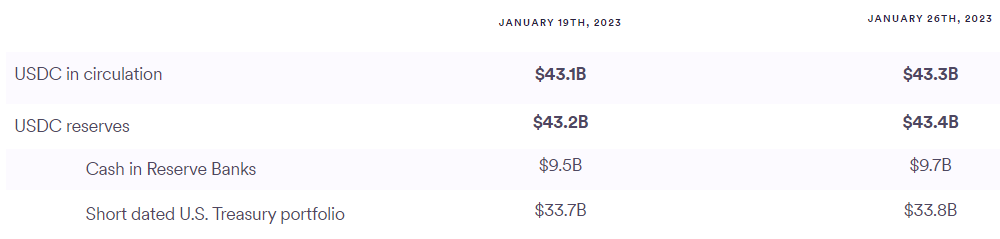
    Deposited assets of USDC stablecoin / Source: Circle

    Moody's analysis on the 20 selected stablecoins examines this reserve evidence for credibility. As an expert in bond rating, the CRA system is likely to be considered by traditional financial institutions in the future - even if the rating is not intended to be an official credit rating. These efforts should be instrumental in ensuring transparency and trust in the growing crypto sector. Finally, a comprehensive rating system can provide both regulators and investors with valuable information for navigating the complex world of digital currencies.


    Share. Facebook Twitter LinkedIn Email Telegram WhatsApp

    About the author

    Editorial Office CVJ.CH
    • Website
    • Twitter
    • LinkedIn

    Since 2018, the editorial team at Crypto Valley Journal has been reporting from Zug - the heart of Switzerland’s Crypto Valley - on Bitcoin, cryptocurrency, blockchain, and regulatory developments in digital assets. Behind the publication’s collective editorial voice is a team of writers with backgrounds in financial markets, law, and technology.

    Related Articles

    Kalshi IPO: the largest US-regulated prediction-market exchange holds early bank talks, with annualized revenue now above USD 2 billion.

    Kalshi holds early IPO talks with investment banks

    Strategy's STRC preferred stock closes 11% under par at USD 89, its lowest level since the July 2025 IPO. What lies behind the sell-off.

    STRC crash: Strategy preferred stock closes 11% below par at USD 89

    CBDC ban in the US: the Senate and House agree on a housing bill that bars the Fed from issuing a digital dollar until the end of 2030.

    US Congress agrees on CBDC ban until 2030

    Kalshi IPO: the largest US-regulated prediction-market exchange holds early bank talks, with annualized revenue now above USD 2 billion.
    19. June 2026

    Kalshi holds early IPO talks with investment banks

    The Ethereum Glamsterdam upgrade is the biggest hard fork since the Merge: ePBS and parallel processing boost network throughput.
    19. June 2026

    Ethereum Glamsterdam upgrade: The biggest hard fork of the year explained

    CME Group sues the CFTC after the regulator approved perpetual futures as futures rather than swaps under the Dodd-Frank Act.
    18. June 2026

    CME Group sues CFTC over approval of perpetual futures

    twitter image button instagram image button linkedin image button youtube image button

    About Crypto Valley Journal
    About Crypto Valley Journal

    On the pulse of the movement

    • Academy
    • Contact
    • Advertising
    • About us
    • Partner
    • Imprint
    • Privacy
    • Disclaimer
    Search

    Type above and press Enter to search. Press Esc to cancel.