
According to a representative survey by Migros Bank, younger generations are increasingly betting on crypto-currencies instead of physical gold.
Around 7 percent of the 18- to 55-year-old Swiss population have invested money in bitcoin or in other crypto-currencies. That is more than they have invested in physical gold. For the over-55s, by contrast, the preference is clearly for precious metals. This is the result of a representative survey conducted by Migros Bank in October 2019 by the market research institute Intervista on behalf of Migros Bank. The survey was conducted online among 1500 people aged 18 and over from German, French and Italian-speaking regions of Switzerland.
Crypto-currencies more popular with younger generations than physical gold
Crypto-currencies are more popular with the younger generations than physical gold in the form of bars and coins. For example, over 7 percent of 18-29 year olds have invested in bitcoin or other crypto-currencies, compared to only 5 percent in physical gold. In the 30 to 55 age group, more than 7 percent have also invested a portion of their money in crypto-currencies; the proportion with investments in physical gold is 6 percent. Among the over-55s, on the other hand, the preference is clearly for gold: 5 percent of respondents have invested in bars or coins, and less than 1 percent in crypto-currencies. Across all age groups, just under 5 percent of the Swiss population aged 18 and over is invested in crypto-currencies – and a good 5 percent in physical gold.
Those who invest in crypto-currencies are satisfied with amounts below 1000 Swiss francs in one third of cases. A fifth invest between 1000 and almost 2000 francs. A good 10 per cent invest between 2000 and just under 5000 francs and at least one in three invests at least 5000 francs.
Common reasons against lack of bitcoin use: little understanding and fear of losses
Of those who have never been involved in crypto-currencies, 15 percent can well or rather imagine investing in crypto-currencies in the future. The younger, the greater the proportion – among 18 to 29-year-olds, the figure is 27 percent. Men are also more willing to invest in crypto-currencies: across all age groups, 20 percent of men can imagine very well or more likely to invest in crypto-currencies for the first time; among women, the figure is only 12 percent.
Across all age groups, 6 percent of those surveyed say that crypto-currencies are becoming more important for them as a form of saving and investment. Among 18 to 29-year-olds, the figure is as high as 13 percent.
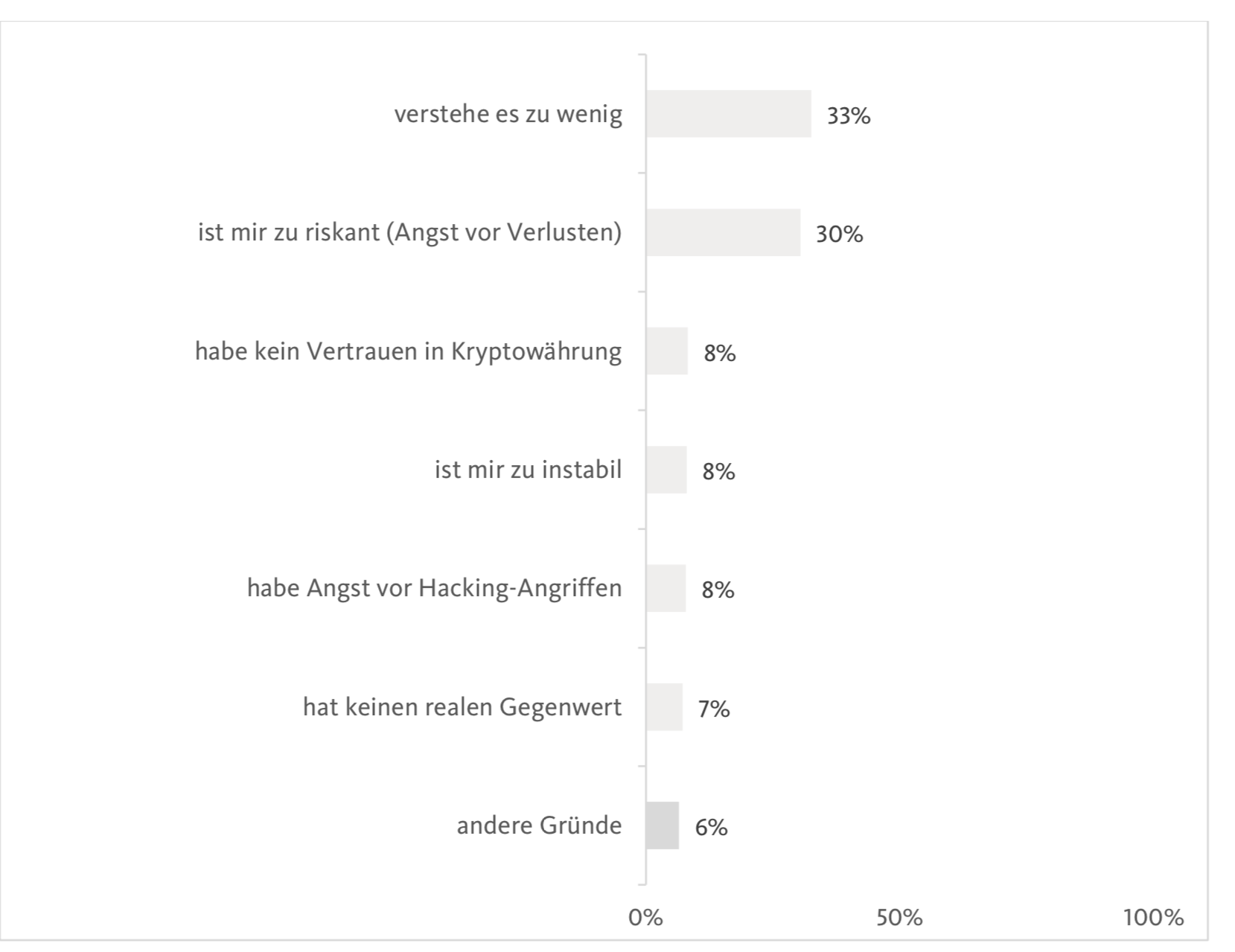
Reasons for reservations about crypto-currencies
On the other hand, what are the reasons for not investing in crypto-currencies? By far the most common reasons cited are lack of understanding and fear of losses (33 percent and 30 percent of mentions respectively, see chart). Clearly, less common are lack of trust, instability and fear of hacking (8 percent each) and the view that crypto-currencies do not represent any real value (7 percent).
Not only Swiss millennials are more open to crypto-currencies
Millennials are also much more open to digital assets in other countries. For example, a quarter of American millennials, who are between 24 and 38 years old and earn $100,000 in individual or collective income, hold and use crypto-currencies.
The so-called “millennials” are expected to become the wealthiest generation in history in the coming decades. For banks, this could be a cause for concern, as younger generations prefer a shift to unconventional banking.