Close Menu
Crypto Valley Journal
    Facebook X (Twitter) Instagram
    Crypto Valley Journal
    • Hot Topics
      • News
      • Minds
    • Focus
      • Background
      • Blockchain
      • Legal & Compliance
      • Non-Fungible Token (NFTs)
    • Investing
      • Markets
      • Financial Products
      • Decentralized Finance (DeFi)
      • Exchange overview
    • Education
      • Basics
      • Glossary
      • Politicians on crypto
    • Statistics
      • Bitcoin-ETF-Flows
      • Ethereum-ETF-Flows
      • Crypto market data
      • On-chain data
    • Academy
      • Overview
      • Part 1: Blockchain
      • Part 2: Money
      • Part 3: Bitcoin
      • Part 4: Cryptocurrencies
      • Part 5: Decentralized Finance
      • Part 6: Investing
    • English
      • Deutsch
    Crypto Valley Journal
    You are at:Home»Focus»Legal & Compliance»Cryptocurrencies in Morocco: regulating instead of banning
    Cryptocurrencies in Morocco: regulating instead of banning

    Cryptocurrencies in Morocco: regulating instead of banning

    By Editorial Office CVJ.CH on 19. January 2023 Legal & Compliance

    Despite a nationwide ban on cryptocurrencies, possession of cryptocurrencies is on the rise in Morocco. Over 3.1% of the total population of Morocco owns some form of cryptocurrency, making the country one of the front-runners in Africa in terms of crypto adoption.

    Morocco's regulator learned firsthand that bans on decentralized technology often fail. The general crypto ban may have slightly slowed down the adoption of blockchain technology, but it did not bring about the end it had hoped for. Instead, the Moroccan central bank, Bank Al-Maghrib (BAM), has chosen a regulatory approach. Through discussions with the International Monetary Fund (IMF) and other countries, the way for the legal introduction of cryptocurrencies is being paved.

    Moroccan central bank's wait-and-see strategy

    Despite the current nationwide ban on possession and trading of cryptocurrencies, possession of cryptocurrencies in Morocco is steadily on the rise. In total, crypto possession has increased from 2.4% in 2021 to 3.1% in 2022 - the highest rate in North Africa.
    A recent analysis by the Moroccan Institute for Policy Analysis (MIPA) concluded that Morocco is taking a wait-and-see approach out of fear of losing control over economic and monetary sovereignty to cope with the rising trend of cryptocurrency. The think tank argues that the decentralized nature of cryptocurrencies represents a significant threat to the Moroccan central bank and the country's banking sector as main actors in the ecosystem.

    As the adoption of cryptocurrencies grows, the analysis by MIPA states that there is increasing pressure on Moroccan financial regulators to create a legal framework for cryptocurrency transactions. The introduction of crypto-based money transactions would also mean that the Moroccan central bank would have little control over capital flight as transactions on the blockchain are not bound by geographical borders- which was the original reason behind the crypto-ban.


    Ray Dalio’s Bridgewater Associates Minds

    Star investor Ray Dalio considers Bitcoin inferior to gold

    CLARITY Act DeFi Background

    CLARITY Act: The year’s most important crypto deal heads for a decision

    JPMorgan warns: Recurring DeFi exploits and stagnant ETH-denominated TVL curb institutional engagement in the DeFi sector. DeFi

    JPMorgan: DeFi hacks and TVL losses weigh on institutional investors

    Basics

    Unit bias in crypto: Why cheap coins mislead investors

    Ray Dalio’s Bridgewater Associates Minds

    Star investor Ray Dalio considers Bitcoin inferior to gold

    CLARITY Act DeFi Background

    CLARITY Act: The year’s most important crypto deal heads for a decision

    Crypto regulation: a chance for Morocco?

    The Moroccan Institute of Political Analysis (MIPA) has concluded that the country's central bank, while cautious in its approach to cryptocurrencies, has much to gain from the technology. The institute argues that the decentralized nature of cryptocurrencies represents a significant threat to the central bank and the banking sector, but also presents opportunities for the economy.

    "For cryptocurrencies, I can assure you that the project is ready. We worked with the World Bank and the consultant to make it happen. The different chapters are completed. Now we are engaged in the discussion with the different stakeholders. It is long, but necessary to allow everyone to adhere to this project." - Abdellatif Jouahiri, Governor of the Central Bank of Morocco

    Ongoing crypto adoption in Africa.

    Morocco is not the only country in Africa whose population is actively involved with cryptocurrencies. After all, the perspective of people from developing countries differs dramatically from that of Westerners, who have easier access to financial services. According to World Bank estimates, over half of African residents do not have a bank account. A gap that can easily be closed with cryptocurrencies.
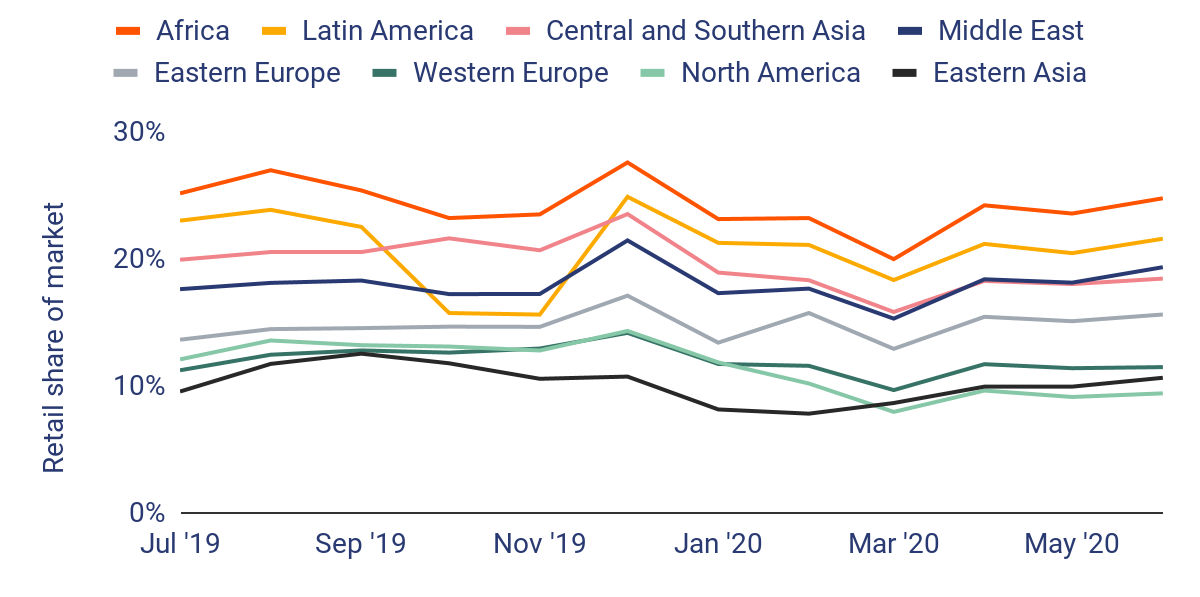
    Anteil des Einzelhandels am Krypto-Volumen nach Region / Quelle: Chainanalysis Insights
    Retail share of crypto volume by region / Source: Chainanalysis Insights

    Additionally, with many currencies in sub-Saharan Africa rapidly depreciating, citizens are increasingly turning to inflation-hedging assets like Bitcoin. This trend is driven particularly by young people in Africa who have access to smartphones but not traditional financial institutions.


    Share. Facebook Twitter LinkedIn Email Telegram WhatsApp

    About the author

    Editorial Office CVJ.CH

      The CVJ editorial staff consists of a team of Blockchain experts and informs daily and independently about the most exciting news.

      Related Articles

      FINMA tightens consumer protection in crypto, grants first DLT license to BX Digital, and plans new license categories for stablecoin issuers.

      FINMA tightens crypto supervision and warns of consumer risks

      Canada announces national crypto ATM ban. Roughly 4,000 machines are affected as Ottawa targets fraud and money laundering.

      Canada bans crypto ATMs

      New York sues Coinbase and Gemini over prediction markets. AG James demands 3.4 billion USD. COIN stock falls 6 percent.

      New York sues Coinbase and Gemini over prediction markets

      CLARITY Act DeFi
      7. May 2026

      CLARITY Act: The year’s most important crypto deal heads for a decision

      The Canton of Lucerne joins the Swiss Blockchain Federation as its seventh member canton, with 73 active blockchain companies.
      7. May 2026

      Canton of Lucerne joins Swiss Blockchain Federation

      FalconX and Sygnum open institutional access to tokenized credit via the Desygnate platform and the FalconX Credit Vault.
      6. May 2026

      FalconX and Sygnum open regulated access to tokenized credit

      twitter image button instagram image button linkedin image button youtube image button

      About Crypto Valley Journal
      About Crypto Valley Journal

      On the pulse of the movement

      • Academy
      • Contact
      • Advertising
      • About us
      • Partner
      • Imprint
      • Privacy
      • Disclaimer
      Search

      Type above and press Enter to search. Press Esc to cancel.