Close Menu
Crypto Valley Journal
    Facebook X (Twitter) Instagram
    Crypto Valley Journal
    • Hot Topics
      • News
      • Minds
    • Focus
      • Background
      • Blockchain
      • Legal & Compliance
      • Non-Fungible Token (NFTs)
    • Investing
      • Markets
      • Financial Products
      • Decentralized Finance (DeFi)
      • Exchange overview
    • Education
      • Basics
      • Glossary
      • Politicians on crypto
    • Statistics
      • Bitcoin-ETF-Flows
      • Ethereum-ETF-Flows
      • Crypto market data
      • On-chain data
    • Academy
      • Overview
      • Part 1: Blockchain
      • Part 2: Money
      • Part 3: Bitcoin
      • Part 4: Cryptocurrencies
      • Part 5: Decentralized Finance
      • Part 6: Investing
    • English
      • Deutsch
    Crypto Valley Journal
    You are at:Home » Focus » Legal & Compliance » US regulator OCC grants banks permission to use Stablecoins
    Das OCC gibt US Banken die Erlaubnis, Stablecoins zu nutzen

    US regulator OCC grants banks permission to use Stablecoins

    By Editorial Office CVJ.CH on 5. January 2021 Legal & Compliance

    The Office of the Comptroller of the Currency (OCC) has published new guidance on Blockchains and Stablecoins in the United States. Licensed US banks are now allowed to use decentralized networks and regulated stablecoins for payments.

    The regulator already showed itself to be Blockchain-friendly six months ago, when it granted U.S. banks permission to hold crypto - a landmark decision. Now the OCC has commented on so-called stablecoins, cryptocurrencies linked to the price of fiat currencies such as the U.S. dollar. It is a hot topic given the strong stablecoin growth in 2020, as well as the initiatives on central bank digital currencies (CBDCs).

    Stablecoin framework for US banks

    The letter clarifies the authority of national banks and federal savings associations to participate in "Independent Node Verification Networks (INVN) - i.e., Blockchains - as well as to use stablecoins to conduct payment activities and other functions. The OCC also emphasizes the benefits of these networks and says it has no interest in banning them.

    "The President’s Working Group on Financial Markets recently articulated a strong framework for ushering in an era of stablecoin-based financial infrastructure, identifying important risks while allowing those risks to be managed in a technology-agnostic way. Our letter removes any legal uncertainty about the authority of banks to connect to blockchains as validator nodes and thereby transact stablecoin payments on behalf of customers who are increasingly demanding the speed, efficiency, interoperability, and low cost associated with these products." - Brian P. Brooks, Aktueller Comptroller of the Currency

    Strong 2020 stablecoin growth

    Last year, the market capitalization of the entire Stablecoin market grew tremendously. Tether (USDT) remains dominant, but fully-regulated competitor USD Coin (USDC) is seemingly catching up. This could be related to the regulatory uncertainty surrounding Tether, among other factors.
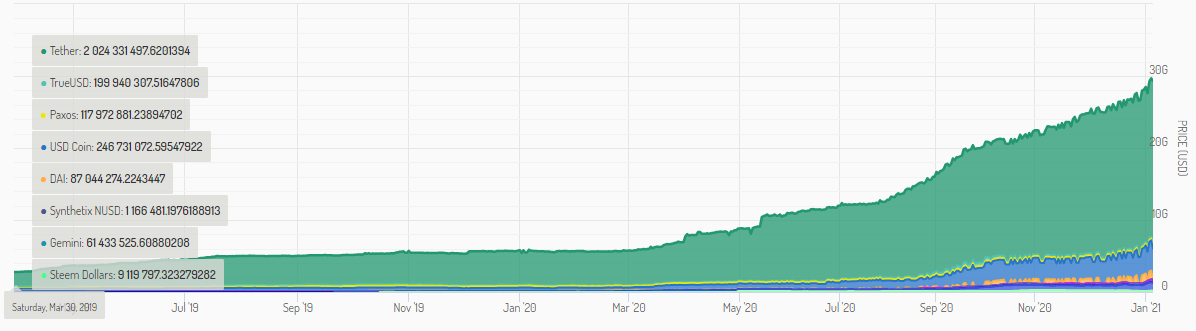
    Marktkapitalisierung des Messari Stablecoin Index
    Source: Stablecoin Index

    The OCC's decision came as a surprise to some. After all, the European Central Bank (ECB) has repeatedly spoken out against private stablecoins and in favor of digital central bank currencies (CBDCs). ECB President Christine Lagarde called privately issued Stablecoins a "threat to the financial status quo in the EU." Co-founder and CEO of Circle, the company behind the second largest Stablecoin USDC, called the OCC announcement a "huge win" for the Crypto industry.

    4/ Decentralized, permissionless, open source and internet mediated software is literally becoming a foundation. Not just for the US financial system but for the global economy.

    — Jeremy Allaire (@jerallaire) January 4, 2021

    Share. Facebook Twitter LinkedIn Email Telegram WhatsApp

    About the author

    Editorial Office CVJ.CH
    • Website
    • Twitter
    • LinkedIn

    Since 2018, the editorial team at Crypto Valley Journal has been reporting from Zug - the heart of Switzerland’s Crypto Valley - on Bitcoin, cryptocurrency, blockchain, and regulatory developments in digital assets. Behind the publication’s collective editorial voice is a team of writers with backgrounds in financial markets, law, and technology.

    Related Articles

    CME Group sues the CFTC after the regulator approved perpetual futures as futures rather than swaps under the Dodd-Frank Act.

    CME Group sues CFTC over approval of perpetual futures

    Illinois becomes the first US state to introduce a 0.2% Illinois crypto tax on digital asset transfers, taking effect in January 2027.

    Illinois crypto tax: first US state levies 0.2% on transfers

    CBDC ban in the US: the Senate and House agree on a housing bill that bars the Fed from issuing a digital dollar until the end of 2030.

    US Congress agrees on CBDC ban until 2030

    Kalshi IPO: the largest US-regulated prediction-market exchange holds early bank talks, with annualized revenue now above USD 2 billion.
    19. June 2026

    Kalshi holds early IPO talks with investment banks

    The Ethereum Glamsterdam upgrade is the biggest hard fork since the Merge: ePBS and parallel processing boost network throughput.
    19. June 2026

    Ethereum Glamsterdam upgrade: The biggest hard fork of the year explained

    CME Group sues the CFTC after the regulator approved perpetual futures as futures rather than swaps under the Dodd-Frank Act.
    18. June 2026

    CME Group sues CFTC over approval of perpetual futures

    twitter image button instagram image button linkedin image button youtube image button

    About Crypto Valley Journal
    About Crypto Valley Journal

    On the pulse of the movement

    • Academy
    • Contact
    • Advertising
    • About us
    • Partner
    • Imprint
    • Privacy
    • Disclaimer
    Search

    Type above and press Enter to search. Press Esc to cancel.