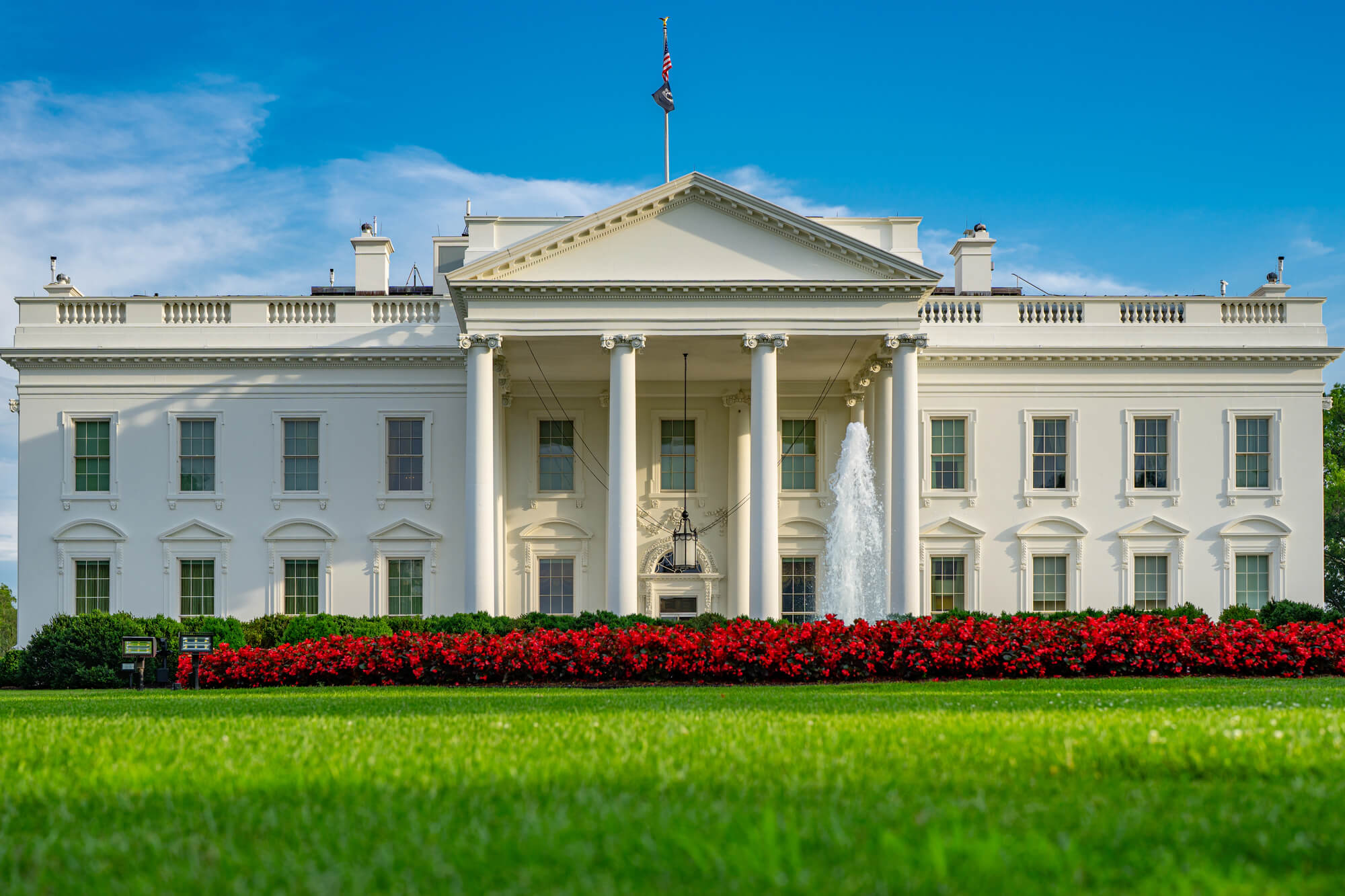
A meeting at the White House lasting over two hours between representatives of the crypto industry and the banking lobby ended on Monday without a compromise. The core issue: should platforms like Coinbase be able to pay interest on stablecoins to their users?
Patrick Witt, Executive Director of the President's Council of Advisers on Digital Assets, chaired the conversation in the Diplomatic Reception Room. The outcome is a new deadline. Both sides must now submit a joint formulation on the stablecoin yield question by the end of February 2026. Without agreement, the CLARITY Act remains blocked. This central legislation governs the regulation of digital assets in the US.
Banks vs. crypto: the core of the conflict
On one side sat Coinbase, Circle, Ripple, Crypto.com, and Kraken. Industry associations Blockchain Association, Digital Chamber, and Crypto Council for Innovation joined them. On the other side stood the American Bankers Association (ABA), the Independent Community Bankers of America (ICBA), the Bank Policy Institute, and the Financial Services Forum, which represents the CEOs of the largest Wall Street banks.
The dispute centers on Section 404 of the CLARITY Act. Specifically, this provision prohibits crypto service providers from making any interest payments "solely in connection with holding a payment stablecoin." The GENIUS Act, passed in June 2025, already prohibits stablecoin issuers from paying interest directly to holders. Yet it still allows third-party platforms like Coinbase to operate rewards programs. The banking lobby now fights back against this loophole. Over 3,200 bankers signed a letter to the Senate on January 14 demanding its closure.
"Policymakers must fully prohibit crypto exchanges, affiliated companies, and other intermediaries, not just issuers, from paying interest, yield, or rewards on payment stablecoin holdings." - Rebeca Romero Rainey, President and CEO, ICBA
$280 billion market as a bone of contention
The sheer size of the market explains the intensity of this debate. Stablecoins have a combined market cap of over $280 billion. Tether (USDT) dominates with a market capitalization of $187 billion and a 63 percent market share. Circle (USDC) follows with $75 billion but recently grew at 73 percent, significantly faster than Tether at 36 percent. Treasury Secretary Scott Bessent projects growth to $3.7 trillion by the end of the decade.
Coinbase already earns substantially from stablecoins. In Q3 2025 alone, they contributed nearly 20 percent of revenue, totaling $355 million. A revenue-sharing deal with Circle forms the basis. Under this arrangement, Coinbase retains 100 percent of the interest income on USDC held on its own platform. Customers currently receive 4.1 percent APY on USDC, while Coinbase One members get up to 4.5 percent. Coinbase therefore has a direct financial interest in the continuation of yield programs.
Standard Chartered, meanwhile, warns of the consequences for traditional banks. Geoffrey Kendrick, Head of Digital Assets Research, estimates the potential outflow at $500 billion by 2028. This assumes a stablecoin market of $2 trillion. An additional $1 trillion could flow out of emerging markets. US regional banks such as Huntington Bancshares, M&T Bank, Truist Financial, and CFG Bank face particular vulnerability, as net interest margin accounts for up to 80 percent of their total revenue.



Coinbase CEO Armstrong escalates the conflict
Brian Armstrong withdrew Coinbase's support for the CLARITY Act in mid-January 2026. He criticized that the provisions on tokenized equities, DeFi restrictions, and stablecoin yields would "institutionalize excessive regulation." The Senate Banking Committee then postponed the markup session planned for January 15. On January 29, the Senate Agriculture Committee passed the CLARITY Act regardless. But without the Banking Committee's approval, the legislation remains blocked.
Armstrong's position isolated Coinbase within its own industry. The rest of the crypto sector showed more willingness to compromise. Accordingly, the White House meeting attempted to break the deadlock. Witt stated his position clearly: "Consumers win when there's choice."
The banking associations pushed back. In a joint statement, ABA, Bank Policy Institute, Financial Services Forum, and ICBA emphasized: "We must ensure that all legislation supports local lending to families and small businesses that drive economic growth." According to ICBA calculations, allowing crypto intermediaries to pay interest could reduce industry deposits by $1.3 trillion. As a result, community bank lending would decline by $850 billion.
Deadline set for end of February
The White House demands a compromise on the stablecoin yield formulation by the end of February. At the same time, the clock is ticking on the GENIUS Act, whose implementation deadline expires on July 18, 2026. Without a resolution to the interest dispute, the CLARITY Act risks remaining stuck in the Senate Banking Committee indefinitely.
"Inaction is not an option, and we are determined to roll up our sleeves and work hard to ensure that legislative progress does not come at the expense of innovators or consumers who see digital assets as the foundation of their financial future." - Cody Carbone, CEO, Digital Chamber