
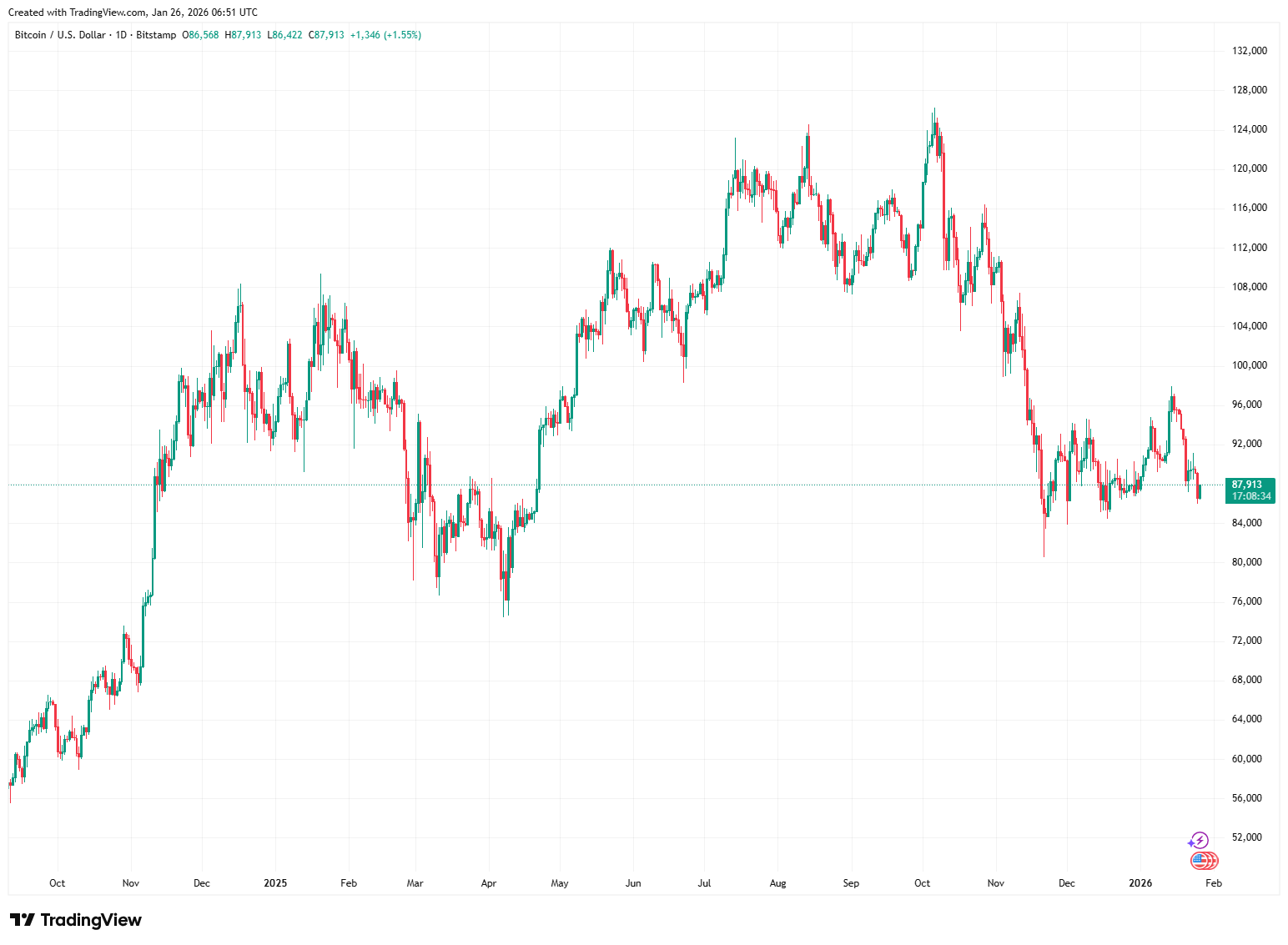
Bitcoin trades at around $87,800, giving back most of its yearly gains over the past week. The largest cryptocurrency lost about 1.5 percent in the past 24 hours. Ethereum trades at around $2,930.
The triggers for this weakness: political uncertainty in Washington, the upcoming Fed meeting, and gold breaking through $5,000 per ounce for the first time. The decline continues since mid-January. On January 21, a drop to $89,000 triggered liquidations exceeding one billion dollars. In the last 24 hours alone, CoinGlass data shows another $224 million in long positions were liquidated. This includes $68 million in Bitcoin futures and $45 million in Ether futures. Bitcoin now trades roughly 30 percent below its all-time high of $126,210, reached on October 6, 2025.
US budget standoff heightens nervousness
Current funding for US federal agencies expires on January 30. Without a congressional agreement, a partial government shutdown looms. This would be the fourth within two years. The longest shutdown in US history ended on November 12, 2025, after 43 days. Polymarket data briefly showed a 77 percent probability of another standstill. After the House passed a 1,059-page budget package, this figure dropped below ten percent.
Still, the situation remains tense. Democratic senators are threatening to block funding for the Department of Homeland Security (DHS). This follows an ICE officer shooting an unarmed woman in Minneapolis. The Senate votes on Monday. A winter storm could delay several senators' return to Washington and jeopardize the vote.
For crypto markets, political uncertainty typically means increased volatility. While some investors view Bitcoin as a hedge against fiscal dysfunction, current price action shows the opposite. Investors are fleeing to traditional safe havens like gold.
Gold breaks $5,000, Bitcoin lags behind
The divergence between Bitcoin and gold has widened significantly in recent weeks. Gold reached $5,000 per ounce for the first time in history on Monday. The rise from around $4,600 in early January to the current record reflects a search for safety. Geopolitical tensions, inflation concerns, and uncertainty about Federal Reserve independence drive this move.
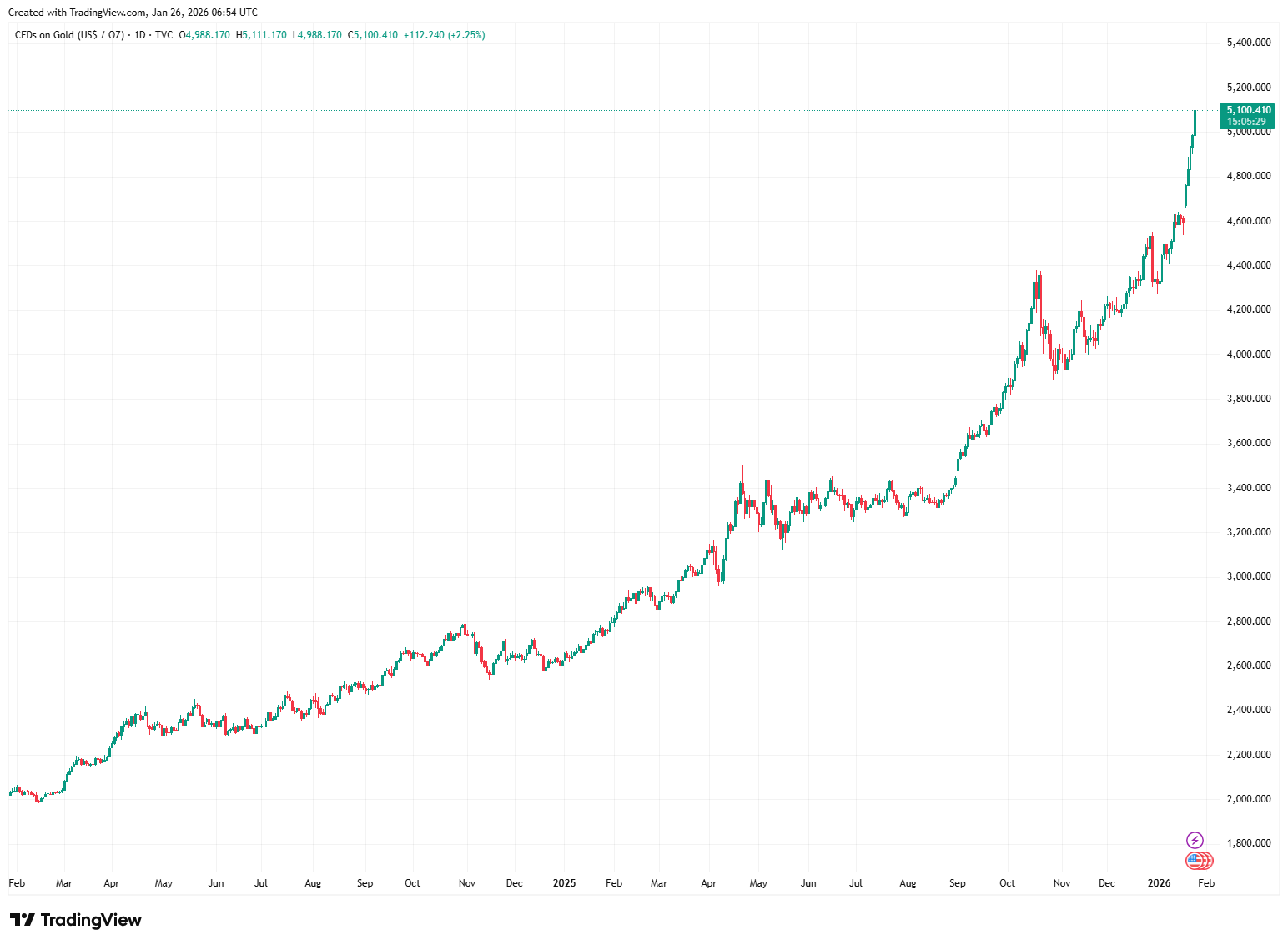
Bitcoin failed to benefit from this environment. On-chain data shows older holders selling into rallies, while newer buyers realize losses. A significant supply overhang limits moves toward $100,000. The "digital gold" and "inflation hedge" narratives are not working right now. Traders on Polymarket see a 45 percent probability that gold outperforms both Bitcoin and the S&P 500 in 2026. Bitcoin stands at 36 percent.




Fed decision on Wednesday: rate pause expected
The Federal Reserve meets on January 28 and 29. After three consecutive rate cuts in the second half of 2025, the benchmark rate currently stands at 3.5 to 3.75 percent. The CME FedWatch Tool shows only a 16 percent probability for another cut in January. The broad expectation: Jerome Powell and his colleagues will wait.
With the new year, the FOMC composition has changed. Beth Hammack, Cleveland Fed President and former Goldman Sachs executive, now holds voting rights. She is considered hawkish and has publicly stated she opposes rate cuts until at least spring 2026.
Cleveland Fed President Hammack argues current monetary policy is "barely restrictive, if at all." She expects inflation to remain around three percent through the end of 2026, before returning to the two percent target. And she is not alone in this assessment. Dallas Fed President Lorie Logan and Minneapolis Fed President Neel Kashkari, both also new FOMC voters, share her skepticism about further easing.
ETF inflows remain robust, but momentum is fading
US Bitcoin spot ETFs now manage around $128 billion and hold approximately 606,000 BTC. This represents about three percent of all Bitcoin ever mined. January started strong. On the first trading day of 2026 alone, $471 million flowed into these products. BlackRock's iShares Bitcoin Trust (IBIT) led with $287 million, followed by Fidelity's FBTC with $88 million.
Between January 13 and 15, ETFs recorded net inflows of $1.71 billion. IBIT led with $648 million on a single day. Yet the outflows of the past week and weak weekend volume suggest waning institutional appetite. Institutional investors are watching multiple factors simultaneously: possible interventions in the Japanese yen market, the US budget crisis, and a heavy earnings week with quarterly results from Microsoft, Meta, Tesla, and Apple. This constellation increases uncertainty and weighs on risky asset classes.
Outlook: key week for Bitcoin
The coming days will show whether Bitcoin can hold support at $87,000. A government shutdown would create additional short-term volatility. But historically, shutdowns have had limited impact on crypto markets. The Fed's communication tone on Wednesday matters more.
Should Powell appear more hawkish than expected, Bitcoin could face further pressure. A more dovish surprise would leave room for recovery. Strong quarterly results from tech giants could also support overall risk appetite. The crypto market remains closely correlated with the Nasdaq.
Long-term investors point to a familiar pattern. When gold rises aggressively while Bitcoin trades sideways, Bitcoin often follows with a delayed but strong upward move. Whether this pattern repeats in 2026 remains to be seen.