
The decentralized perpetuals platform Hyperliquid achieved an annual derivatives trading volume of 2.9 trillion USD in 2025. Coinbase International, the institutional derivatives platform of the US-listed exchange group, reached 1.4 trillion USD over the same period.
This means the DEX, founded only in 2023, recorded more than double the trading volume of an established publicly listed company. The comparison refers specifically to Coinbase International, not the US retail platform. Still, the development marks a turning point. For the first time, a fully decentralized platform outperformed an institutional player in the crypto derivatives business. The total DEX perpetuals market grew by 346 percent to 6.7 trillion USD in 2025, according to CoinGecko data.
The rise of decentralized perpetual markets
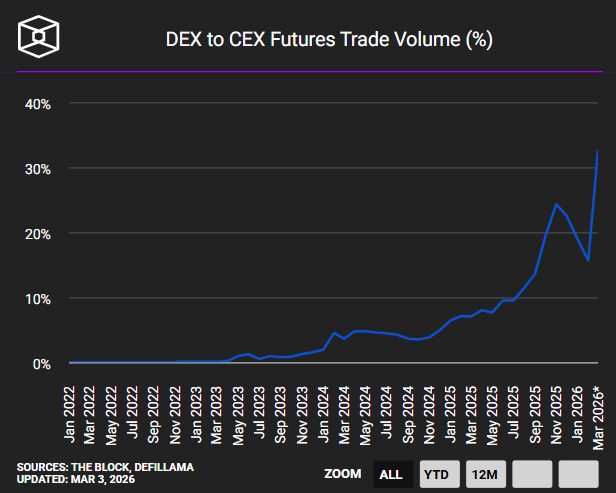
Perpetual futures, derivatives contracts without an expiration date, were long considered the domain of centralized exchanges. In 2022, less than 2 percent of global perp volume came from decentralized platforms. By the end of 2025, that ratio had shifted fundamentally. The DEX-to-CEX volume tripled in Q3 2025 alone, reaching 13 percent.
The numbers clearly illustrate this structural shift. In January 2025, monthly DEX perp volume stood at 260 billion USD. By December, it had risen to 840 billion USD. At the same time, open interest on centralized exchanges fell by 21 percent, while DEX platforms recorded a 230 percent increase.
In total, the combined perpetual swap volume of the top 10 CEXs and DEXs reached 92.9 trillion USD in 2025. That represents annual growth of 65 percent. Centralized exchanges continue to dominate in absolute numbers. Yet the share of decentralized platforms is growing disproportionately.
Hyperliquid's technical edge
Hyperliquid operates its own Layer 1 blockchain called HyperCore, specifically optimized for perpetual swap trading. The dual architecture of HyperCore and HyperEVM processes over 20'000 transactions per second with sub-second finality. Its fully on-chain order book delivers spreads and execution speeds comparable to centralized platforms.
The platform launched without venture capital funding. A contrast to most DeFi projects, where high token unlock risks persist. In August 2025, Hyperliquid reached peak values of over 30 billion USD in daily volume. Total value locked (TVL) stood at 2.2 billion USD. Monthly protocol revenue exceeded the 100 million USD mark.
The revenue-sharing model actively promotes the ecosystem. The protocol pays developers higher shares than it retains for itself. With HIP-3, Hyperliquid Improvement Proposal 3, the platform has enabled permissionless deployments of new markets since the second half of 2025. Users now trade commodities like gold and crude oil alongside crypto assets. Synthetic equity exposures for companies such as SpaceX and OpenAI are also available.




Market position and growing competition
Hyperliquid's dominance in the DEX segment fluctuated significantly in 2025. In May, the platform held 71 percent of all on-chain perp volumes. In the second quarter, market share was 73 percent. By Q3, it fell to 55 percent, and by the end of October to around 25 percent. In terms of open interest, Hyperliquid maintained its position, holding 75 percent market share among DEXs as of October 2025, and 62 percent in November.
The erosion of volume share has specific causes. Competitor Lighter operates on a zk-rollup with a central limit order book and achieved 1.3 trillion USD in annual volume. This placed it at rank 10 in the global derivatives ranking. Aster offers 24/7 stock perpetuals and leverage of up to 1'001x. By the end of October 2025, Lighter already held 21 percent of the volume share, and Aster 14 percent.
The overall market ranking remains clear. Binance dominates the CEX market with 35.7 percent market share and over 56 billion USD in daily derivatives volume. Hyperliquid ranks 7th among all derivatives exchanges globally, with 3.8 billion USD in 24-hour volume and 4.1 billion USD in open interest. The gap to Binance remains large. But the momentum favors the decentralized platforms.
Capital markets price in the shift
The relative performance of Hyperliquid's HYPE token against the Coinbase stock reflects the shift in the derivatives market. HYPE gained 32 percent in 2025, while the Coinbase stock lost 27 percent. The performance gap amounts to more than 58 percentage points.
For the overall market, the picture is clear. DEX platforms controlled over 20 percent of perpetual volume by the end of 2025, compared to less than 2 percent three years earlier. Volume measurement is not without controversy, though. Coinglass and other data providers point to potential distortions from self-trading when volume is not cross-referenced with open interest and liquidation data.
Binance and other centralized exchanges face a new competitive landscape. CEX platforms processed 5.3 trillion USD monthly in December 2025, a multiple of DEX volumes. But the growth rates tell a different story. DEX platforms grew by 346 percent, while the total market expanded by 65 percent. Hyperliquid has demonstrated that on-chain infrastructure can deliver institutional-grade performance.