
A summarizing review of what has been happening at the crypto markets of the past week. A look at trending sectors, liquidity, volatility, spreads and more. The weekly report in cooperation with market data provider Kaiko.
The last 7 days in cryptocurrency markets:
- Price Movements: Bitcoin broke all-time highs following the successful debut of the first Bitcoin-based ETF in the U.S.
- Volume Dynamics: FTX spot volumes have increased 10x over the past year.
- Order Book Liquidity: We explore how a flash crash on Binance.US rippled through the markets.
- Derivatives: Funding rates surged to 6-month highs in a sign that markets may be overheating.
- Macro Trends: The ProShares Bitcoin ETF broke $1 billion AuM in record time.
Price Movements

Bitcoin is again topping the charts after last week's record-setting debut of the first U.S. Bitcoin-based ETF on the New York Stock Exchange, nearly a decade in the making. The ProShares BITO ETF - which tracks Bitcoin futures trading on the Chicago Mercantile Exchange - garnered more than $1 billion in trade volume on the first two days of trading and nearly maxed out the contract purchasing limit CME imposes for a single entity. For the first time, CME surpassed Binance to become the largest cryptocurrency derivatives exchange by open interest.
The extraordinary institutional interest propelled Bitcoin to new all-time highs above $66k and Ethereum above the $4k price level. In other news, FTX raised a $420 million funding round, Facebook launched its Novi digital wallet with Paxos' stablecoin, and a flash crash on Binance.US demonstrated how a technical glitch can ripple through markets.
Bitcoin dominates markets in October
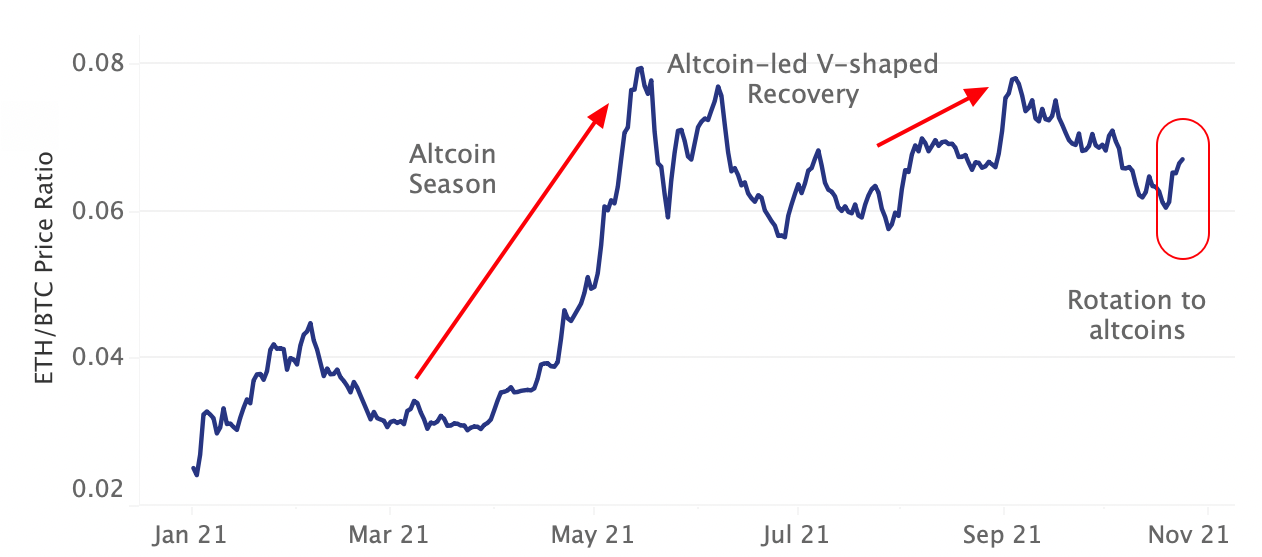
The Ethereum-to-Bitcoin price ratio can be used as an indicator of Bitcoin's dominance relative to altcoin markets and has historically served as a decent gauge for investor sentiment. When the ratio decreases, it suggests investors are rotating funds into Ethereum and altcoin markets, and vice versa. Since the start of September, the ratio has been on a steady downward trend in a sign that Bitcoin is leading the latest crypto market rally. From March to May, the ratio rose as Ethereum and altcoin markets surged and Bitcoin failed to break previous highs. Over the summer, the ratio stayed flat as altcoins led the crypto market's V-shaped recovery. After reaching all-time highs last week, Bitcoin is showing slight signs of exhaustion, with a slight spike in the ratio.
FTX is coming for the world
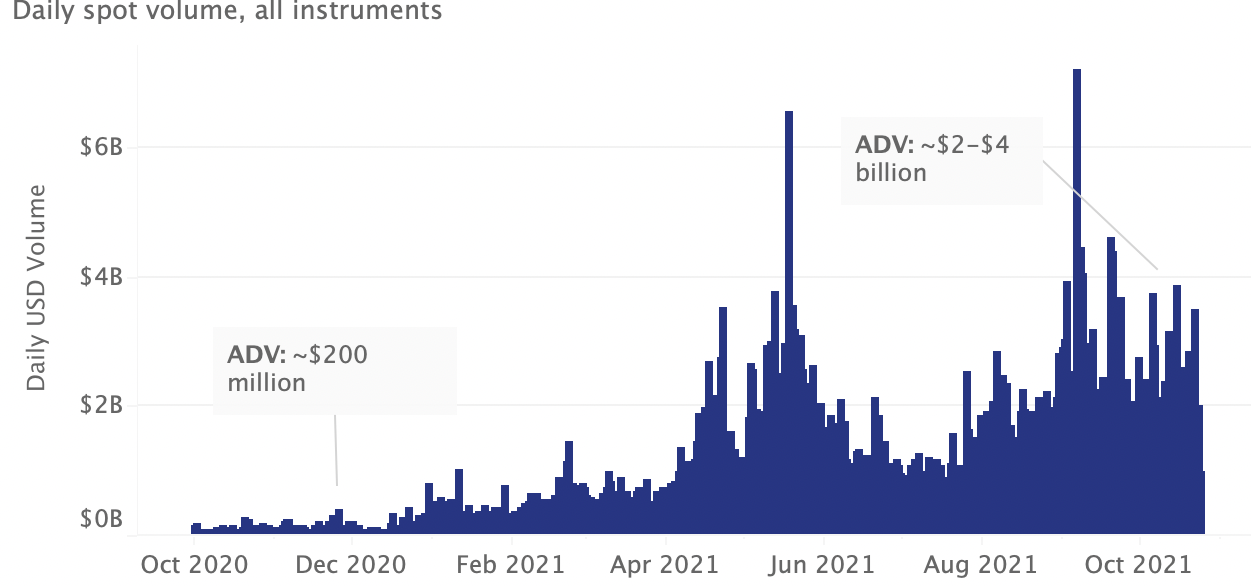
Crypto exchange FTX made headlines yet again after closing a massive $420 million funding round, it's second of the year, at a new valuation of $25 billion. Transaction fees are how exchanges earn the majority of their revenues, so looking at volume is a good way to measure an exchange's growth. FTX used to primarily be known for its innovative leveraged derivatives products, which attracted a more niche user base. But over the past year, the exchange has become one of the dominant spot exchanges. Last October, the average daily volume hovered around $200 million for all spot instruments. Today, the average daily volume ranges between $1-$2 billion. This growth places FTX on track to become a major global competitor to exchanges such as Binance and Coinbase.



Algorithm bug causes havoc on Binance US
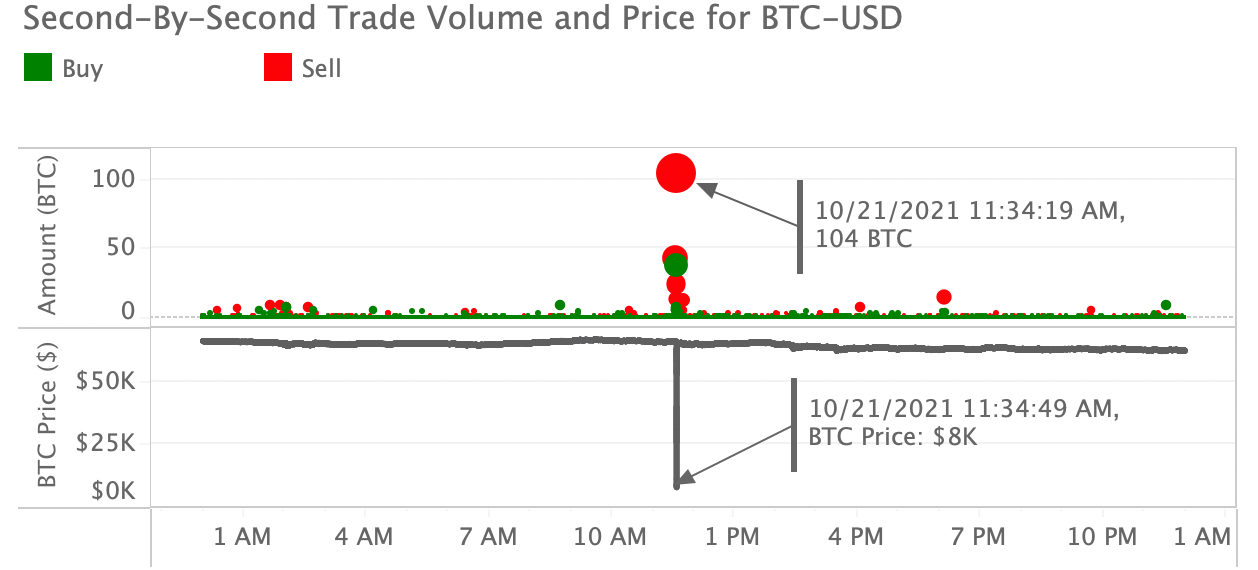
While cryptocurrency market infrastructure has drastically improved over the years, markets still occasionally suffer technical glitches. Last week, a flash crash occurred on Binance US, causing Bitcoin’s price to plunge from $66K to as low as $8K before bouncing back to $65K within seconds. Above, we chart Bitcoin’s second-by-second trade volume and price on Binance US on October 21 and can observe the exact moment a large number of sell orders were executed, causing prices to tank. This reportedly occurred due to a bug in the trading algorithm of a large institutional investor.
The flash crash resulted in an almost complete decimation of market depth during and immediately following the crash. Below, we chart the hourly average quantity of orders within 1% of the mid-price and observe that both the bid and ask depth plummeted, with bid depth nearing zero immediately surrounding the mid-price. 1% bid depth averages around 20 BTC, so a large number of sell orders (>100 BTC) in just a single second was simply too much for Binance.US's order book to handle.

Market depth recovered relatively quickly but remained well below its pre-crash levels throughout the day as market makers readjusted their positions and reduced their presence on the order book. The liquidity crunch and extreme volatility on Binance.US rippled throughout other Bitcoin markets, demonstrating how an exchange-specific glitch is never an isolated event. Bitcoin’s price fell on several other exchanges and the bid-ask spread spiked and remained volatile.
Are markets overheating?
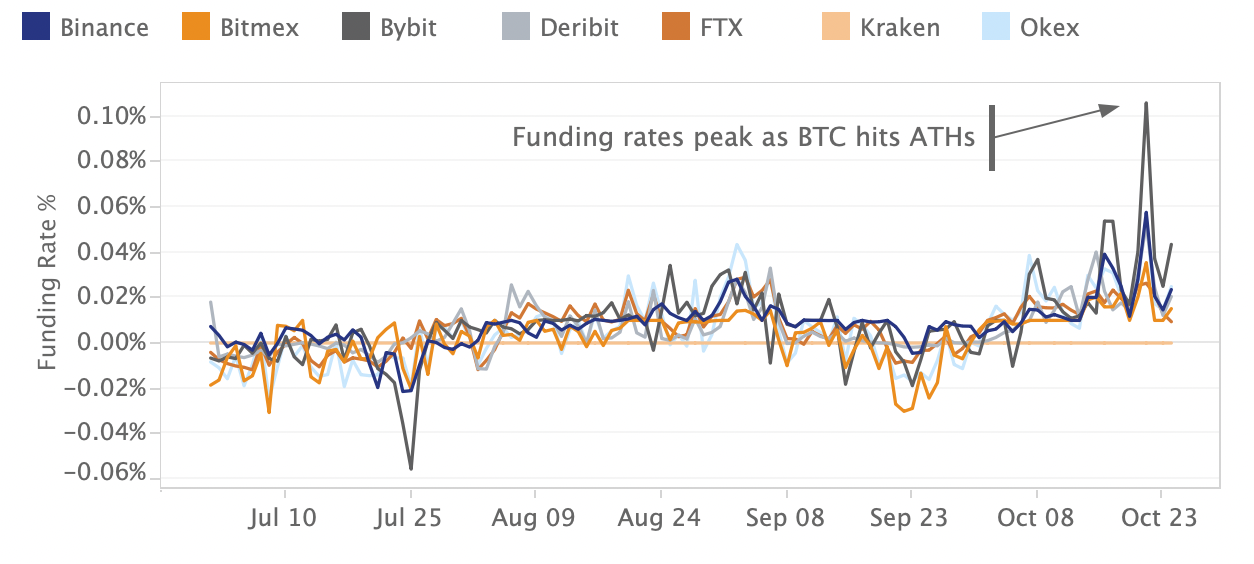
Funding rates for Bitcoin perpetual futures spiked to a 6-month high last week as Bitcoin broke all-time highs. Funding rates on Bybit, a predominantly retail exchange, underwent the most dramatic spike which has historically been a sign that markets are overheating. The funding rate is the mechanism that pegs the perpetual futures price to the spot price. When investors are bullish on an asset, they accumulate long perpetual futures positions which can cause the contract to trade at a premium to spot prices. Funding rates will turn positive, signifying that long holders need to pay shorts, which should incentivize shorting and an eventual convergence between the perpetual futures contract and the underlying spot. High funding rates often precede a price reversal and over the weekend we saw Bitcoin give up its gains and close the week in the red.
ProShares ETF breaches $1 billion in AuM

On Thursday, the ProShares Bitcoin-based exchange-traded fund became the fastest ETF in history to breach $1 Billion in Assets under Management. This is the first Bitcoin-based ETF to trade in the United States, but several Bitcoin ETF’s already trade on the Toronto Stock Exchange in Canada. Above, we chart the Net Asset Value of several Canadian ETFs compared with ProShares. It should be noted that Canadian ETFs physically hold Bitcoin while ProShares builds synthetic exposure via short term Bitcoin futures. We observe that only the Purpose Bitcoin ETF and 3iQ Bitcoin ETF have a larger Net Asset Value (NAV) compared to ProShares’, which is remarkable considering that ProShares has been in existence for less than a week. As more U.S. ETFs get approved, we will likely see a dispersion in volume across several products, rather than just one.
Despite the record levels of interest for the U.S. ETF, many analysts have expressed concerns that a futures-based ETF could incur high costs to long-term investors due to a phenomenon known as “contango bleed”. Contango occurs when the futures price of an asset is higher than the spot price. Unlike spot-based ETFs which invests in physical Bitcoin, a futures-based ETF invests in futures contracts and needs to regularly renew or roll the forward contracts it holds. In contango, the longer future contracts are more expensive than the expiring futures which translate into additional costs (known as contango bleed). Essentially, investors pay a premium for exposure to Bitcoin, but in exchange get the familiarity of a regulated ETF without direct exposure.
To demonstrate this phenomenon, we chart the performance of three oil futures ETFs since 2016 along with the West Texas Intermediate (WTI) spot price.

We observe that these futures-based ETFs have significantly underperformed spot WTI despite differences in operating structure and investment strategies. While spot oil prices have risen 124% since 2016, the United States Oil Fund (USO), one of the largest oil futures ETFs, declined by 35%. The United States 12M Oil Fund (USL) which takes positions in 12 different futures contracts (one for each upcoming month) performed better, rising by 72% over the same period.
Bitcoin’s correlation with commodities climbs

Bitcoin’s correlation with commodities - which historically perform well during times of unexpected inflation - has been mostly rising since the start of Q3. Above we chart Bitcoin’s 30-day rolling correlation with gold, oil, and copper. We observe that its correlation with industrial copper and oil has been increasing since September. Both oil and copper rose over the past few weeks boosted by growing demand and record low inventories. By contrast, Bitcoin’s correlation with safe-haven gold has been mostly negative this year despite briefly turning positive in September. According to a recent analysis by JPMorgan Chase, the perception of Bitcoin as a better inflation hedge than gold has been driving the recent price rally, rather than ETF euphoria.