CleanSpark has signed a 20-year triple-net data center lease worth USD 6.6 billion for a campus in Georgia. The unnamed tenant is a global technology group in the "high-investment-grade" category. With two extension options, the contract value can rise to as much as USD 11.6 billion.
CleanSpark started as a pure Bitcoin miner. The company operates large data center sites already connected to the power grid. Long-term power contracts back these facilities. Those exact resources have become scarce in the current AI infrastructure boom. The shift toward a digital infrastructure platform began in October 2025. Then the miner hired Jeffrey Thomas as SVP AI Data Centers and acquired land and power capacity in Texas. The new tenant will draw around 175 MW of "critical IT load" from the fourth quarter of 2027. The cumulative net operating income margin sits at nearly 100%, with an annual contribution of about USD 330 million.
Triple-net data center lease secures predictable revenue for CleanSpark
A triple-net lease shifts all ongoing costs onto the tenant. Beyond the rent, the tenant also covers insurance and every operating expense at the site. For CleanSpark, this therefore creates a revenue profile that differs fundamentally from the volatile earnings of Bitcoin mining. Mining income depends on the Bitcoin price and network difficulty. Meanwhile, the lease payments stay contractually fixed across the full term. Over the 20-year base term, the contract thus secures around USD 6.6 billion in revenue.
At the heart of the contract is a critical IT load of 175 MW. The tenant is set to draw this capacity from the fourth quarter of 2027. This figure describes the computing power that is guaranteed to the tenant and available without interruption. CleanSpark puts the project costs for the landlord at USD 10 to 12 million per MW of critical IT load. For the entire campus, the required investment therefore adds up considerably. Yet two decades of secured payments offset it.
The cumulative net operating income margin reaches nearly 100%. On average, the provider receives about USD 330 million in net operating income each year. The tenant's credit quality, which the company rates as "high-investment-grade", further lowers the default risk across the long term. In addition, two extension options of five years each could stretch the contract. If the tenant exercises both, the total value rises to as much as USD 11.6 billion.
Letter of intent extends lease to entire Texas portfolio
Sandersville may be only the start. The same tenant also signed a letter of intent with an exclusivity agreement covering CleanSpark's entire Texas portfolio. The exclusivity binds both sides together for as long as the negotiations run. In total, the portfolio spans 718 acres and up to 885 MW of secured and planned power capacity. As a result, the business relationship would reach a multiple of the Sandersville contract.
The capacity splits across two sites. The Sealy site covers around 300 MW on 271 acres. Brazoria is initially slated for 300 MW, with a planned expansion to 600 MW across 447 acres. Together, that amounts to nearly five times the capacity of the current Georgia deal. Should the tenant convert the exclusivity into firm contracts, the secured revenue volume would ultimately multiply once more. For CleanSpark, the double move marks a turning point in the business model.
"This lease is a transformative moment for CleanSpark, as we complete our evolution into a diversified digital infrastructure platform and begin to monetize our power portfolio at institutional scale." - Matt Schultz, CEO and Chairman, CleanSpark




CleanSpark's shift from Bitcoin miner to AI infrastructure platform
The Sandersville contract is not an isolated event. It is the result of a strategic overhaul that began in October 2025. First, CleanSpark hired Jeffrey Thomas as SVP AI Data Centers. Thomas was previously President of AI Data Centres at the Saudi AI company Humain. With that appointment, the company signaled its ambition to develop AI data centers in-house. The market rewarded the move at the time with a share price gain of up to 13%.
At the same time, the company acquired land and power capacity in Texas. The goal was to develop a new data center campus there. For fiscal year 2025, the provider also reported record revenue. This growth stemmed from its repositioning as a compute platform for Bitcoin mining and AI workloads. As a result, the former pure-play miner became a flexible operator. It can shift computing capacity between mining and AI loads depending on demand. The AI data center in Georgia now carries this development forward at institutional scale.
The timing coincides with a structural bottleneck. According to industry estimates, around 40% of existing AI data centers will hit their power capacity limits by 2027. Bitcoin miners, however, hold exactly the scarce asset: large sites already connected to the grid with secured power contracts. This position therefore makes their locations attractive to hyperscalers and other AI operators.
Core Scientific rejection shows limits of AI data center mergers
The structure of the deal sets CleanSpark apart from a prominent failure in the sector. In late October 2025, Core Scientific shareholders rejected a takeover by CoreWeave worth around USD 9 billion. The all-stock deal failed because major shareholders considered the offer too low. These included Two Seas Capital, Gullane Capital, and the proxy advisors ISS and Glass Lewis. The investors criticized above all the missing price protection on a volatile CoreWeave share. As a benchmark, critics also pointed to the USD 40 billion deal by Aligned Data Centers. That transaction valued capacity at around USD 8 million per MW, well above the valuations of listed Bitcoin miners.
Core Scientific therefore continues its AI pivot separately. An existing infrastructure contract with CoreWeave still provides for a 590 MW expansion. That build-out is projected at USD 10.2 billion in revenue over twelve years. In April 2026, the company also announced a bond issue of USD 3.3 billion to finance the transition. A lease to a credit-rated tenant, by contrast, avoids the approval hurdles of a merger entirely.
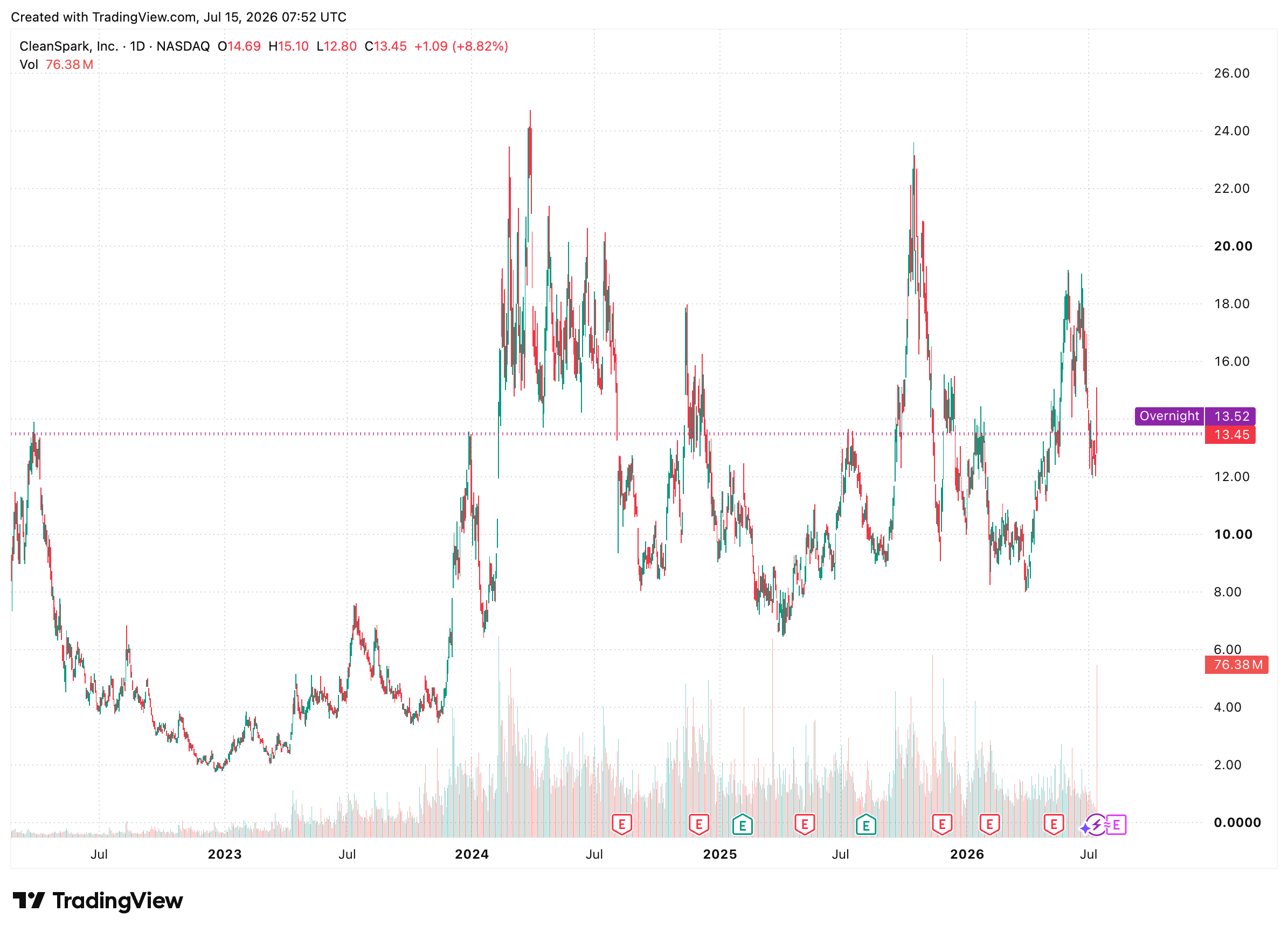
Bernstein analysts named CleanSpark in May 2026 as one of the beneficiaries of the AI infrastructure boom. They also pointed to more than USD 90 billion in data center deals announced across the industry. The market reaction to the Sandersville lease was therefore clear. In pre-market trading, the CLSK share rose more than 15% to around USD 14.45. The previous close stood at USD 12.36. For now, the CleanSpark share ranks among the visible winners of the miner-to-AI consolidation.