Close Menu
Crypto Valley Journal
    Facebook X (Twitter) Instagram
    Crypto Valley Journal
    • Hot Topics
      • News
      • Minds
    • Focus
      • Background
      • Blockchain
      • Legal & Compliance
      • Non-Fungible Token (NFTs)
    • Investing
      • Markets
      • Financial Products
      • Decentralized Finance (DeFi)
      • Exchange overview
    • Education
      • Basics
      • Glossary
      • Politicians on crypto
    • Statistics
      • Bitcoin-ETF-Flows
      • Ethereum-ETF-Flows
      • Crypto market data
      • On-chain data
    • Academy
      • Overview
      • Part 1: Blockchain
      • Part 2: Money
      • Part 3: Bitcoin
      • Part 4: Cryptocurrencies
      • Part 5: Decentralized Finance
      • Part 6: Investing
    • English
      • Deutsch
    Crypto Valley Journal
    You are at:Home»Hot Topics»News»Crypto bear market: Bitcoin drops to $72,900 and wipes out Trump election gains
    Crypto bear market: Bitcoin drops to $72,900 and wipes out Trump election gains

    Crypto bear market: Bitcoin drops to $72,900 and wipes out Trump election gains

    By Editorial Office CVJ.CH on 4. February 2026 News

    Bitcoin hit a 15-month low of around $72,900. The largest cryptocurrency is now trading at the same level as on US election night in November 2024, when Trump's victory catapulted the price from $69,000 to over $75,000 within hours.

    The entire "Trump premium" has been erased. This decline accelerated in late January. On January 31 alone, Bitcoin lost 10 percent in a single day, accompanied by liquidations totaling over $2 billion. Overall, the price fell more than 15 percent within one week. Bitcoin is now trading at around $76,400 after a brief recovery.

    Subscribe to our newsletter

    The best articles of the week, directly delivered into your mailbox.

    Liquidations and ETF outflows amplify the sell-off

    The crash triggered a cascade of forced sales. On February 1, exchanges liquidated over $2 billion in crypto positions -- one of the largest liquidation events in the industry's history. Two days later, another $740 million followed, including $287 million in Bitcoin long positions alone. The steepest price drop occurred over the weekend during thin liquidity, when stop-loss orders triggered algorithmic selling.

    At the same time, institutional investors pulled capital from Bitcoin spot ETFs. Over two weeks, $2.8 billion flowed out of the funds. On January 29, ETFs recorded record outflows of $818 million, followed by $510 million the next day. BlackRock's iShares Bitcoin Trust (IBIT) alone lost $528 million. The average cost basis of ETF holdings sits at around $84,000. At a price of $73,000, roughly 62 percent of invested capital is in the red.
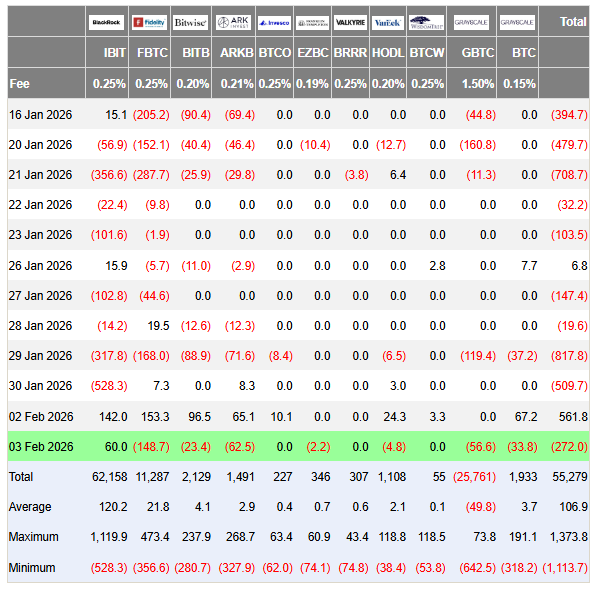
    Bitcoin ETF flows since mid-January / Source: Farside

    Macro factors pressure the crypto market

    Several factors converged at the same time. The US Federal Reserve held interest rates at 3.50 to 3.75 percent on January 28. Fed Chair Powell signaled he was "not in a rush to cut." Elevated inflation data further delayed rate cut expectations. Meanwhile, a stronger US dollar reduced the appeal of risk assets.

    Adding to the pressure, a US government shutdown began on January 31. It was triggered by a dispute over immigration policy and Department of Homeland Security spending. Bitcoin fell to $73,100 during the shutdown. Trump signed a funding package on February 3. The House of Representatives voted 217 to 214 in favor. His tariff threats of 25 to 60 percent on automobiles, pharmaceuticals, and semiconductors also weighed on markets. As a result, the S&P 500 lost around 1.4 percent, the Nasdaq 2.2 percent.

    The Fear & Greed Index dropped to 20-25 points, signaling "Extreme Fear." In total, the crypto market shed nearly $500 billion in market capitalization within one week. Ethereum plunged 26 percent, XRP lost 17 percent, and Solana gave up 7 percent.


    Ray Dalio’s Bridgewater Associates Minds

    Star investor Ray Dalio considers Bitcoin inferior to gold

    Analysis by Bitget Research on Bitcoin quantum computing risks, ECDSA exposure, NIST post-quantum standards, and BIP-360 migration paths. Background

    Bitcoin quantum computing: What recent developments mean for network security

    JPMorgan warns: Recurring DeFi exploits and stagnant ETH-denominated TVL curb institutional engagement in the DeFi sector. DeFi

    JPMorgan: DeFi hacks and TVL losses weigh on institutional investors

    Basics

    Unit bias in crypto: Why cheap coins mislead investors

    Ray Dalio’s Bridgewater Associates Minds

    Star investor Ray Dalio considers Bitcoin inferior to gold

    Analysis by Bitget Research on Bitcoin quantum computing risks, ECDSA exposure, NIST post-quantum standards, and BIP-360 migration paths. Background

    Bitcoin quantum computing: What recent developments mean for network security

    Gold rises, Bitcoin falls: the "digital gold" narrative crumbles

    While Bitcoin crashed, gold approached the $5,600 per ounce mark and hit a record high. Gold gained 8.6 percent during geopolitical tensions, while Bitcoin lost 6.6 percent. As a result, the narrative of Bitcoin as "digital gold" and an inflation hedge is losing credibility.

    Instead, Bitcoin increasingly behaves like a tech stock. The 30-day correlation between Bitcoin and the Nasdaq 100 stood at 0.80 in January 2026. Galaxy Digital's Head of Research Alex Thorn sees no evidence of a role as a store of value.

    "There is little evidence of significant accumulation. Bitcoin has failed to follow gold and silver as a debasement hedge." - Alex Thorn, Head of Research, Galaxy Digital

    Technical signals point to further downside potential

    Bitcoin already lost the 50-week moving average in November 2025. In previous cycles, a break below this level was often followed by a decline to the 200-week moving average. This currently sits at around $58,000. Between $70,000 and $80,000, a significant supply gap exists that favors high volatility.
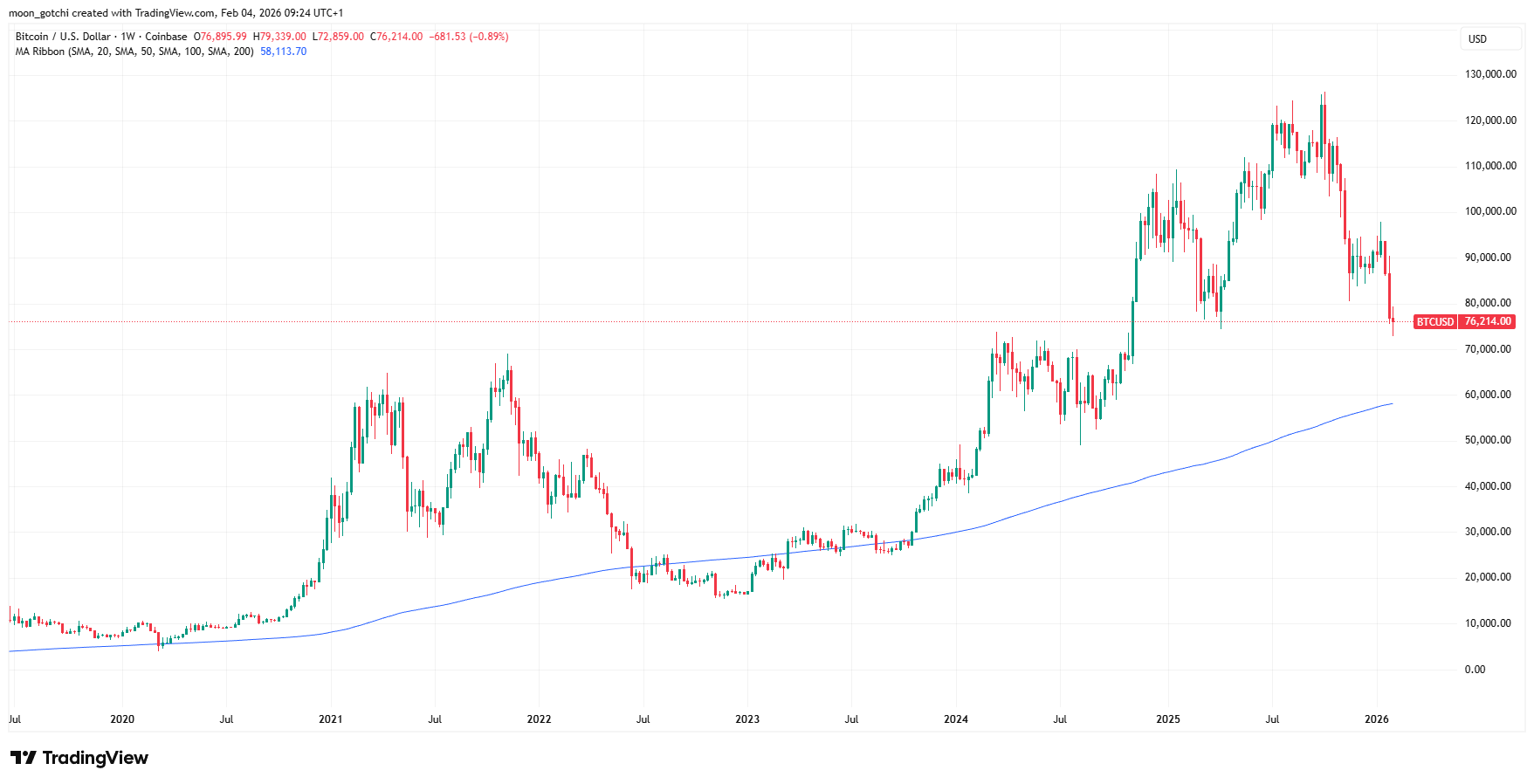

    Bitcoin BTC/USD with 200W moving average (blue) / Chart: Tradingview
    Share. Facebook Twitter LinkedIn Email Telegram WhatsApp

    About the author

    Editorial Office CVJ.CH

      The CVJ editorial staff consists of a team of Blockchain experts and informs daily and independently about the most exciting news.

      Related Articles

      OKX, BlackRock and Standard Chartered launch a joint framework that makes tokenized RWAs usable as margin collateral under G-SIB custody.

      OKX, BlackRock and Standard Chartered use tokenized treasuries as collateral

      Hoskinson calls support of the CLARITY Act by Garlinghouse and the XRP community insanity and accuses Ripple of harming the industry.

      XRP vs. Cardano: Hoskinson calls CLARITY Act support “insanity”

      Trump would sign the CLARITY Act immediately. But the Senate is blocking it, and a May deadline could push the law back to 2030.

      Trump wants to sign CLARITY Act immediately, but chances drop to 50%

      Canada announces national crypto ATM ban. Roughly 4,000 machines are affected as Ottawa targets fraud and money laundering.
      29. April 2026

      Canada bans crypto ATMs

      OKX, BlackRock and Standard Chartered launch a joint framework that makes tokenized RWAs usable as margin collateral under G-SIB custody.
      29. April 2026

      OKX, BlackRock and Standard Chartered use tokenized treasuries as collateral

      Hoskinson calls support of the CLARITY Act by Garlinghouse and the XRP community insanity and accuses Ripple of harming the industry.
      28. April 2026

      XRP vs. Cardano: Hoskinson calls CLARITY Act support “insanity”

      twitter image button instagram image button linkedin image button youtube image button

      About Crypto Valley Journal
      About Crypto Valley Journal

      On the pulse of the movement

      • Academy
      • Contact
      • Advertising
      • About us
      • Partner
      • Imprint
      • Privacy
      • Disclaimer
      Search

      Type above and press Enter to search. Press Esc to cancel.