
Harvard Management Company has sold its entire position in the BlackRock iShares Ethereum Trust (ETHA), worth 86.8 million USD. At the same time, the endowment manager cut its Bitcoin ETF holding by 43 percent. Consequently, the remaining IBIT stake stands at roughly 117 million USD.
Harvard Management Company (HMC) is the professional investment firm that manages the endowment of Harvard University. With 56.9 billion USD as of June 2025, it ranks as the largest academic endowment in the world. HMC initially began with the purchase of Bitcoin ETF shares (IBIT) in Q2 2025. Ethereum exposure followed in Q4 2025 as Harvard's first ever Ethereum investment. Moreover, according to Bloomberg analyst James Seyffart, the endowment ranked as the largest institutional new buyer of ETHA in that quarter. However, filing data tells a different story for the following quarter. HMC sold all 3.87 million ETHA shares in Q1 2026. Meanwhile, the IBIT holding fell from 5.35 million to 3,044,612 shares. Consequently, the remaining crypto ETF position represents less than 0.3 percent of the total portfolio.
Harvard fully liquidates Ethereum ETF within one quarter
In Q4 2025, HMC entered Ethereum for the first time. The endowment purchased 3.87 million shares of the BlackRock iShares Ethereum Trust for 86.8 million USD. Previously, Harvard had held no direct Ethereum exposure through a US spot ETF. BlackRock launched ETHA in July 2024. Furthermore, the fund has since ranked among the highest-volume Ethereum spot vehicles on the US market.
Just one quarter later, HMC reversed the position entirely. The 13F filing published on 14 May 2026 (SEC reference 0001193125-26-226658) shows zero ETHA shares as of 31 March 2026. Institutional investors with more than 100 million USD in US-listed securities must file such 13F reports. Specifically, the deadline falls 45 days after each quarter-end. These filings show only long positions in US equities and ETFs. Therefore, neither derivatives nor foreign securities nor direct crypto exposure appear. As a result, the document captures only the ETF-wrapper view, not any other crypto engagements of the endowment.
The timing context is unfavorable. Ethereum reached its all-time high of around 4,953 USD in August 2025, thus before Harvard entered the position. By the end of December 2025, the price had retraced to roughly 3,300 USD. Since then, Ethereum has lost another 29 percent in 2026. The endowment's exact entry price is not public. Nevertheless, the exit fell during a phase of pronounced weakness in the underlying asset.
Bitcoin allocation remains in the portfolio despite the cut
In Q3 2025, Harvard's Bitcoin exposure peaked at 6.81 million IBIT shares worth roughly 442 million USD. The BlackRock iShares Bitcoin Trust thus temporarily ranked as the most valuable publicly held equity position of the endowment overall. HMC first trimmed this holding by 21.5 percent to 5.35 million shares in Q4 2025. Subsequently, a further reduction of 43 percent followed in Q1 2026. Specifically, only 3,044,612 shares remained, with a residual value of around 117 million USD as of 31 March 2026.
The position therefore remains in place, although small relative to total assets. The combined crypto ETF holding still stood at 352.6 million USD at the end of 2025. By the end of March 2026, it had shrunk to less than 0.3 percent of the 56.9 billion USD portfolio. Harvard's US equity portfolio comprises only 16 public holdings in any case. Furthermore, roughly 72 percent of the endowment flows into private equity and hedge funds. IBIT therefore remains one of the few visible bets of the endowment in listed markets.
Notably, the move is highly selective. HMC fully exited Ethereum, whereas it merely scaled Bitcoin down. Consequently, this does not signal a general retreat from crypto. Instead, it reflects a targeted withdrawal from ETH exposure alongside continued confirmation of Bitcoin as a portfolio building block.




Mubadala adds: institutional picture split
While Harvard reduces, other large investors show the opposite trajectory. Mubadala Investment Company from Abu Dhabi held 14.7 million IBIT shares as of 31 March 2026. The stake was worth roughly 565.6 million USD. The sovereign wealth fund has thus added for the seventh quarter in a row. Moreover, the latest quarter brought a 16 percent increase compared to the previous one. The combined Bitcoin holding of the fund already exceeded the 1 billion USD mark at the end of 2025. This illustrates the different investment horizon of a sovereign wealth manager compared to a university endowment.
Other US university endowments are holding their positions comparatively steady. Dartmouth reported 201,531 IBIT shares as well as 304,803 shares of the Bitwise Solana ETF. Brown University held an unchanged 212,500 shares of a blockchain ETF. Similarly, Emory University kept 1,354,148 shares of the Grayscale Bitcoin Mini Trust. Overall, this does not point to an exodus of academic investors from crypto vehicles. Instead, it shows a picture of stable mini-allocations, with Harvard as a prominent outlier.
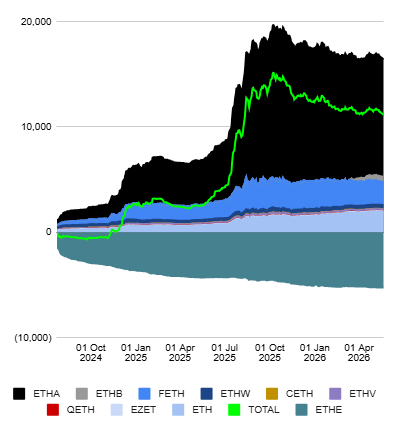
The ETHA fund itself reflects weaker institutional demand. Net assets fell from a peak of around 10.3 billion USD at the end of 2025 to 6.38 billion USD as of 31 March 2026. That corresponds to a decline of roughly 38 percent. Harvard previously ranked as the largest Q4 new buyer and is now entirely out. Consequently, this additionally highlights the pressure on the ETH spot ETF category.
Narvekar departure and political pressure as background factors
N.P. "Narv" Narvekar has led HMC since December 2016. Furthermore, the industry views him as the architect of the recent crypto allocation. According to a Wall Street Journal report, he reportedly mentioned late 2027 to the board. Specifically, this date came up as a possible retirement. A formal announcement remains pending. Nevertheless, the prospect of a leadership change is relevant for the allocation. A future HMC leadership could set different asset-class priorities. Moreover, the ongoing adjustments may already mark an early recalibration.
In addition, the political backdrop plays a role. Harvard has faced pressure from the US government since spring 2025. Specifically, the administration has cut federal funding in the context of higher-education policy conflicts. Such funding cuts can influence the capital planning of an endowment. However, the effect cannot be derived directly from 13F data. HMC generally does not comment on portfolio decisions and likewise declined to comment on this transaction. Consequently, the next reliable data point will only follow with the Q2 13F filing in August 2026.