
Close Menu
Crypto Valley Journal
    Facebook X (Twitter) Instagram
    Crypto Valley Journal
    • Hot Topics
      • News
      • Minds
    • Focus
      • Background
      • Blockchain
      • Legal & Compliance
      • Non-Fungible Token (NFTs)
    • Investing
      • Markets
      • Financial Products
      • Decentralized Finance (DeFi)
      • Exchange overview
    • Education
      • Basics
      • Glossary
      • Politicians on crypto
    • Statistics
      • Bitcoin-ETF-Flows
      • Ethereum-ETF-Flows
      • Crypto market data
      • On-chain data
    • Academy
      • Overview
      • Part 1: Blockchain
      • Part 2: Money
      • Part 3: Bitcoin
      • Part 4: Cryptocurrencies
      • Part 5: Decentralized Finance
      • Part 6: Investing
    • English
      • Deutsch
    Crypto Valley Journal
    You are at:Home » Hot Topics » News » Ethereum’s transition to Proof of Stake (Merge) successful
    Ethereum's transition to Proof of Stake (Merge) successful

    Ethereum’s transition to Proof of Stake (Merge) successful

    By Editorial Office CVJ.CH on 15. September 2022 News

    One of the biggest upgrades in the history of blockchain technology is behind us. Ethereum's switch to Proof of Stake, also known as the Merge, went through without complications. The network no longer relies on miners, with block validation being handled by stakers.

    The first Ethereum blocks have just been validated by the Proof of Stake consensus algorithm. This is a huge milestone for the largest smart contract platform. The transition, which was announced in the original 2013 whitepaper, means new properties for both Ethereum as a network and the native cryptocurrency Ether (ETH) as an asset.

    No more Proof of Work

    Until now, the Ethereum blockchain used the common Proof of Work consensus algorithm. Which actor was allowed to validate the next block was determined based on the computing power provided. This energy-intensive process prevents malicious takeover of the network by requiring a massive amount of real resources to be expended.

    Proof of Stake achieves the same goal by providing capital (staking) that can be slashed in case of malicious acts. Switching the consensus algorithm leads to an estimated reduction of the total network energy consumption by over 99.9%. This not only means less ammunition for crypto opponents, but also new attractiveness for investors who adhere to ESG standards.

    "The merge will reduce worldwide electricity consumption by 0.2%" - @drakefjustin

    — vitalik.eth (@VitalikButerin) September 15, 2022

    Smooth Merge process

    Nearly 40,000 users watched the transition via a Youtube livestream from the Ethereum Foundation. Around 13 minutes after the validation of the first proof of stake block, the finalization was confirmed and potential reorganizations (reorgs) of the blockchain were ruled out. The whole process went smoothly and without any complications. Nothing changes for Ethereum users and the 200 billion in deposited assets on the network, all applications continue to work as usual. The price of Ether didn't react much to the news.
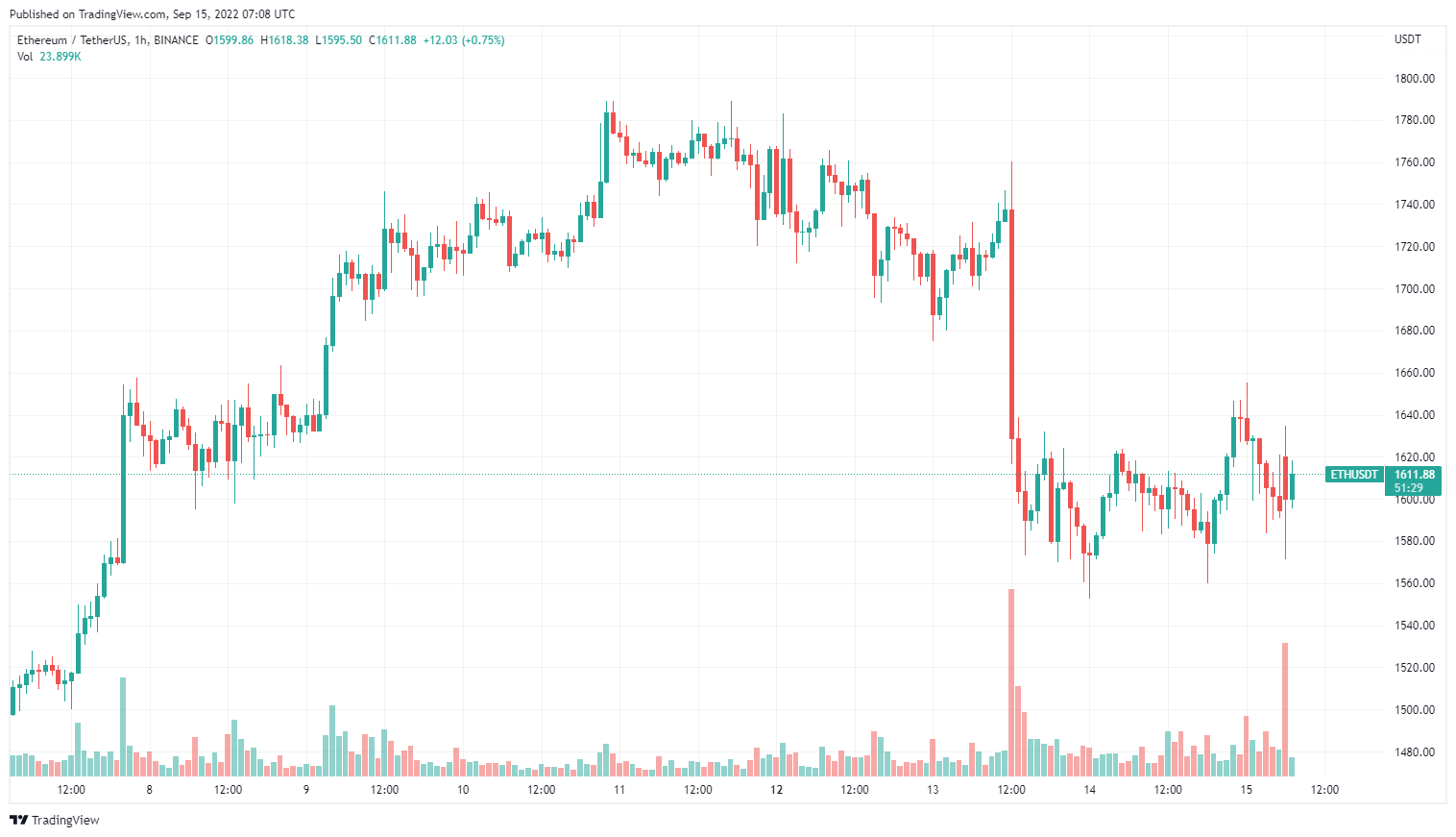
    Ether ETH/USD (1h) / Chart: Tradingview

    No lower transaction fees

    A common misconception about the Merge relates to the transaction cost and speed of the Ethereum network. Since the Merge is merely a consensus shift from Proof of Work to Proof of Stake, the upgrade does not include any improvements to network throughput. Transaction fees will continue to be handled as they always have been. The real scaling Ethereum comes with the developers' next focus: sharding.

    Sharding is a common process in computer science of splitting a database horizontally to divide the load among different "shards." This offloads individual parts of the network and, when combined with rollups, allows Ethereum to accelerate exponentially. Sharding will become the primary focus of developers after the successful Ethereum Merge, and an implementation is expected before the end of 2023.


    Share. Facebook Twitter LinkedIn Email Telegram WhatsApp

    About the author

    Editorial Office CVJ.CH
    • Website
    • Twitter
    • LinkedIn

    The CVJ.CH editorial staff consists of a team of Blockchain experts and informs daily and independently about the most exciting news.

    Related Articles

    PostFinance opens its crypto offering with 22 coins to Swiss corporate clients. Custody runs via Sygnum, execution only, starting in May 2026.

    PostFinance opens crypto offering to corporate clients

    Goldman Sachs liquidiert im Q1 2026 alle XRP- und SOL-ETF-Positionen, kürzt Ethereum um 70% und eröffnet HYPE-Treasury-Position PURR.

    Goldman Sachs fully liquidates XRP and Solana ETFs

    General Bytes ATM

    ATM provider Bitcoin Depot is ceasing operations and filing for bankruptcy

    Die Bank of England prüft Alternativen zu Haltelimits für Sterling-Stablecoins. Branchenkritik trifft auf konservative Reservepflichten.
    19. May 2026

    Bank of England opens up to alternatives for stablecoin holding limits

    PostFinance opens its crypto offering with 22 coins to Swiss corporate clients. Custody runs via Sygnum, execution only, starting in May 2026.
    19. May 2026

    PostFinance opens crypto offering to corporate clients

    SEC plans Innovation Exemption for tokenized stocks in May 2026. DTCC pilot launches July, NYSE rules already active.
    19. May 2026

    SEC prepares “Innovation Exemption” for tokenized stocks

    twitter image button instagram image button linkedin image button youtube image button

    About Crypto Valley Journal
    About Crypto Valley Journal

    On the pulse of the movement

    • Academy
    • Contact
    • Advertising
    • About us
    • Partner
    • Imprint
    • Privacy
    • Disclaimer
    Search

    Type above and press Enter to search. Press Esc to cancel.