
The switch of the consensus algorithm from Proof of Work (PoW) to Proof of Stake (PoS) of the Ethereum blockchain is a drastic event for the still young crypto world. If the "merge" works in mid-September, new perspectives will open up for the largest smart-contract-enabled blockchain network.
The Ethereum smart contract platform has already undergone significant changes. The next step in Ethereum’s history became known as Ethereum 2.0 and features a change in the consensus mechanism to proof-of-stake in the first phase. This first phase was launched in December 2020 and is expected to result in a merge of the proof-of-stake blockchain (Beacon Chain) and the main blockchain in mid-2022. An introduction to the myriad implications of the Ethereum Merge.
Split consensus and application layer
Ethereum is a shared virtual machine that allows users to manage the global state of the system through decentralized consensus. A user can send and receive transactions between addresses as well as Turing-complete computer programs, known as smart contracts, on the blockchain. These smart contracts can be used for countless applications, with the most popular applications currently found in the world of decentralized finance (DeFi) and non-fungible tokens (NFTs).
The Beacon Chain, which has been operating since late 2020, will act as a consensus layer alongside the Ethereum blockchain, securing the blockchain with proof-of-stake consensus. Similar to traditional proof-of-work systems, the beacon chain will select the node that validates the next block in the chain. However, this decision is not made based on computational power (mining), but based on the deposited ether (staking). The Beacon Chain then coordinates the inclusion of the validated blocks and finally the distribution of the chain in the Ethereum blockchain.
The merge of the Beacon Chain with Ethereum
The Beacon Chain was originally shipped separately from the Ethereum blockchain, as mentioned earlier. The Ethereum mainnet continues to be secured by Proof-of-Work, while the Beacon Chain runs in parallel with Proof-of-Stake. Merge refers to the point at which these two systems are finally merged. The Ethereum Foundation often uses the comparison of a spaceship that is not quite ready for interstellar travel. With the Beacon Chain, the community has built a new engine and a hardened hull. When the time comes, the current ship will dock with the new system and merge into a ship that can travel several light years and conquer the universe.
According to announcements from the Ethereum Foundation, the Ethereum blockchain will "merge" with the Beacon Chain between Sept. 15 and 16 and become its own “shard” using the resource-efficient Proof-of-Stake instead of Proof-of-Work. The merge will thus allow the Ethereum network to execute smart contracts in the proof-of-stake system. Since all of Ethereum’s history and current state must be adopted in order for the transition to be smooth for all Ethereum users, the developers are proceeding with extreme care. In the event of a significant failure, hundreds of billions in user funds would be at risk.



No lower transaction fees after the merge
A common misconception about the merge relates to the transaction cost and speed of the Ethereum network. Since the merge is merely a consensus switch from Proof of Work to Proof of Stake, the upgrade does not include any network throughput improvements. Transaction fees will continue to be handled as they always have been. The actual scaling of Ethereum will only take place with the next focus of the developers: sharding.
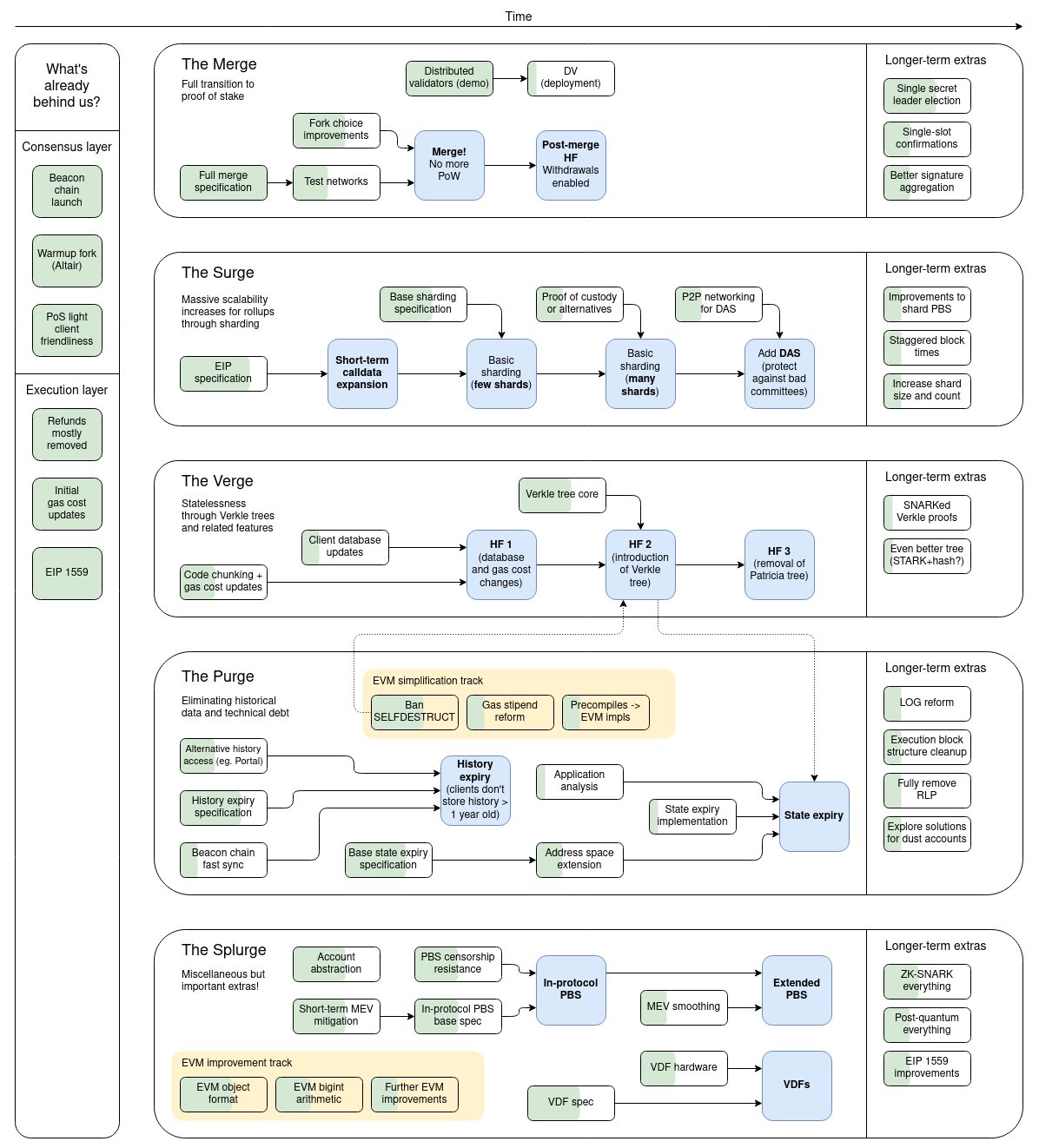
Sharding is a common process in computer science of splitting a database horizontally to distribute the load across different "shards". This offloads individual parts of the network and, in combination with rollups, allows Ethereum to accelerate exponentially. Sharding is expected in 2023, as long as there are no further complications with the merge. At the annual Ethereum Conference in Paris (EthCC), Ethereum co-founder Vitalik Buterin presented an updated diagram of the network's development:
ETH - The perfect future blockchain investment vehicle?
With the "merge", the blockchain-native token of the Ethereum network could increasingly fall on the radar of investors. Ether (ETH) is already accessible to institutional investors via various exchange instruments. However, the second-largest cryptocurrency by market capitalization has always been overshadowed by bitcoin. The merge, if successful, will lead to weighty new features. These could lead to Ether being perceived as an attractive investment in the blockchain sector.
ESG compatible
The change of the consensus algorithm leads to an estimated reduction of the total network energy consumption by over 99.9%. This suddenly moves Ether to the top of the agenda of investors trading according to the ESG standard, compared to the top dog Bitcoin. Ether could thus be the first major cryptocurrency to qualify for ESG-compliant investing.
Deflationary "tokenomics"
The law of market price is dictated by supply and demand. This is no different in the crypto market. Especially in this area, it could be well observed what happens when highly inflated tokens meet a limited number of buyers. Bitcoin's creator Satoshi Nakomoto was aware of the issue. He created one of the cornerstones for sustainable trust in the value preservation of the largest cryptocurrency with a decreasing payout rate. Currently, the Ethereum protocol creates around 4% new Ether per year to reward the network's operators. With the merge, the payout rate changes dramatically. Instead of around 13,000 Ether currently being distributed to miners every day, only around 1,600 Ether will hit stakers after the merge. Since the London-Upgrade in August 2021 (EIP1559) also "burns" Ether depending on the use of the network, it may well lead to deflationary phases of the cryptocurrency in the future.
Distribution for staker
The change to Proof of Stake now rewards the network's stakers. So-called validators, which ensure the security of the network, are equipped with 32 ETH. In principle, every network participant can act as a staker via validator software. In addition, a number of service providers in the area will offer their customers simplified staking options. The distributions for Stakers are estimated to lead to annual returns in the range of 4-10%. Mind you, the distribution takes place in Ether, but this means that an investment in the fastest growing Web3 network has a return; particularly attractive for institutional investors.