Robinhood Chain generated roughly USD 3.1 billion in cumulative DEX trading volume during its first week after the mainnet launch. According to a Bernstein analysis, the network now ranks among the five largest blockchains by DEX activity.
Robinhood Chain is an Ethereum Layer-2 blockchain built on Arbitrum. The online broker designed it for financial services and tokenized real-world assets. Tokenized real-world assets (RWAs) represent real assets such as shares or bonds as tradable tokens on the blockchain. External developers can use the network permissionlessly. Trading runs through decentralized exchanges (DEXs), where users trade directly against each other without a central counterparty. Robinhood first announced the project in July 2025 and launched a public testnet in February 2026. The mainnet finally went live in London in early July 2026, during the event "The World is Flat". At the same time, Stock Tokens, Robinhood Earn, and Agentic Accounts went live. Daily volume climbed to as much as USD 809 million on individual trading days.
Robinhood Chain records 17 million transactions and top-five DEX volume
The trading volume does not stand alone. According to company figures, Robinhood Chain recorded more than 17 million transactions in its first week. The network also counted nearly 350,000 active addresses. At first, it remained unclear whether the fast start would prove more than a brief flash in the pan. However, the early numbers point to broad participation rather than a few large traders. As a result, the combination of high volume and a wide address base sets the launch apart. It differs from purely incentive-driven networks. This activity lifted the young network into the five largest chains by DEX volume within days.
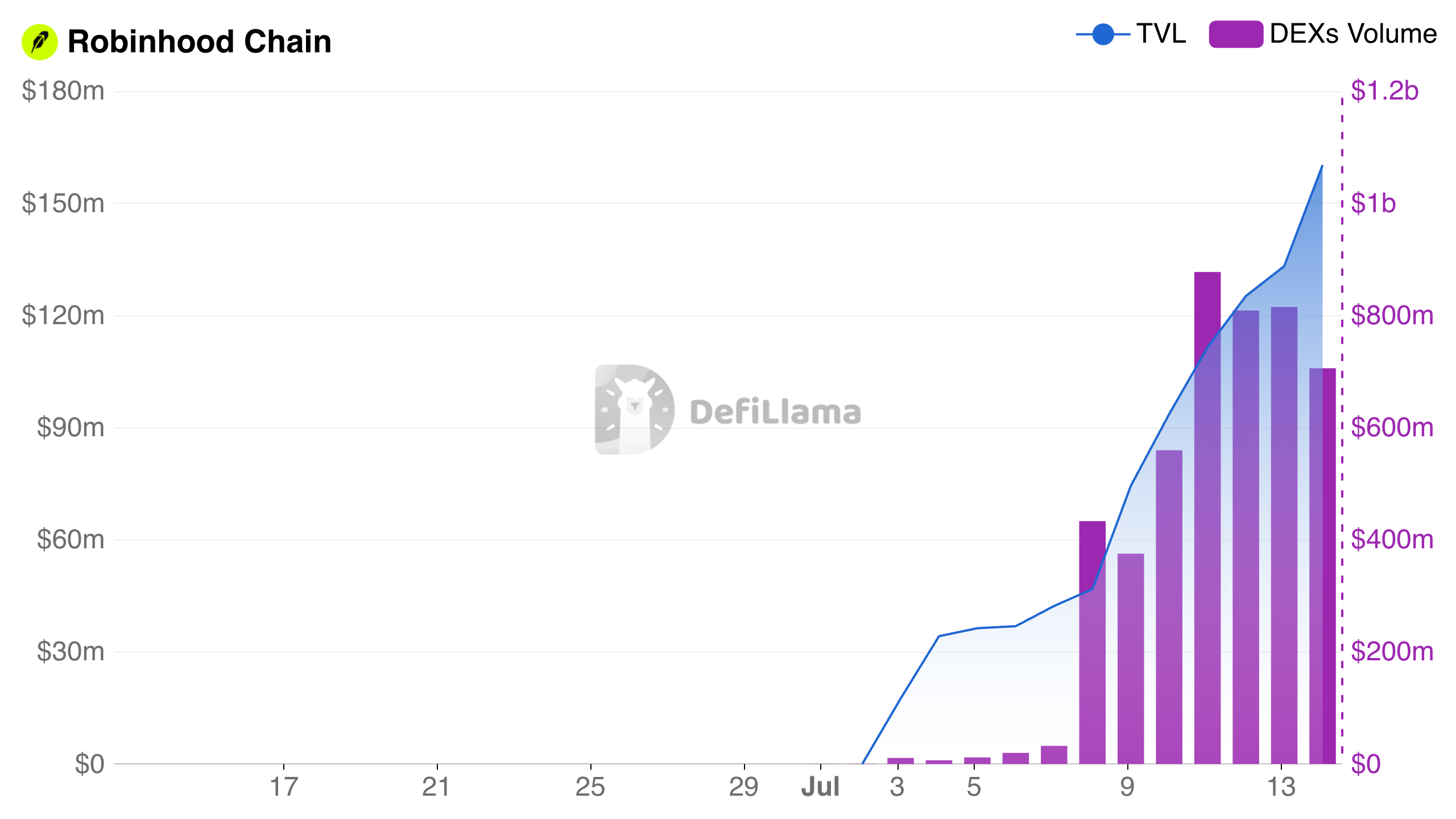
The value locked in DeFi protocols also grew quickly. DeFi TVL crossed the USD 100 million mark within 15 days of the launch. On its peak days, the network briefly ranked third among all chains, behind Solana and BNB Chain. For such a young network, this placement marks a notable starting position. It puts Robinhood Chain in a league with far older ecosystems.
Tokenized shares and stablecoin yield as core products
A concrete product offering sits behind the volume. Around 65,000 users currently hold USD 13 million in tokenized shares and USD 300 million in stablecoin balances. The tokenized shares are available in more than 120 countries, though not in the United States. Users trade them around the clock on decentralized exchanges. Moreover, they can post them as trading collateral or deploy them in lending pools to earn yield. As a result, holders can actively weave tokenized shares into yield strategies rather than merely hold them.
For the individual building blocks, the broker therefore cooperates with established DeFi protocols. Through a connection to Morpho, eligible US users lend the stablecoin USDG directly via the app. The yield reaches up to 7% APY under the name "Robinhood Earn". Perpetual futures continue to run through the trading platform Lighter. The venue provides USD 11 million in LIT tokens to incentivize users. The ecosystem also includes Uniswap, Chainlink, and BitGo, along with providers such as 1inch, Ethena, and Spark. Thus, the network relies on infrastructure proven in the DeFi sector rather than on in-house development.
"Decentralized financial systems open up possibilities that go beyond what traditional financial services can offer. Until now, however, this required technical expertise. We are bringing together the best of traditional finance and DeFi, expanding access to financial participation into every corner of the world." - Johann Kerbrat, SVP and General Manager Crypto and International at Robinhood

Tokenized debt security instead of real share ownership
Legally, Robinhood's stock tokens differ significantly from real share ownership. Robinhood Assets (Jersey) Limited issues them as tokenized debt securities. In practice, the tokens track the price movement of the share without establishing a direct ownership right. Holders therefore acquire neither ownership nor shareholder rights in the underlying assets.
Ondo Finance, by contrast, pursues a different model. In early July 2026, the company launched what it calls the first third-party, US-compliant solution. The registered transfer agent Oasis Pro TA, a subsidiary of Ondo Finance, issues the tokens. Broadridge transfers full shareholder rights, including voting rights.
To demonstrate this, Ondo initially tokenized the iShares Core S&P 500 ETF and Micron stock. For US investors, however, the product is not yet accessible. By its own account, the provider holds around 70% of the global market share in tokenized shares. The sector also grew 147% in 2026 to USD 5.5 billion in market capitalization. Coinbase's Base serves as a further competitive benchmark. Both brokers compete for liquidity and developers with their own Layer-2 networks. Coinbase, however, runs Base as an established Layer-2, while Robinhood's network is only just beginning. The competition between the two brokers is thus shifting from the user interface to the level of blockchain infrastructure.
RWA market grows 50 percent despite crypto slump
Robinhood Chain's launch comes at a time when onchain real-world assets are gaining broadly. The market for tokenized real-world assets rose from USD 35 billion at the end of 2025. It has since climbed to more than USD 51 billion. That marks an increase of roughly 50% within a few months. At the same time, the broader crypto market lost around 25% of its value over the year. Private credit makes up the largest share of the RWA market at 48%, followed by US Treasuries at 29%.
Furthermore, the user base is broadening. The number of RWA holders recently passed 1 million, a gain of 75% since the start of the year. Ethereum and Provenance together host nearly 70% of onchain RWA activity. The contrast between the growing RWA segment and the shrinking overall market ultimately underscores the structural nature of the trend.
Bernstein rates Robinhood stock "Outperform" against this backdrop, with a price target of USD 130. The stock last closed at USD 111.97. Therefore, the investment bank also views the onchain push as value-accretive for the shares.