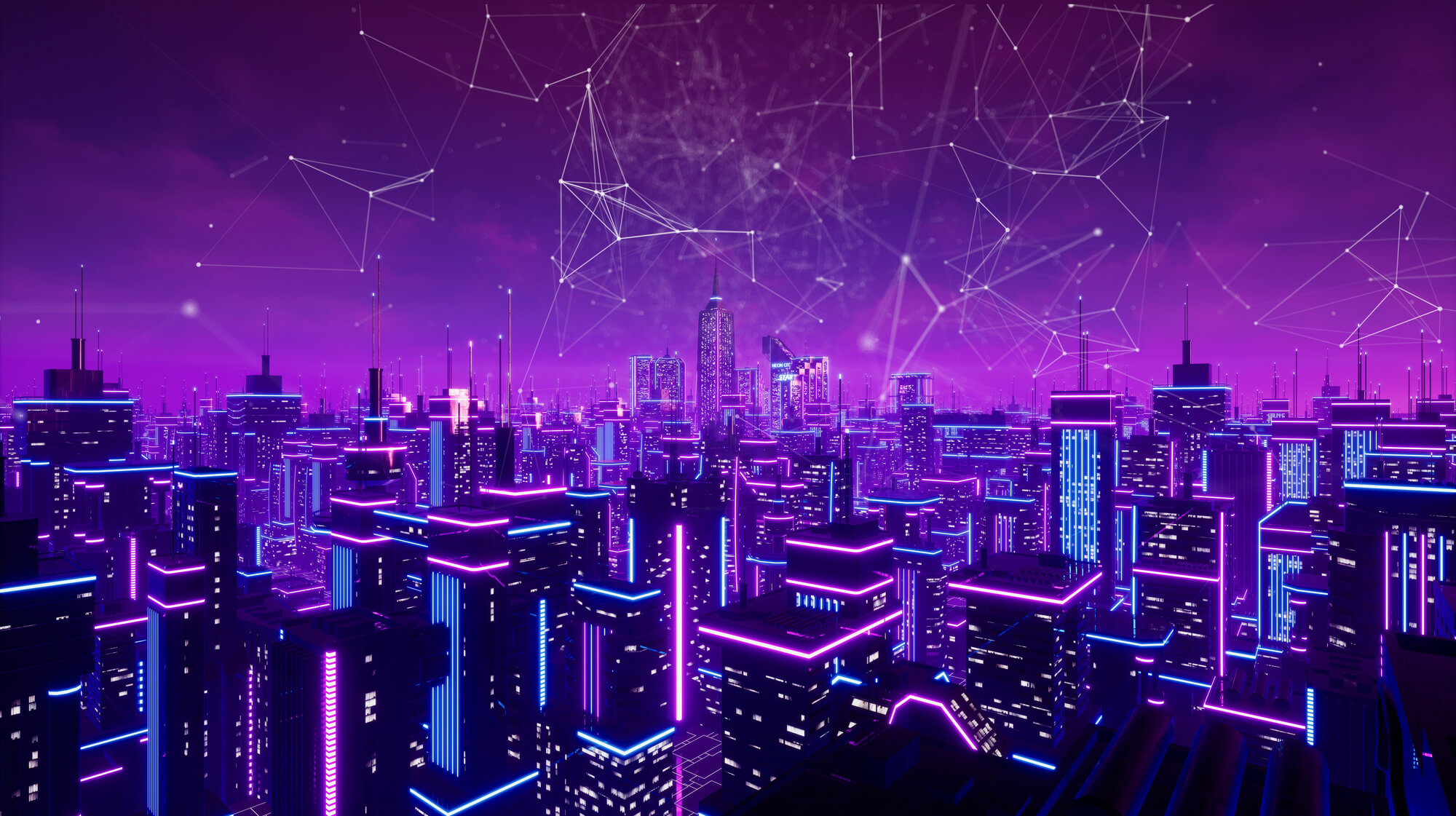
The Metaverse is a digital alternative to the physical world. Not a game, not a fixed destination, but a digital reality. The Metaverse thus encompasses far more areas of life than today's web. Leading companies around the world are beginning to realize the potential of the Metaverse.
Metaverse is a digital space comprising of virtual worlds. Idealistically the metaverse offers digital ownership, distinctive online identities, augmented reality and immersive experiences accessible through the internet. These ideas are made possible by using blockchain and NFT technology, which form a strong backbone of current metaverse projects.
What is the metaverse?
The term metaverse was first used in the science fiction novel "Snow Crash" by Neal Stephenson, published in 1991. In it, the author describes the metaverse as a global virtual reality in which people are represented as avatars and live their lives digitally, as in today's multiplayer online games. However, the Metaverse is not an all-encompassing game, there is no high score and no set goal. The Metaverse is much more of a digital alternative to the physical world.
Meta (ex Facebook) CEO Mark Zuckerberg, as well as Fortnite CEO Tim Sweeney and Microsoft CEO Satya Nadella, have all recognized the potential of the Metaverse and are reorienting themselves in this regard. Matthew Ball published an essay in 2020, considered one of the most influential essays on the Metaverse. The venture capitalist identifies seven core attributes of the Metaverse:
- The Metaverse will be persistent
It will never "reset" or "pause" or "end," it will simply go on indefinitely. - It will be synchronous and live
Even though pre-planned and self-contained events will take place. Just as in "real life," the Metaverse will be a living experience that exists consistently and in real-time for everyone. - No user limitation
While at the same time giving each user an individual sense of "presence". Everyone can be a part of the Metaverse and participate in a particular event/place/activity together, at the same time. - Functioning economy
individuals and businesses will be able to create an incredibly wide range of "work". In addition to owning, investing, selling, they will be rewarded for creating "value" that is recognized by others. - Spanning the digital and physical
It will be an experience that spans both the digital and physical worlds, private and public networks/experiences, and open and closed platforms. - Interoperability
Data, digital items/assets, content, etc. across all of these experiences. For example, a Counter-Strike weapon skin could also be used to adorn a weapon in Fortnite or given to a friend on Facebook. Similarly, a car designed for Rocket League could also be used in Roblox. - Populated by user created content
Content and experiences are created and operated by an incredible array of users. There will be independent individuals, informally organized groups, or commercially oriented companies.
Aside from the shift to virtual reality, the Metaverse would not be much different from today's Web. The only difference is that it would encompass many more areas of our lives. Further changing the world of work. As an example, Matthwe Ball cites companies that hire video gamers in poorer countries to earn in-game objects. These items are then sold to gamers from richer countries for profit.
"While this 'work' is typically menial, repetitive and limited to a few applications, the variety and value of this 'work' will grow with the Metaverse itself." - Matthew Ball, Strategist and Venture Capitalist.
The metaverse will generate revenue
Matthew Ball expects that even if the Metaverse doesn't catch on, it will generate even more revenue than the traditional Web does today. The value of being a major participant, if not a driving force, in such a system is obvious. Today, there is no 'owner' of the Internet. However, almost all leading Internet companies are among the ten most valuable companies worldwide.
It is probably this forecast that drove Meta CEO Zuckerberg and Fortnite CEO Sweeney to invest in the space so early. After all, just as Internet corporations were able to topple many classic companies from their thrones, the future success of the Metaverse could lead to the fall of many top dogs.
Self-determination instead of platform dependency
Many roads lead to the metaverse, and it doesn't seem to be a fad. Instead of using a Facebook login, which probably has the history of the physical world attached to it, new digital identities can be created. A new identity can easily spring from each wallet, which can be contextually extended in the metaverse. The transaction history and the possession of corresponding NFTs write an automatic and tamper-proof biography. An avatar reflects the digital identity and can be dressed accordingly in the metaverse.
The identity per se is not platform-dependent. It is stored decentralised in the corresponding owner's blockchain wallet. Whether this is still represented outside of a platform or contains the promised function depends on the way the NFT is created. An NFT of a certain standard (e.g.: ERC-721) can be moved, sold, or destroyed by the owner at any time without the need of a third party.
Examples of blockchain based Metaverses
An early metaverse project running on the blockchain is Decentraland. It is an Ethereum-based virtual reality platform. Decentraland users can buy virtual land, interact with other users through digital avatars and access user-built social activities. It is a blockchain-powered metaverse adventure that lets users experience true ownership and gamified social functionality combined with blockchain interoperability.
Another exciting metaverse project is The Sandbox. It is a virtual environment with a DAO architecture. The native currency of Sandbox is its cryptocurrency $SAND. Users can develop and monetize their gaming experience using the SAND token. It also allows users to generate their own virtual assets as NFTs, upload them to the marketplace, trade or use them as in-game items. The metaverse offers immersive gaming, social interaction, learning environments, collaboration spaces, and shopping experiences. It will shape how we live, play, earn and work in the future.