
Solana is a highly functional open source project that banks on blockchain technology’s permissionless nature to provide Decentralized Finance (DeFi) solutions in a highly scalable fashion. While the idea and initial work on the project began in 2017, Solana was officially launched in March 2020 by the Solana Foundation.
Solana strives to improve the user experience of both builders and end-users with its novel consensus mechanism called Proof of History (PoH). PoH helps reduce network congestion, which has been a plague for decentralized blockchains in high usage times. As a complement to Ethereum, Solana has one of the most vibrant communities and a noticeable developer activity with over 300 projects building decentralized financial services and crypto-native games, art - and audio streaming and media services on its platform.
Enjoying a high throughput of processing up to 50,000 transactions per second (vs. ~15 TPS for Ethereum) and block time generation of 400ms (0.4 seconds) puts the Solana network on par with highly proficient centralized systems. At the heart of those features is the network’s ability to provide means to reach consensus on a global clock without the need for substantial peer-to-peer messaging.
How does Solana work
Before settlements on the Ethereum blockchain, miners generally prioritize transactions from high to low transaction fees rather than their respective timestamp. As such, this leads to exclusions of transactions with relatively lower fees — and hence prices out microtransactions. Furthermore, given the open-source design of Ethereum, bots take advantage of market signals to prioritize their trades in a block in order to seize opportunities — such as timely participating in a token sale or an NFT auction. This concept is dubbed Miner Extractable Value (MEV) as transaction fees represent a portion of miners’ revenue alongside the block reward.
Solana’s Proof-of-History (PoH) aims to address this issue by establishing a trustless, secure source of time or a global clock preventing arbitrage based on transaction fees and time discrepancies amongst validators. Proof of History is an add-on protocol – not a consensus mechanism – that embeds the passage of time into the blockchain data structure as it constructs a chronological record of events. It can achieve this outcome as it is a high-frequency verifiable delay function (VDF). This algorithm dictates applying a set of consecutive steps for proper evaluation without parallel processing.
Solana relies on a serialized reiterative algorithm, SHA-256, for hashing every transaction and documenting their chronological order. As such, processed transactions are both hashed and introduced as the input for the subsequent transaction. This concept is analogous to an old newspaper picture on a phone where one would be proving that the magazine originated before their device. As a result, the harmony around the time and order of the transactions expedites the time needed to verify them, as this process doesn't require validator communication.




The vibrant ecosystem
The Total Value Locked (TVL) in Solana reached $8 billion by September 2021 with a high dominance from Saber, one of Solana’s native decentralized exchanges - the counterpart of Curve Finance. Comparing Solana’s development to other networks, the current Solana TVL is equivalent to that of Ethereum in September 2020. The majority of Solana’s total value locked (TVL) emanates from three projects - two automated market makers (AMMs), Saber and Raydium and a yield aggregator, Sunny. We expect crypto assets to be staked across a greater number of projects with the rise of new financial services leveraging the Solana network.
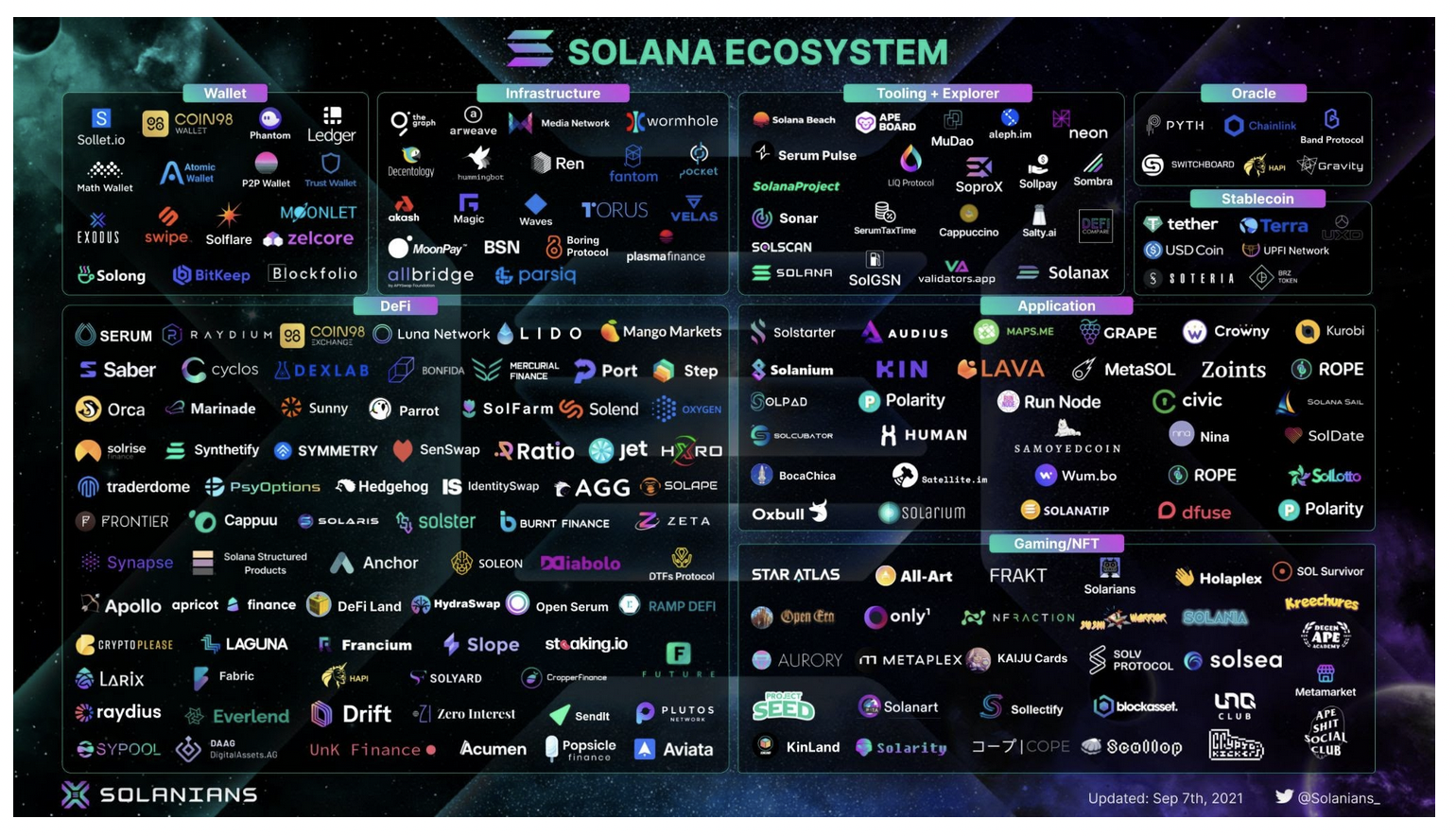
As of writing, the Solana network has recorded 30 billion transactions through a vibrant ecosystem composed of more than 360 applications in various sectors mainly decentralized financial services and crypto art and games. The use of Rust over EVM-compatible Solidity as the core programming language has been identified as one of the key constraints for developers building on Solana. To facilitate ecosystem growth, the Solana foundation hosts annual hackathons. In the most recent event, there were 13,000 participants with 350+ project submissions, demonstrating the interest and strength of the growing community and continued developer support.
Reviewing Solana’s performance in the past year, the network has experienced significant and exponential growth. This growth has largely been attributed to various components: the viral launch of the Degenerate Ape Academy in mid-August 2021, high yield incentives, and the introduction of several legitimate financial applications such as various DeFi protocols and the Solana wallet Phantom
Technical trade-offs
One of the impediments potentially undermining the decentralization of the blockchain relates to the immoderate expenses for running a Solana validator node. Minimum hardware requirements vital for operating a node are estimated to cost somewhere between 3000-5000 dollars - for procuring high-end CPU, as validators would be expected to feature machinery locked-in with at least 128 GB of RAM memory, a motherboard with at least 256 GB capacity, and a CPU with 24 threads. In other words, aspiring nodes would be looking at acquiring hardware with high-end specs that aren't affordable for average retail consumers, as when comparing the economic hardware specs required for running an Ethereum mining node. Solana’s rebuttal to the challenge is that hardware will persistently improve, on the basis of Moore’s law, resulting gradually in cheaper equipment and thereby lowering the barrier of entry towards the more average consumer.
Another potential delicacy arises from the semi-centralized structure of network leaders that allows the network to achieve its high-transaction throughput. Rather than relying on nodes cross-communicating to ensure they’re synchronized before proceeding to validate transactions, Solana features a network leader tasked with producing a proof-of-history sequence that guarantees a distinctive global order of transactions for efficient processing by the validators. Subsequently, transactions are then broadcasted to validators adjoined with a signature of the final state that manifests the leader’s identity via his public key. A tenable drawback of this system is empowering central leaders to censor transactions and votes. That’s why leaders rotate every 4 blocks or 1.6 seconds.
In late September 2021, the Solana network went into a grinding halt triggered by the blockchain’s inability to produce new blocks for almost 17 hours. This attack was caused by trading bots aiming to venture into sniping a token launch on Raydium, Uniswap’s counterpart on the Solana ecosystem. The preliminary technical overview provided by the Solana Foundation explained that the explosive bot activity exceeded the network’s capacity of 50K transactions per second to reach 400K transactions per second. This induced the network to produce multiple forks of itself, meanwhile subsequently forcing nodes to go offline as they couldn’t agree on the network’s correct state. 3 similar incidents happened over the following months.