BNB isn’t just another token—it’s the fuel powering Binance, the world’s largest crypto exchange, and BNB Chain, a high-speed blockchain driving DeFi, AI, and next-gen applications.
Initially launched in 2017 as an ERC-20 token on Ethereum, BNB has since migrated to its own blockchain, evolving into a hybrid exchange and utility token with diverse applications. Further, the BNB chain was amongst the earliest networks that offered a scalable alternative to Ethereum, on top of being the first EVM-compatible network, developers could migrate their existing applications from Ethereum without heavily changing the codebase. As a result, BNB is one of the most battle-tested networks in the crypto landscape, having successfully withstood multiple stress-test scenarios.
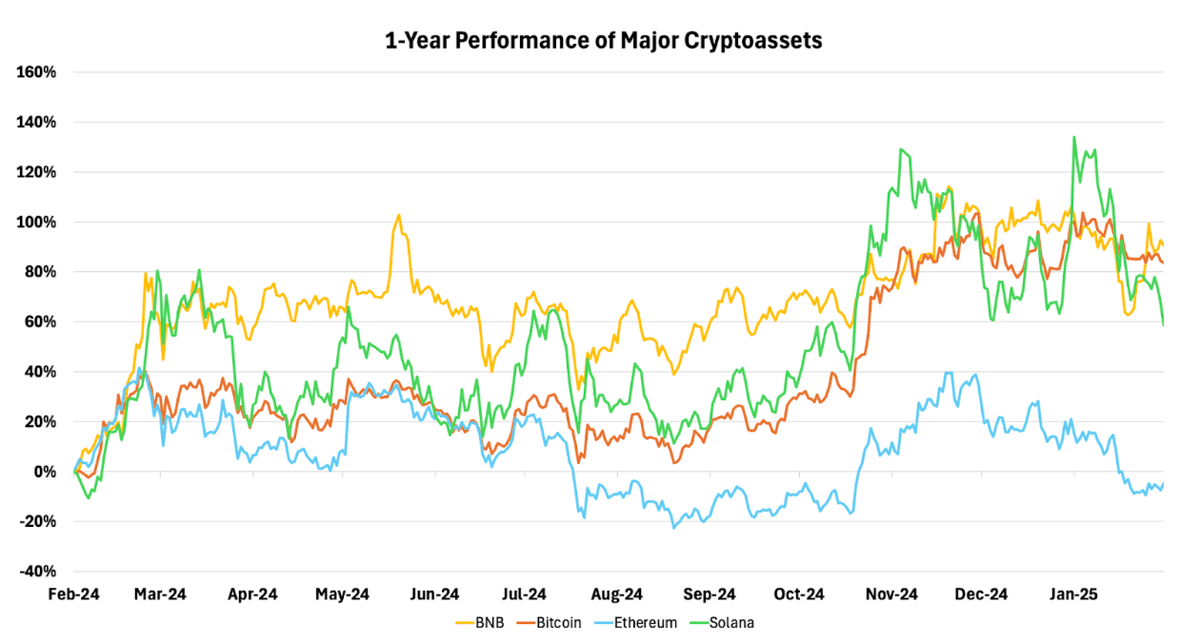
Impressively, while much of the year’s attention has been on the big three—Bitcoin, Solana, and Ethereum—BNB has quietly flown under the radar. Yet, it has outperformed all three, surging by approximately 90% over the past year.
So, why are we talking about BNB now?
For one, centralized exchange (CEX) tokens ranked second among the fastest-growing sectors last year, surging 370% in value. This growth trailed only tokenization-related assets, which skyrocketed by around 700% during the same timeframe, as depicted below.
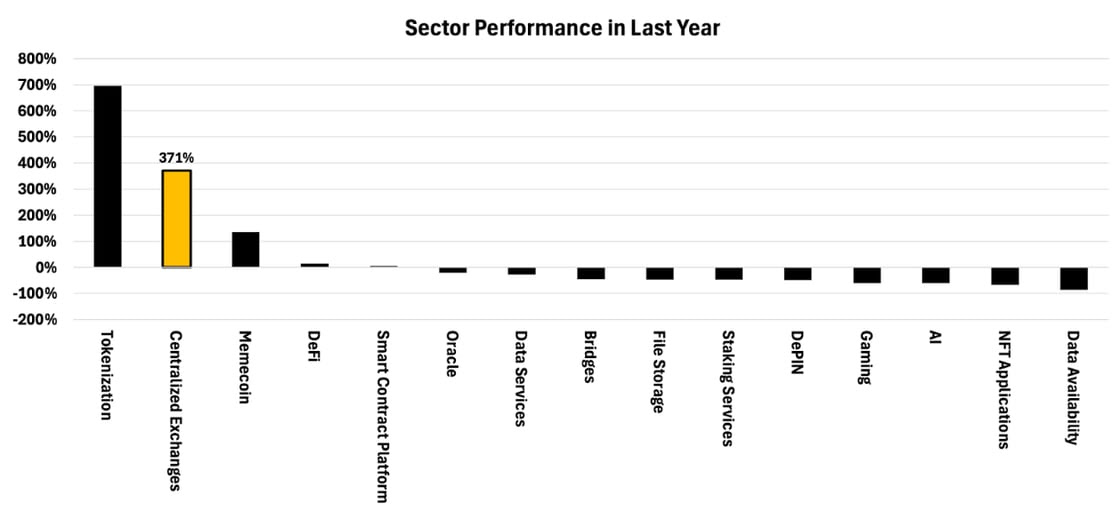
Source: 21Shares, Artemis
The reason they stood out is that they have proved their product-market fit. These tokens remain structurally dependent on centralized exchanges that function as primary liquidity gateways for retail traders, particularly during periods of high market activity. Their value accrual operates through a dual mechanism: direct exposure to exchange revenue growth combined with mandatory utility functions, including transaction cost reductions, ecosystem interoperability requirements, and participation in yield-bearing initiatives controlled by platform operators. This symbiotic relationship between token and platform creates a potent network effect.
In addition, BNB just revealed its 2025 technical roadmap, which promises to significantly increase the competitiveness of the network by focusing on scalability, security, and AI integration:
1. Sub-second transaction speeds
- BNB Chain will reduce block time from 3 seconds to sub-second latency while maintaining capacity for 100M daily transactions.
Impact: Upgrade eliminates frustrating network delays, making blockchain interactions feel nearly instantaneous – critical for high-frequency applications like DeFi & AI.
2. Gasless transactions
- "Megafuel system" is a system that previously allowed users to pay gas fees with stablecoins. This is now expanded to other BEP-20 tokens (BNB-based tokens) instead of just BNB and stables.
- Organizations can also sponsor gas fees for specific transactions, which is a similar feature to what newer networks like SUI offer.
Impact: This removes a major barrier for new users unfamiliar with crypto gas mechanics and enables novel business models like "freemium" dApps.
3. Anti-MEV protection
- New safeguards target sandwich attacks and other malicious Maximal Extractable Value (MEV) strategies.
- Validators and wallets will collaborate to hide transaction details until blocks are finalized, preventing front-running, while transaction details could be encrypted to prevent bots from exploiting pending transactions.
- Validators facilitating MEV abuse face slashing and expulsion via governance votes, while users will be Incentivized with reporting systems to flag bad actors.
Impact: This creates a fairer trading environment, particularly crucial for retail investors.
4. Smart wallet integration
- EIP-7702 compatible wallets introduce batch transactions and simplified key management. Users can execute multi-step operations (like DEX trades) in one click instead of multiple approvals.
- Future plans include AI-powered wallet assistants to optimize spending, cross-chain swaps, and portfolio management.
Impact: Simplify on-chain interactions and create a more user-intuitive experience
5. AI-first infrastructure - with key initiatives including:
- Code Copilot: AI-assisted coding/debugging for smart contracts
- DataDAOs: Monetize private datasets for AI training via decentralized governance
- Trusted Execution Environment (TEEs): Secure environments for autonomous AI agents handling financial decisions
Impact: These tools lower development barriers while enabling sophisticated AI dApps in healthcare, gaming, and DeFi.
6. Memecoin ecosystem support
- BNB Chain commits to infrastructure for meme coins like simplified launch platforms and liquidity tools.
Impact: While controversial, this recognizes memes' role in driving retail adoption and network activity, which can be realized below in the case of Trump’s token launch.
What sets BNB apart?
The BNB ecosystem unifies development across its three core chains with shared tooling, eliminating external dependencies while consolidating typically fragmented blockchain use cases across multiple networks:
- BNB Smart Chain: Supports diverse dApps as a general-purpose network.
- opBNB: Processes 100M+ daily transactions via low-cost Optimistic rollups, optimized for DeFi/gaming.
- BNB GreenField: Integrates decentralized storage with DeFi/NFTs via programmable data ownership, driving a 350% surge in stored data this year through AI and data economy applications.
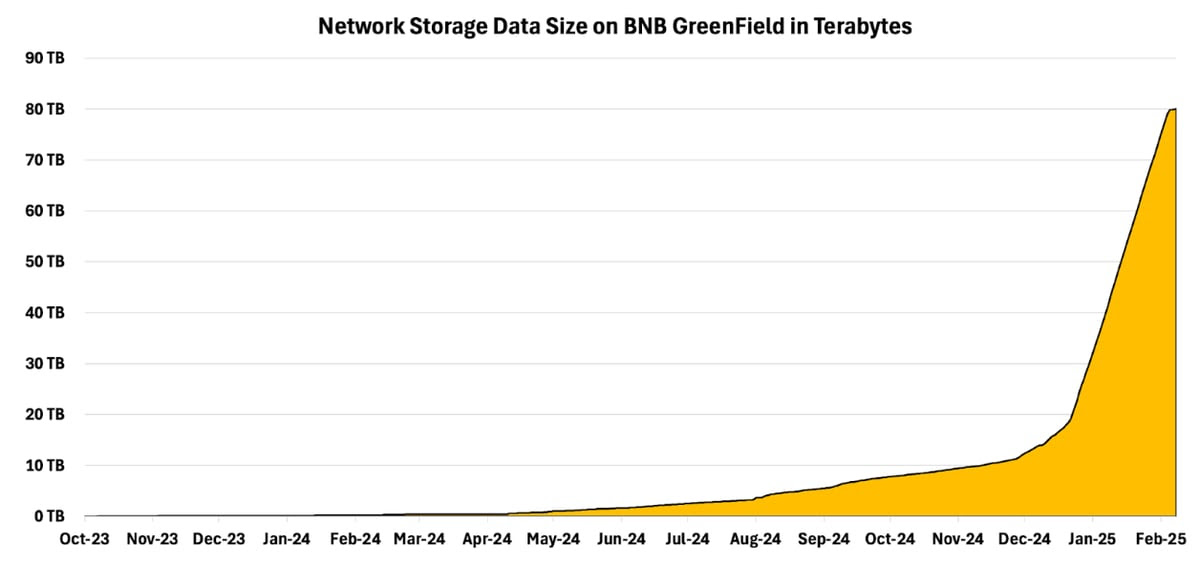
This vertically integrated design enables developers to address diverse needs – scalability, privacy, and cost – without bridging to external ecosystems.
Unmatched integration with Binance’s global infrastructure
The BNB ecosystem leverages Binance’s position as the world’s largest crypto exchange to create a seamless, interconnected experience:
- Direct Exchange-to-Blockchain Onboarding: Binance’s Web3 Wallet simplifies onboarding for millions of users, enabling one-click access to BNB Chain DeFi, NFTs, and dApps without leaving the exchange interface.
- Token Utility Synergy: BNB’s role spans fee discounts, staking rewards, Launchpad participation, and gas fees on all three networks (BNB Chain, OpBNB & GreenField), creating circular demand tied directly to Binance’s services.
Corporate muscle
In 2023, Binance earned nearly $15B, with 2024 profits expected to grow amid record crypto activity. Despite spinning off, Binance Labs remains invested in the BNB ecosystem, backing key projects like THENA, a major DEX with dual AMMs and full revenue sharing, which plans to merge with Venus, the chain’s largest lending protocol. Binance Labs also fosters innovation through the MVB Accelerator program, supporting 131 startups in 2024 across DeFi, NFTs, AI-driven Web3, and infrastructure and helping BNB to stand out from other networks where the foundation doesn’t have a VC arm that invests directly in the ecosystem.
Safety features
Beyond the 2025 MEV-focused upgrades, BNB Chain enhances user protection through:
- Built-in MEV Protection: Wallets like Trust Wallet, Binance Web3 Wallet, and OKX Wallet automatically shield transactions from sandwich attacks and predatory bots.
- Free Private RPCs: Users of wallets like MetaMask can use private RPCs (e.g., PancakeSwap, Merkle BSC) to keep transactions hidden from the public mempool.
Deflationary supply
BNB is amongst the few networks with a truly deflationary policy. To be able to execute this strategy, the network employs two different apparatuses:
Quarterly burns
- Burns tokens based on BNB’s price and network activity
- Removed 58M BNB total so far
- Became truly deflationary after 2022 (23M net reduction)
- Continues until supply drops below 100M, currently at 146M
Real-time burns
- Destroys part of every transaction fee automatically
- Burned 252K BNB ($166M value) to date
With a capped supply and a 5.2% deflation rate in 2024 (depicted below), BNB’s scarcity-driven approach sets it apart in a market dominated by inflationary tokens.
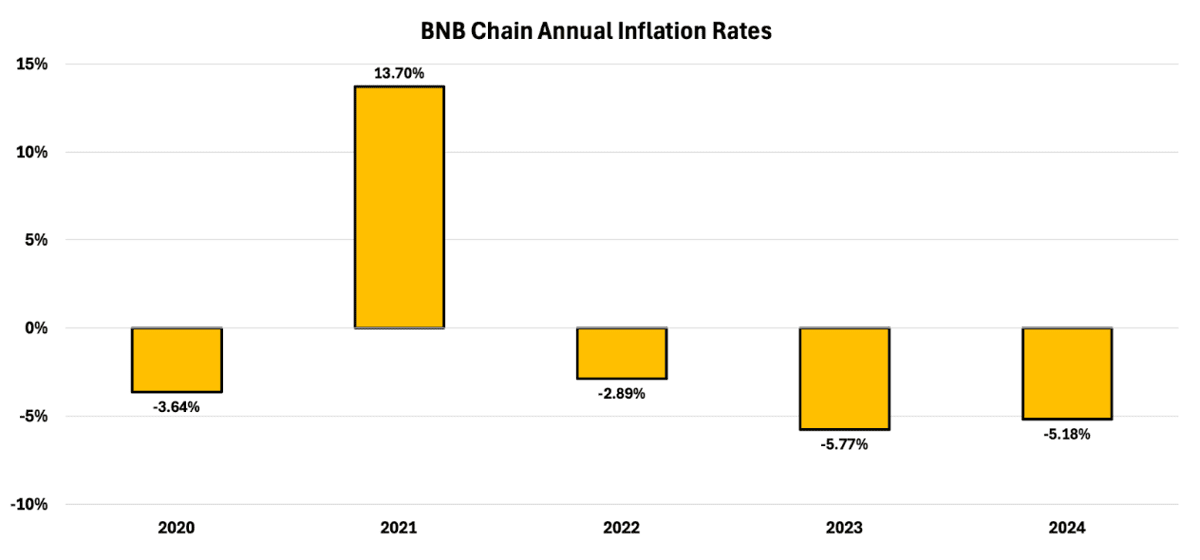
Source: 21Shares, TokenTerminal
Via the BEP-95 improvement proposal, BNB burns a portion of gas fees collected by validators from each block on the BNB Chain. This has burnt close to 252K BNB, since its inauguration, currently worth around $166M.
As a result, BNB’s deflationary monetary policy ranks among the strongest in crypto, combining a 5.2% 2024 deflation rate with a capped max supply—a stark contrast to assets reliant on uncapped emissions. This deliberate scarcity framework positions it uniquely in a market dominated by inflationary tokens.
Leader in embracing AI
As outlined in the BNB 2025 technical roadmap, the network aims to introduce features designed to enhance its competitiveness and strengthen its position as a leader in next-generation blockchain infrastructure. At the core of this vision is an AI-first architecture that natively integrates advanced tools for debugging smart contracts and enabling private data monetization without dependence on third-party services. This strategic shift positions BNB as the premier platform for scalable AI applications, bridging the divide between speculative AI concepts and practical, user-focused innovation.
What are BNB’s Challenges and Risks?
- Centralization Risks: Operates with only 45 active validators vs. thousands in networks like Ethereum.
- Competitive Pressures:

- AI complexity risks: The "AI-first" roadmap introduces untested risks, including AI-generated smart contracts that may exacerbate vulnerabilities. In 2024 alone, 35K high-risk contracts were flagged on the BNB Chain, and AI tools could worsen this trend.
- Market dependency: BNB's performance is highly reliant on favorable market conditions and Binance's legal standing. Regulatory or operational issues with Binance could severely impact BNB's prospects.
- Binance reliance: BNB's success is tightly tied to Binance’s reputation and operations, creating a single point of failure that could deter investors amid security or regulatory challenges.
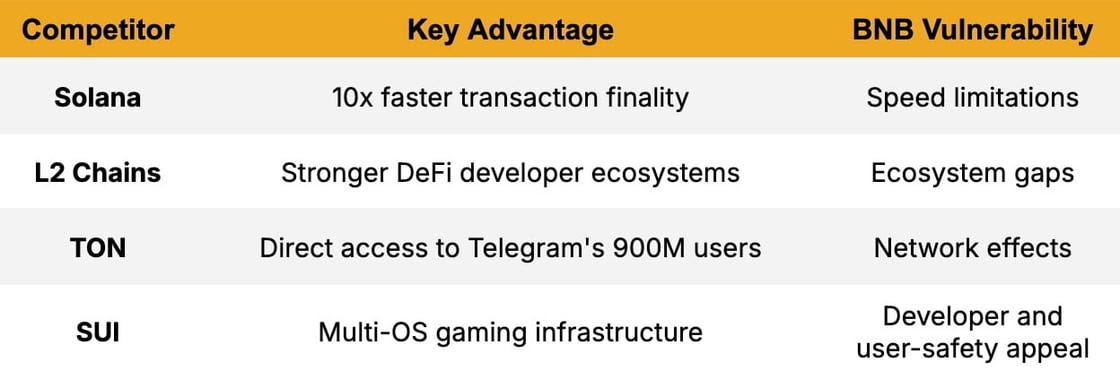
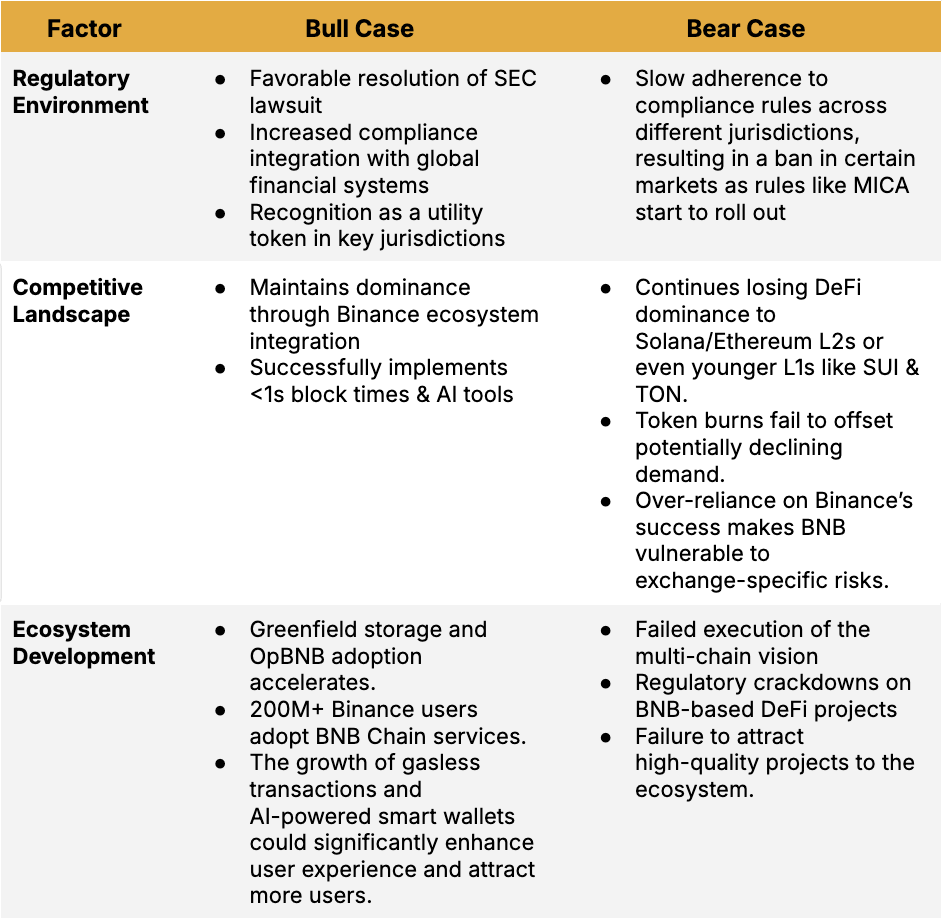
To sum up, here is our outlook for the BNB Chain, taking into account potential outcomes for the bull and bear scenarios: