
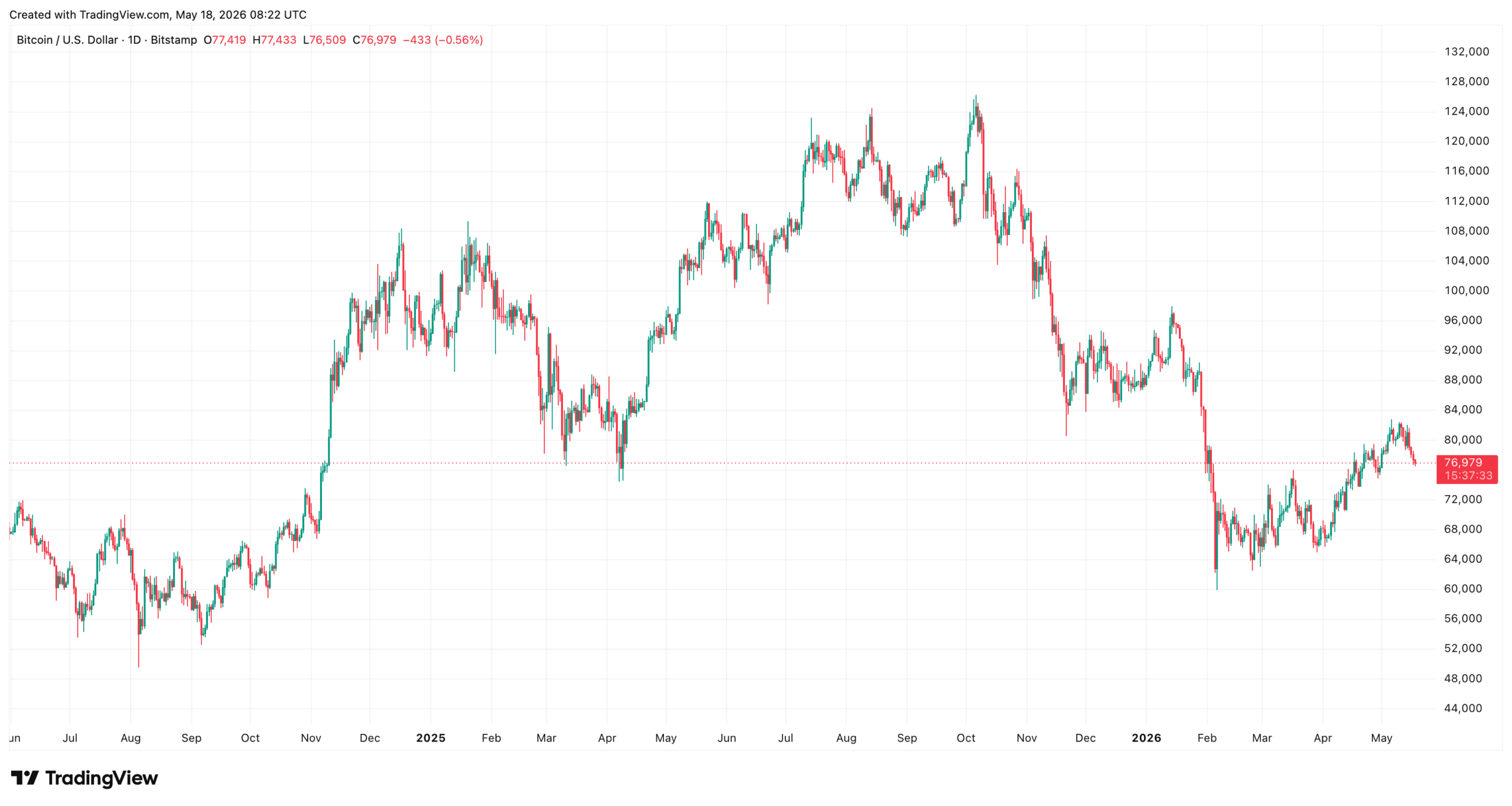
Bitcoin slid below the 77,000 USD mark in early Monday trading and hit a low of 76,650 USD. The initial trigger was a public threat from President Trump against Iran, which, together with rising Treasury yields and ETF outflows, triggered around 660 million USD in liquidations.
Moreover, the Bitcoin sell-off ends a six-week run of net positive inflows into the eleven US spot Bitcoin ETFs. As a result, the rate-cut narrative that had carried the spring rally is also wavering.
Trump threat meets thin liquidity
Late on Sunday, Trump posted on Truth Social: "For Iran, the Clock is Ticking, and they better get moving, FAST, or there won't be anything left of them." Because crypto markets run on thin weekend liquidity, the post accelerated an already unfolding downtrend.
Within 24 hours, exchanges forcibly liquidated crypto positions worth around 660 million USD, of which 584 million USD were long positions. In particular, roughly 610 million USD of these liquidations concentrated in a one to two hour window during the steepest decline. In addition, trading volume jumped to over 24 billion USD.
The total market capitalisation of the crypto sector fell to 2.57 trillion USD, a daily loss of 1.13%. In absolute terms, around 33 billion USD in market value evaporated within a few hours. Bitcoin itself lost 1.62% on a 24-hour basis and moved within a range of 76,678 to 78,539 USD.
Treasury yields and rate narrative break down
Furthermore, the geopolitical escalation hit an already strained macro backdrop. The 30-year US Treasury yield climbed to 5.114%, while the 10-year rose to 4.54%. Both readings mark 12-month highs. At the same time, stubborn inflation prints from PPI and CPI largely destroyed hopes of imminent rate cuts.
Specifically, the CME FedWatch Tool now prices in a 44% probability of a rate hike by December 2026. This represents a structural shift away from the rate-cut narrative that had buoyed risk assets such as Bitcoin in spring. In addition, a stronger US dollar added to the pressure.




Institutional investors retreat
Institutional investors had already been reducing risk before the weekend. For example, the US spot Bitcoin ETFs recorded net outflows of 635 million USD on 13 May, the largest single-day outflow since January. BlackRock's IBIT alone lost 284.69 million USD in one day. In parallel, the Ethereum ETFs saw outflows of 36.3 million USD, of which 21.1 million USD came from BlackRock's ETHA product.
Over five trading days, weekly outflows added up to 1.26 billion USD across all eleven US spot Bitcoin ETFs. Consequently, the six-week inflow streak officially ends, after the funds had collectively pulled in 1.97 billion USD in April 2026. The timing is notable, however: the outflows began before Trump published his Iran post, pointing to a broader reassessment of short-term risk.
Compared to the wider crypto market, Bitcoin shows relative strength. While Ethereum, Solana and XRP lost between 1.5% and 3.8% in the days prior, Bitcoin held up considerably better than ETH, XRP, BNB or SOL during the recent stress phases in 2025 and 2026. The institutional ETF base appears to act as a buffer, even though it is also recording short-term outflows.
Another correction
The current price sits about 30% below the all-time high of more than 109,000 USD that Bitcoin set in January 2025. Therefore, the resistance zone now lies between 79,000 and 82,000 USD, while the next meaningful support runs between 74,000 and 76,000 USD. The 200-day EMA sits at 83,513 USD and acts as a longer-term resistance.
In the background, US-Iran peace talks continue. However, even a recently concluded US-China trade agreement covering Boeing aircraft and agricultural products failed to ease the markets. Beyond that, the geopolitical escalation pushed oil prices higher: on the decentralised trading platform Hyperliquid, traders temporarily moved oil perpetuals at 106 USD per barrel.
The market narrative is therefore shifting overall. Instead of a rally driven by rate cuts, geopolitical risk premia and inflation concerns now dominate. Whether institutional adoption via ETFs holds up through a longer phase of elevated risk aversion will likely define the coming weeks.