
The crypto market has recovered noticeably in recent weeks. On a year to date basis, however, the picture remains more selective. Bitcoin is still trading around 9% lower, while Ethereum remains under even greater pressure with losses of roughly 24%. The rebound points to a stabilization in risk appetite, but not yet to a broad based new bull market.
This marks a key difference from the previous market phase. Capital is no longer flowing evenly back into the broader crypto sector. Instead, it is concentrating in the segments that are deepest in liquidity, most accessible to institutions, and most established from a regulatory perspective. Bitcoin fits these criteria more clearly than any other asset. The broader market, by contrast, remains fragmented and must simultaneously absorb weaker risk appetite, a growing number of tradable tokens, and unevenly distributed liquidity.
As a result, a two tiered market structure is emerging: Bitcoin is increasingly being accumulated through ETFs and corporate treasuries, while altcoins have yet to experience a classic rotation cycle. The recent rebound therefore masks a structural divergence between Bitcoin as the institutional core asset and an altcoin market that is becoming increasingly driven by individual token selection.
Bitcoin: Accumulation Meets Limited New Supply
This dynamic becomes particularly visible when looking at supply and demand. Since the approval of US spot ETFs, Bitcoin has gained a new structural source of demand. Alongside ETF inflows, publicly listed companies have emerged as additional buyers, most notably Strategy/MicroStrategy. This demand is meeting a supply base that continues to grow only at a limited pace.
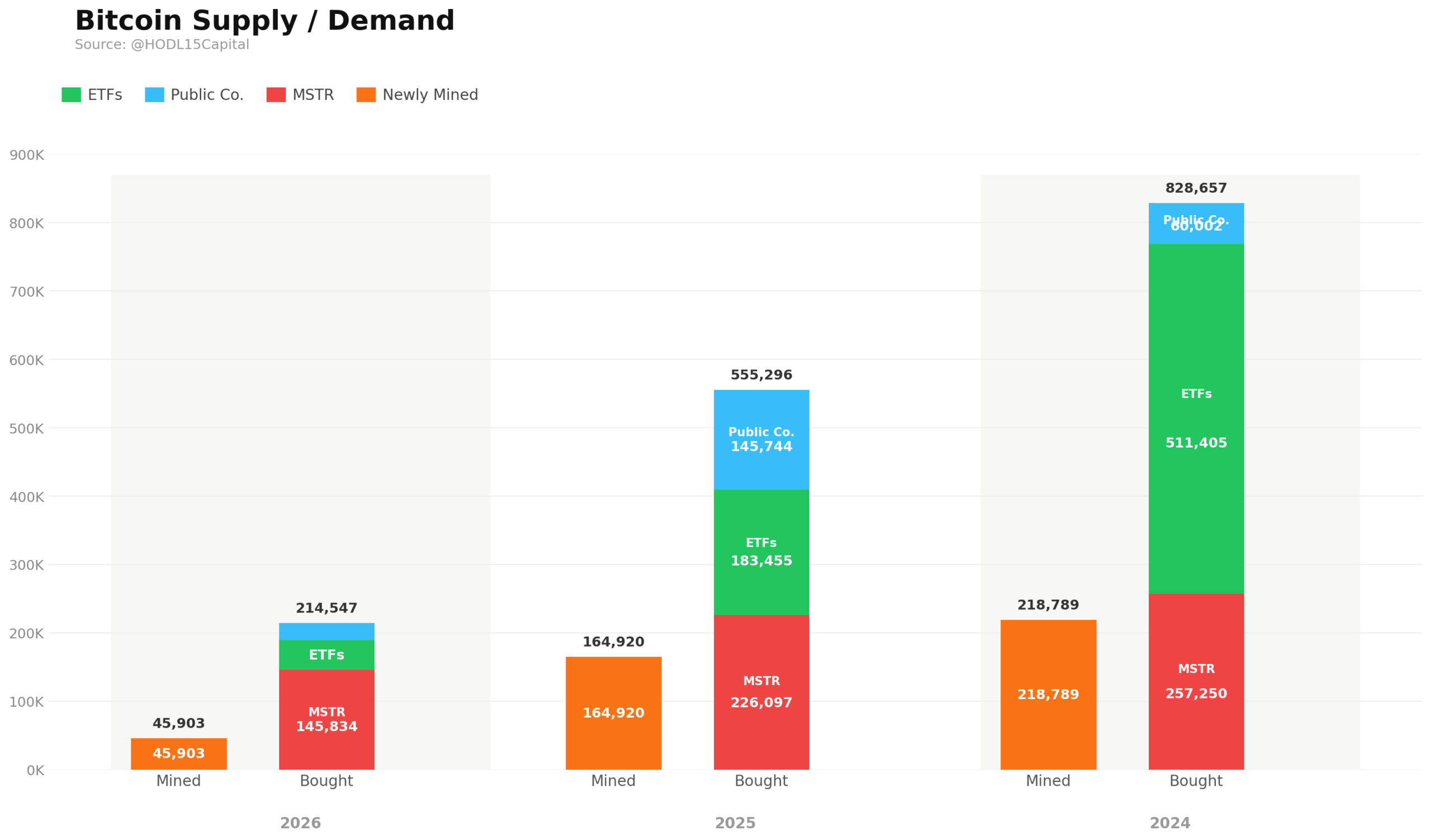
The chart illustrates this dynamic clearly: over the past three years, demand from ETFs, Strategy/MicroStrategy, and other publicly listed companies has already exceeded newly mined Bitcoin supply by a wide margin. Particularly since 2024, it has become increasingly evident that Bitcoin is not only being traded speculatively, but is also being structurally absorbed. Ongoing mining issuance is no longer sufficient to fully satisfy this demand.
These figures should not be interpreted as a short term price signal. They do, however, help explain why Bitcoin is behaving differently from the rest of the sector in the current market environment. What matters is not only the total circulating supply, but the amount of liquid Bitcoin that is actually available in the market. As ETFs and corporate treasuries continue to accumulate Bitcoin, additional demand increasingly has to be met by existing holders. If willingness to sell remains limited, market liquidity can tighten rapidly.
As a result, Bitcoin ETF demand is becoming an increasingly important driver of price formation. Traditional technical analysis remains relevant for short term movements, but medium term dynamics are increasingly shaped by capital flows. Bitcoin is not only being traded, but structurally accumulated. This is what differentiates the current phase from a purely speculative market impulse.
Altcoins: No Classic Rotation, but Increasing Fragmentation
The contrast with the altcoin market remains pronounced. In previous cycles, stronger Bitcoin moves were often followed by rotations into Ethereum, larger altcoins, and eventually smaller tokens further down the market cap curve. So far, this dynamic has only appeared to a limited extent. Bitcoin remains the market’s primary driver, yet its relative strength is no longer automatically translating into broad based gains across the sector.
Year to date performance illustrates this fragmentation clearly. Ethereum (-24%) continues to lag Bitcoin significantly, while Solana (-27%), XRP (-22%), and Cardano (-20%) have also underperformed. At the same time, a handful of outliers have managed to post positive returns: TRON (+25%) and Hyperliquid (+54%) have both outperformed, while Canton Network (+7%) delivered only moderate gains on a year to date basis, despite experiencing stronger momentum at times during the year. These divergences suggest that capital is still seeking opportunities within the altcoin segment, but in a far more selective manner than in previous market phases.
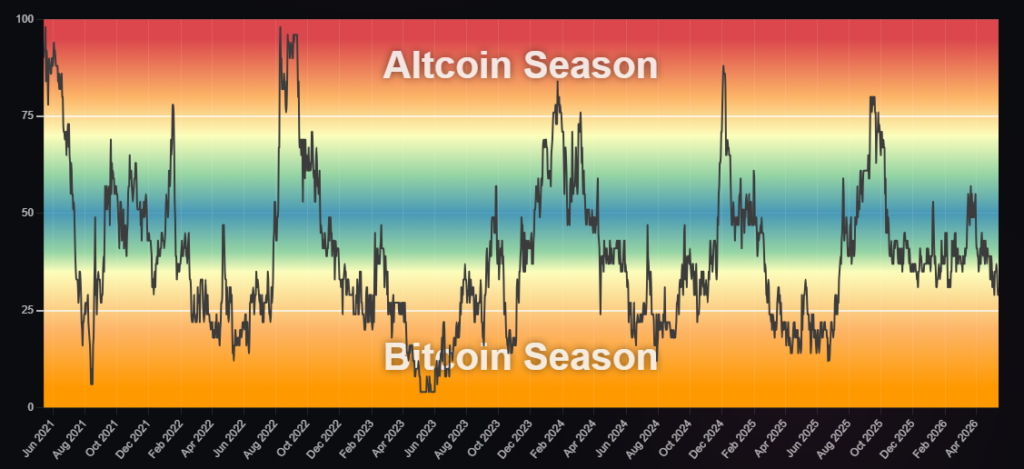
These outliers are particularly important for understanding the current market structure. They do not point to a classic altcoin season, but rather to a market in which individual tokens stand out due to specific narratives, usage trends, or liquidity conditions. Hyperliquid, for example, continues to benefit from its strong positioning in on chain derivatives trading, while TRON is supported by stable stablecoin activity. Canton Network, meanwhile, is more closely tied to institutional infrastructure and tokenization narratives. Despite these isolated winners, overall market breadth remains weak.
Ethereum in particular highlights how challenging the environment has become for the broader altcoin market. Despite its role as the leading smart contract platform, ETH continues to lag Bitcoin significantly on a year to date basis. This is less the result of a single negative factor and more a reflection of shifting capital allocation within the sector: liquidity is no longer automatically moving down the market capitalization curve, but instead remains concentrated in the largest and most accessible assets for longer periods of time.
For altcoins, this creates a much higher selection threshold. Individual tokens can still strongly outperform, but they increasingly require their own catalysts, whether through usage growth, fee generation, stable liquidity, or a compelling narrative. At the same time, the growing number of tradable tokens is intensifying competition for capital. As a result, the market remains investable, but far less broadly supported than in previous cycles.




Institutional BTC Demand Versus the Token Flood
The current market phase therefore cannot be explained by the recent rebound alone. What matters is the structure beneath it. Bitcoin continues to benefit from ETF inflows, corporate treasury purchases, and a limited pace of new supply issuance. The broader crypto market, by contrast, remains far more dependent on risk appetite, ongoing token issuance, and project specific catalysts.
Bitcoin ETF demand has therefore become an important stabilizing force within the market. It creates recurring capital inflows into an asset with a transparently limited supply profile. At the same time, the altcoin market must absorb a continuously expanding universe of tradable tokens. This combination helps explain why Bitcoin remains structurally supported, while many altcoins continue to lag despite the broader market recovery.
As a result, the crypto market in 2026 remains increasingly divided. Bitcoin benefits from structural demand and constrained supply, while altcoins remain fragmented despite a handful of notable outperformers. Unless capital begins to rotate more sustainably from Bitcoin into the broader market, the divergence between accumulated Bitcoin and fragmented altcoin performance is likely to persist.
The recent recovery is therefore constructive, but not yet evidence of a new broad based bull market. The key question is no longer simply whether the market is moving higher, but where capital is flowing. For now, the answer continues to point clearly toward Bitcoin.