
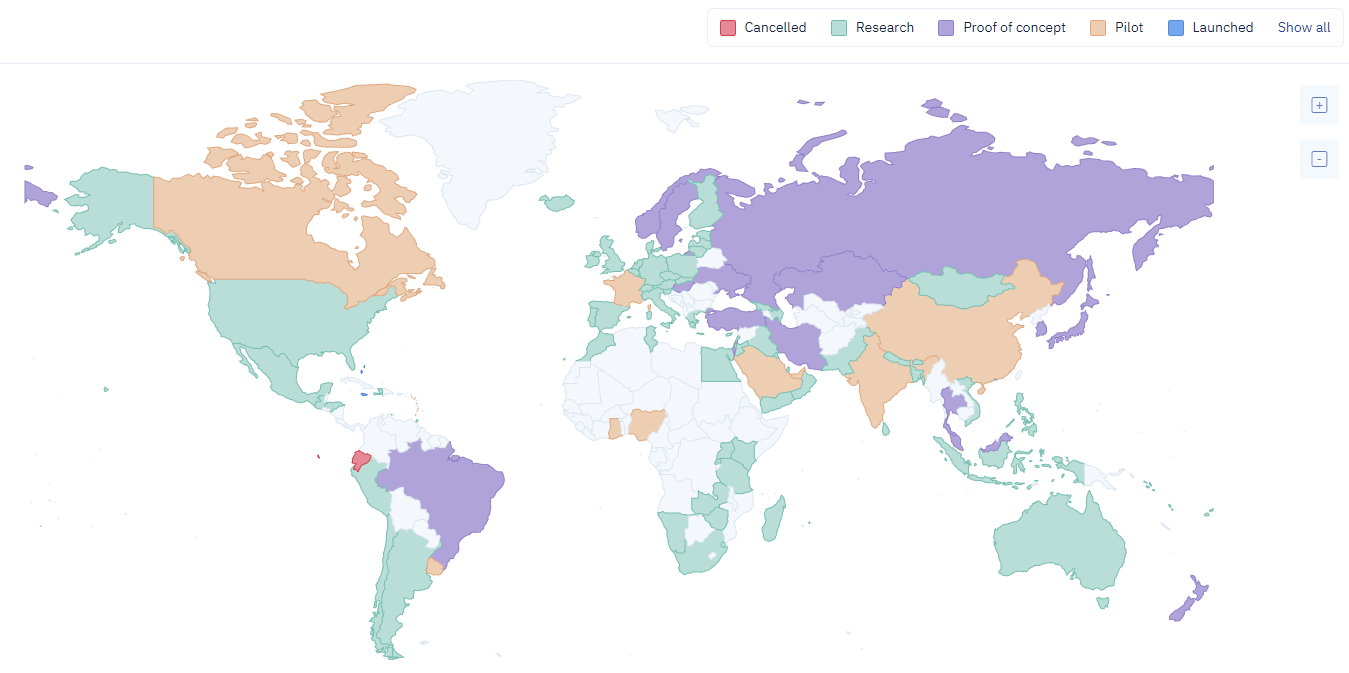
According to the Atlantic Council think tank, nine out of ten central banks around the world are currently exploring the use of CBDCs, while nearly a dozen countries have already adopted their own digital currencies. Together, they represent economies that account for more than 95% of global GDP.
Blockchain technology offers various advantages over the architecture of traditional payment networks. Its distributed ledger enables a decentralized and secure record of transactions, eliminating the need for intermediaries and reducing the risk of fraud. It also makes cross-border payments faster, cheaper and more efficient. These are all advantages that central banks around the world have now recognized. An overview of the partially advanced CBDC efforts around the world.
Central banks under pressure from digitization
The digitization of payments has revolutionized the processing of transactions and makes the cross-border transfer of money easier, faster and more secure. Blockchain technology has an important role to play here, as it enables decentralized, tamper-proof transactions that do not require an intermediary. By using blockchain technology, companies can offer cost-effective and efficient payment solutions that already compete with traditional banking services. In addition, blockchain technology allows for the creation of smart contracts that can automate complex financial arrangements and eliminate the need for intermediaries.
However, the majority of these blockchain and FinTech applications are in the hands of private companies. This devolution of power to the private sector has led to concerns among various central banks about the security and stability of the financial system. One response is reflected in the acceleration of any projects around central bank digital currencies (CBDCs) - digital currencies issued and regulated directly by the central bank. According to leading central banks, CBDCs would maintain their control over the money supply and the financial system while providing consumers with an efficient payment system.
China at the forefront
No other major economic power had started developing a CBDC as early (2014) as China, which explains the advanced stage of the digital yuan. In the meantime, the world's most populous country is in an extensive test phase in which citizens can already use the CBDC to pay for real services and products. China has thus established itself as a clear pioneer in the field. The fact that the digital yuan is severely lacking in privacy hardly needs to be mentioned.
But the Asian economic region as a whole is working diligently on CBDC pilot projects. Indonesia is toying with a wholesale CBDC (Project Garuda), the Japanese government is studying blockchain-based payment infrastructures with the Lao People's Republic (Project DLak), Fiji, Vietnam, as well as the Philippines, and the Monetary Authority of Singapore (MAS) is using CBDCs for cross-border transactions.
World Power USA: Focus on CBDC for large customers
The starting signal for CBDC efforts in the U.S. was given by the Federal Reserve Bank in mid-2021 with its first study on the subject. What began as an "initial consideration" of a digital currency quickly led to gradually expanding pilot projects. The Federal Reserve Bank of New York, for example, announced in November the successful completion of a trial run (Project Cedar) using a CBDC for wholesale cross-border transactions. This involved exchanging a digital dollar with experimental foreign currencies on separate blockchains.
"The experiment's test results showed that the blockchain-enabled payment system settles transactions in less than ten seconds on average, and that throughput across the system increases when additional currencies are included. Evidence of the potential for continued scalability of a modular ledger ecosystem and that DLT could enable atomic settlement faster than the current industry standard of two days." - Federal Reserve Bank of New York Conclusion
Any projects here focus on a "wholesale CBDC" - a digital currency for large customers and banking giants. The advantages of a retail CBDC for everyday payments are of secondary importance to the Federal Reserve. After all, the Federal Reserve does not welcome risks in the area of data protection and potential expansions of authority at the expense of private banks. For everyday payments, privately issued stablecoins are already a capable alternative, as Fed Governor Christopher A. Waller explained at a symposium at Harvard University.
EU wants to catch up
Since 2020, the digital euro has been steadily moving up the priority list of the European Central Bank (ECB). What was propagated at the time as an interesting idea soon seems to become reality. In a study at the beginning of 2023, the euro area's monetary guardian already laid out an approximate timetable for the introduction of a CBDC. After further pilot projects over the summer, the ECB hopes to make the final decision toward the end of the year. The CBDC efforts are driven directly by Chairwoman Christine Lagarde, who has been in favor of the digital euro for quite some time.
The situation is similar in the former EU state of England. According to the deputy governor of the Bank of England (BoE), Jon Cunliffe, a digital pound should be a necessity by the end of the decade at the latest. Similar to the ECB, the British monetary guardian also sees the greatest potential in a digital everyday currency. In a fledgling project, the BoE is working with the Treasury on a comprehensive plan of a CBDC. Including the development of the technical concept, the first public prototype should be ready in three years.
Swiss central bank sees no urgency for CBDC
The Swiss National Bank (SNB) is considered a pioneer due to its active research into blockchain technology and CBDCs based on it. With the help of numerous prototypes, the SNB has already been testing the potential benefits and challenges of a digital currency since 2019. In collaboration with the Bank for International Settlements (BIS) and neighboring central banks, pilot projects have examined cross-border payments (Project Jura), the tokenization of securities (Project Helvetia), and the trading of those assets via DeFi protocols (Project Mariana).
But the SNB also clearly emphasizes the risks of central bank digital currencies. Difficult trade-offs between cyber resilience, scalability and data protection continue to make the central bank hesitant. In particular, a CBDC for private investors is therefore out of the question altogether. If the digital franc is implemented in the future, it would essentially affect financial institutions.