
Close Menu
Crypto Valley Journal
    Facebook X (Twitter) Instagram
    Crypto Valley Journal
    • Hot Topics
      • News
      • Minds
    • Focus
      • Background
      • Blockchain
      • Legal & Compliance
      • Non-Fungible Token (NFTs)
    • Investing
      • Markets
      • Financial Products
      • Decentralized Finance (DeFi)
      • Exchange overview
    • Education
      • Basics
      • Glossary
      • Politicians on crypto
    • Statistics
      • Bitcoin-ETF-Flows
      • Ethereum-ETF-Flows
      • Crypto market data
      • On-chain data
    • Academy
      • Overview
      • Part 1: Blockchain
      • Part 2: Money
      • Part 3: Bitcoin
      • Part 4: Cryptocurrencies
      • Part 5: Decentralized Finance
      • Part 6: Investing
    • English
      • Deutsch
    Crypto Valley Journal
    You are at:Home»Focus»Background»MicroStrategy’s $42 Billion Plan: A Systemic Risk for Bitcoin?
    Der 42 Mrd. USD MicroStrategy-Plan: ein systemisches Risiko für Bitcoin?

    MicroStrategy’s $42 Billion Plan: A Systemic Risk for Bitcoin?

    By Editorial Office CVJ.CH on 28. November 2024 Background

    Since 2020, software developer MicroStrategy has taken on billions in debt to acquire bitcoin. So far, the strategy has paid off. The company's stock is at an all-time high. But how does Michael Saylor's bitcoin strategy work, and does it pose a risk to the industry?

    Before entering the bitcoin market, MicroStrategy was primarily a business intelligence and analytics software company, providing tools for data-driven decision making and corporate reporting. However, this business had been stagnant for more than a decade. The company could not reinvest its remaining cash in a scalable way. So in August 2020, MicroStrategy CEO Michael Saylor decided to make an initial investment in bitcoin. After evaluating various asset classes, the company concluded that investing in "digital gold" was the best use of its reserves. The strategy paid off when bitcoin hit an all-time high in December 2020 and MicroStrategy's stock soared. Saylor discovered a seemingly endless cycle of capital generation.

    Subscribe to our newsletter

    The best articles of the week, directly delivered into your mailbox.

    MicroStrategy Becomes a Bitcoin Hedge Fund

    Instead of simply investing excess profits in bitcoin, MicroStrategy began taking on debt to fund its purchases. This was done primarily through convertible bonds. Convertible bonds are a type of corporate debt that allows investors to convert their bonds into a predetermined number of shares of the issuing company. These bonds combine the characteristics of debt (regular interest payments) and equity (potential for stock appreciation).

    Due to significant price increases, MicroStrategy has seen strong demand for long-dated (2027+) convertible bonds with low interest rates (below 2%). Buyers of these bonds are less interested in the interest payments and more focused on the upside potential of the stock.
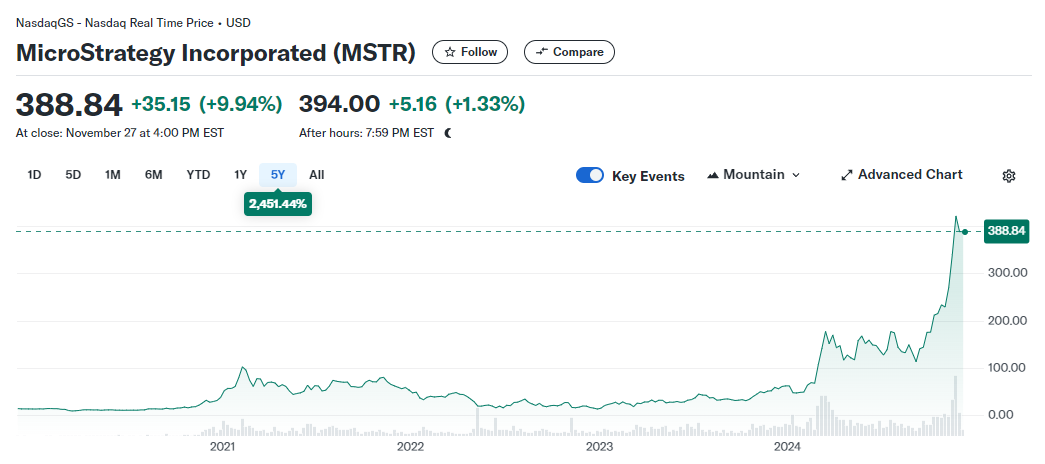
    MicroStrategy Stock (MSTR) since 2019 / Source: Yahoo Finance

    The company channels all the capital it raises directly into bitcoin. The billions of dollars of buying pressure helps drive the price of bitcoin even higher. These investments increase in value, which supports MicroStrategy's stock price. Saylor then gains access to more debt. The CEO plans to continue this cycle indefinitely-as long as there is demand for the company's bonds. By 2027, MicroStrategy aims to raise more than $42 billion to invest in bitcoin. In November alone, the company secured $5 billion at zero interest, according to press releases.


    Ray Dalio’s Bridgewater Associates Minds

    Star investor Ray Dalio considers Bitcoin inferior to gold

    CLARITY Act DeFi Background

    CLARITY Act: The year’s most important crypto deal heads for a decision

    Descartes Finance is the first Swiss asset manager to systematically integrate Bitcoin into pillar 3a and vested benefits portfolios. Financial Products

    Descartes integrates Bitcoin into pillar 3a model portfolios

    Digital finance transparency relies on Proof of Reserves, Merkle trees, MPC custody and 24/7 monitoring to verify solvency and user assets. Basics

    Transparency as the foundation of security in digital finance

    Ray Dalio’s Bridgewater Associates Minds

    Star investor Ray Dalio considers Bitcoin inferior to gold

    CLARITY Act DeFi Background

    CLARITY Act: The year’s most important crypto deal heads for a decision

    A sustainable strategy?

    In essence, Saylor is selling call options on MicroStrategy stock to accumulate as much bitcoin as possible. Bond holders include insurance giants like Allianz, who find the potential price gains more enticing than the typical 5% annual returns of conventional bonds. If the price of bitcoin doesn't rise enough, investors simply get their money back. They only bear the opportunity cost and the risk of MicroStrategy's insolvency. This leveraged bitcoin strategy is now priced at a premium to the company's assets. To date, MicroStrategy has purchased 386,700 bitcoins worth $37 billion for $21.9 billion, at an average price of $56,761 per bitcoin. With a current market valuation of nearly $90 billion, this results in an approximate 2.4x multiple on the company's assets.
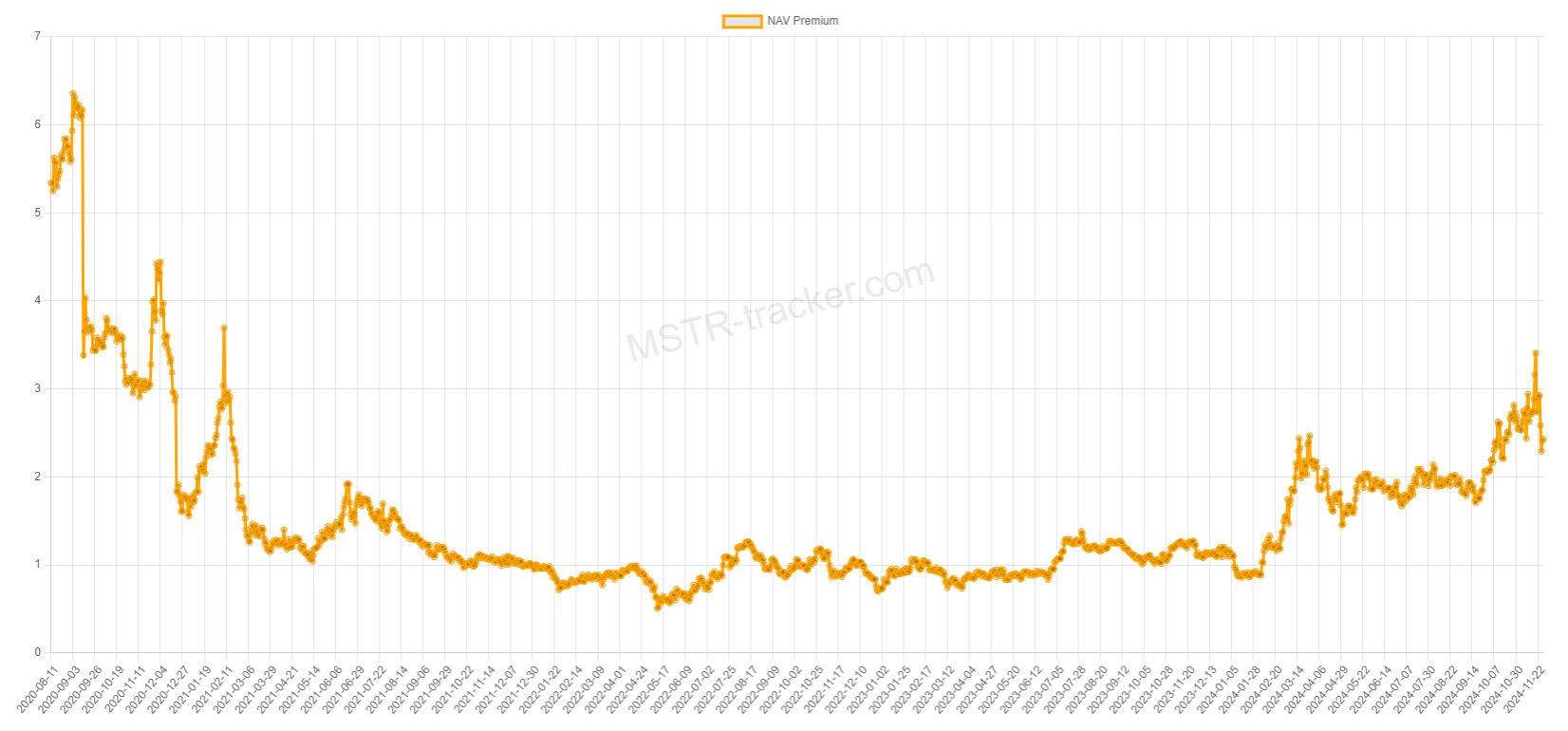
    MicroStrategy Multiplier Compared to "Net Asset Value" (NAV) / Source: MSTR Tracker

    Some investors view this valuation as a sign that MicroStrategy's stock is relatively overvalued. Last week, prominent short seller Citron Research announced a short position, arguing that the company's valuation is completely disconnected from bitcoin fundamentals. After all, there is no direct mechanism to exchange bitcoin for stocks. What's more, MicroStrategy is not obligated to pay back its loans until 2027 at the earliest. As long as the price of bitcoin continues to rise, the cycle works. Only a significant price crash in the distant future might force Saylor to sell some of his holdings.


    Share. Facebook Twitter LinkedIn Email Telegram WhatsApp

    About the author

    Editorial Office CVJ.CH

      The CVJ editorial staff consists of a team of Blockchain experts and informs daily and independently about the most exciting news.

      Related Articles

      Bitcoin falls below 77,000 USD after Trump's Iran warning. Around $660 million in liquidations and ETF outflows weigh on the crypto market.

      Bitcoin falls below 77,000 USD after Trump’s Iran warning

      Crypto Market 2026: Bitcoin Supply Tightens, Altcoins Remain Fragmented

      Charles Schwab launches Schwab Crypto: spot trading for Bitcoin and Ethereum with a 75 basis point fee and Paxos as sub-custodian.

      Charles Schwab launches spot trading for Bitcoin and Ethereum

      Goldman Sachs liquidiert im Q1 2026 alle XRP- und SOL-ETF-Positionen, kürzt Ethereum um 70% und eröffnet HYPE-Treasury-Position PURR.
      18. May 2026

      Goldman Sachs fully liquidates XRP and Solana ETFs

      General Bytes ATM
      18. May 2026

      ATM provider Bitcoin Depot is ceasing operations and filing for bankruptcy

      Bitcoin falls below 77,000 USD after Trump's Iran warning. Around $660 million in liquidations and ETF outflows weigh on the crypto market.
      18. May 2026

      Bitcoin falls below 77,000 USD after Trump’s Iran warning

      twitter image button instagram image button linkedin image button youtube image button

      About Crypto Valley Journal
      About Crypto Valley Journal

      On the pulse of the movement

      • Academy
      • Contact
      • Advertising
      • About us
      • Partner
      • Imprint
      • Privacy
      • Disclaimer
      Search

      Type above and press Enter to search. Press Esc to cancel.