
Strategy and BitMine are deep in the red: across their crypto treasury positions, the two companies together sit on roughly USD 21 billion in unrealized book losses. At the same time, the entire Digital Asset Treasury Company sector has shed USD 62 billion in market capitalization.
Digital Asset Treasury Companies, or DATs, raise capital through share and bond issuance and deploy it exclusively into crypto assets such as Bitcoin or Ethereum. Here, crypto is the primary balance sheet asset, not a means of payment or a technology. Strategy is regarded as the pioneer of the model: Michael Saylor launched it in August 2020 with an initial purchase of 21,454 BTC for USD 250 million. BitMine, by contrast, pivoted in 2025 under Tom Lee from a Bitcoin mining operation to an Ethereum treasury and named the strategy "Alchemy of 5%". Both stocks initially traded for a long time with mNAV premiums above 1.0x, which is what drove the model in the first place. Meanwhile, Bitcoin stands 32% lower year to date and Ethereum 48%, leaving both assets well below the treasury companies' entry prices.
Strategy sells Bitcoin for the first time since 2022
Between May 26 and 31, 2026, Strategy sold 32 BTC for USD 2.5 million, which corresponds to a price of USD 77,135 per Bitcoin. It was the first disposal since 2022 and therefore a break with the company's own "never sell" doctrine. The proceeds flowed into the dividend on the STRC preferred shares. The size is not what makes the move significant; instead, it is the precedent: on May 11, the company had still bought an additional 535 BTC for USD 43 million.
Behind this sits a tight obligation structure. As of May 31, Strategy held a USD reserve of USD 900 million, while five series of preferred shares generate annual obligations of USD 750 to 800 million. As a result, the reserve barely covers the running dividend and debt costs. The 32 Bitcoin sold therefore look less like an exception than like a first signal of structural pressure.
Saylor himself announced the step openly and framed it as a deliberate signal to the market.
"We will probably sell some Bitcoin to pay a dividend, simply to immunize the market and to set the signal that we have done it." - Michael Saylor, CEO Strategy
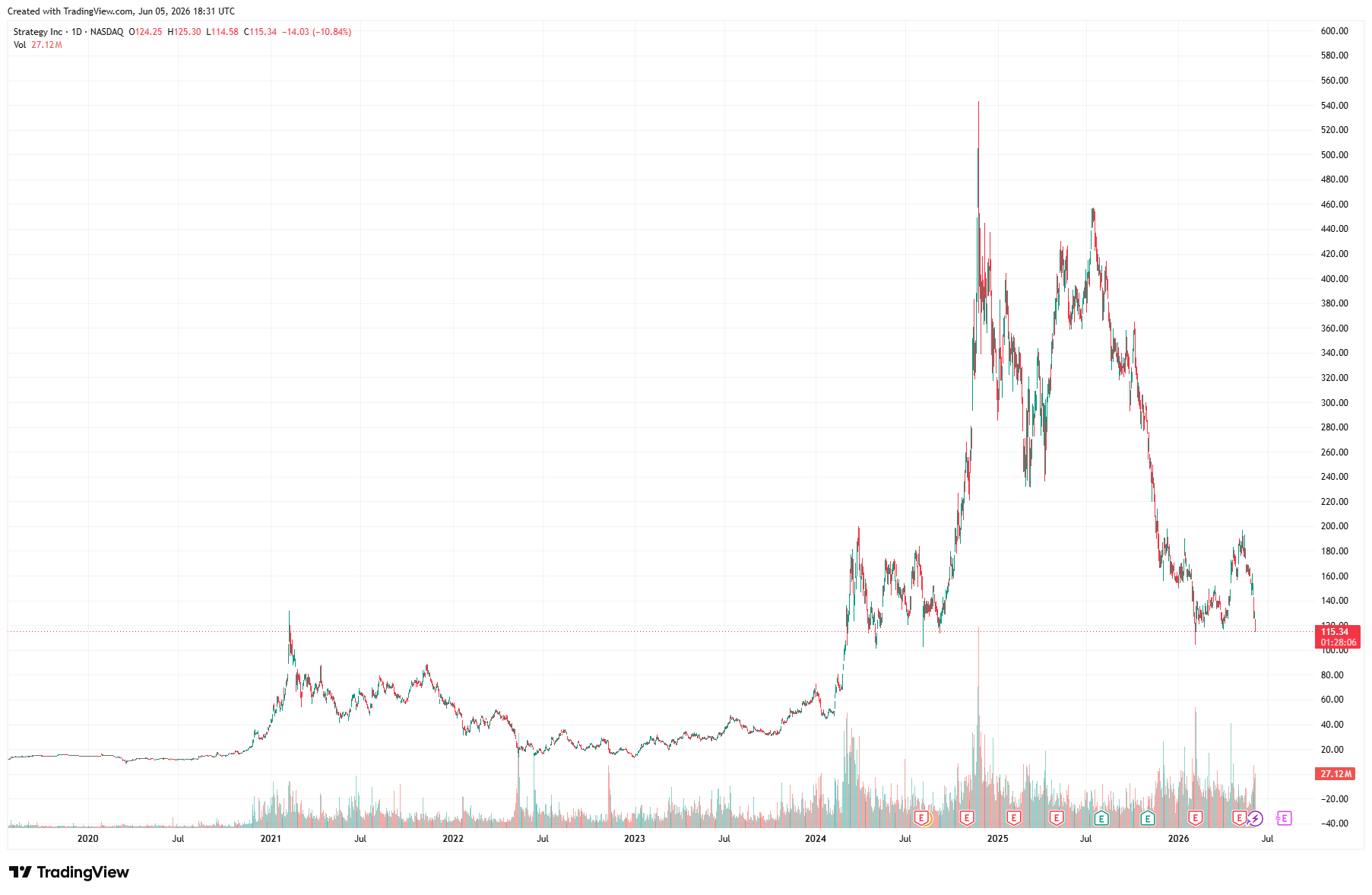
The book loss on the total position of 843,706 BTC currently amounts to roughly USD 10.8 billion, measured against the average entry of USD 75,699. For the first quarter of 2026, the company additionally reported a net loss of USD 12.54 billion, driven by an unrealized Bitcoin loss of USD 14.46 billion. The MSTR stock now trades around 66% below its 52-week high.
BitMine's ETH bet costs 10 billion
As of June 1, 2026, BitMine holds roughly 5,416,901 ETH, equal to about 4.49% of the circulating supply. Of this, 4,718,677 ETH, or 87%, is staked. The cost basis stands at around USD 18 billion, with an average entry of USD 3,476 per ETH. At a current price of USD 1,555, this results in a book loss of about USD 10.4 billion. With "Alchemy of 5%", Tom Lee had initially set the goal of accumulating roughly 6 million ETH, and thus about 5% of the total supply.
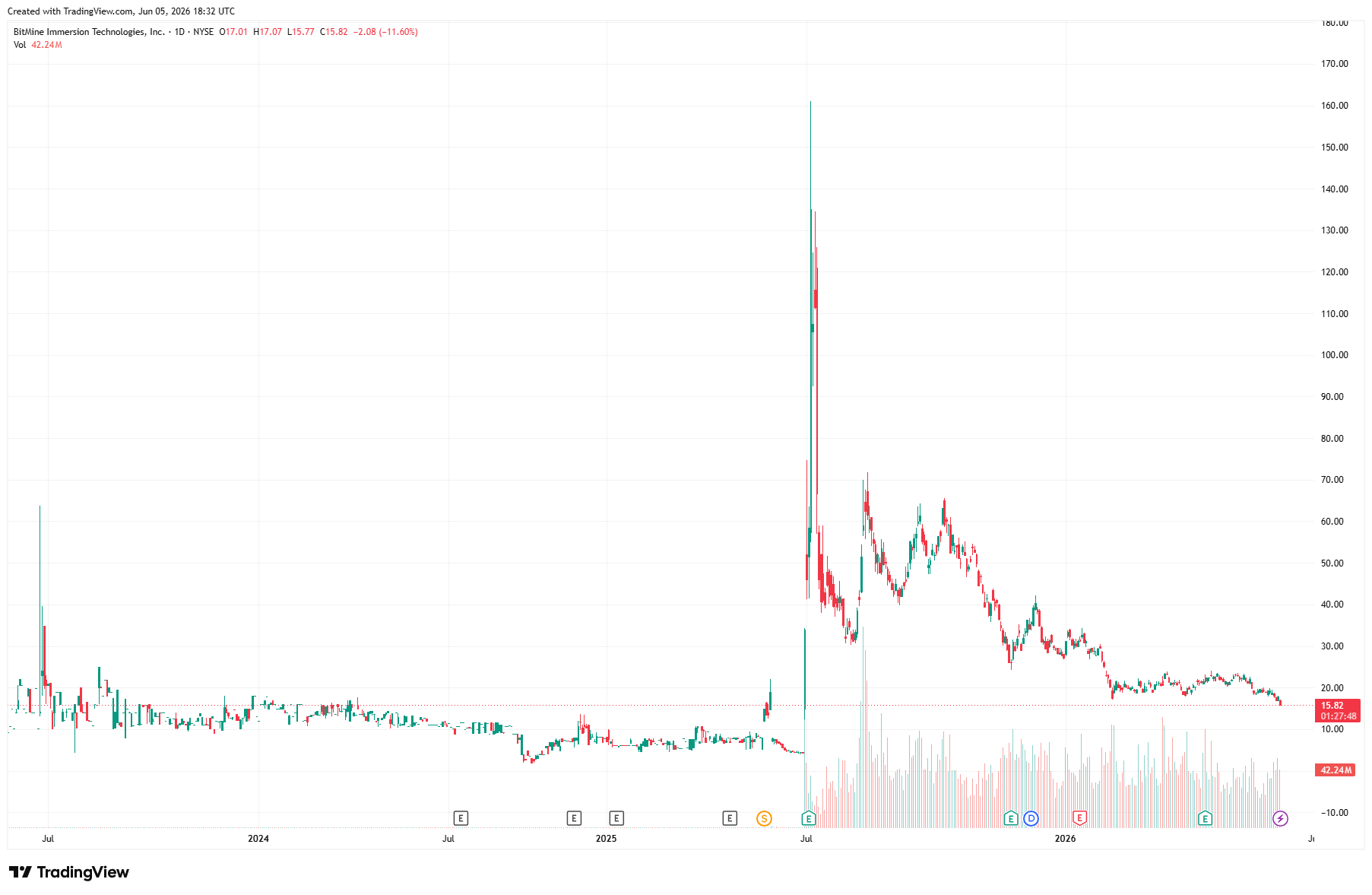
The buildup was financed exclusively through share issuance, meaning without debt. The company estimates annualized staking income at USD 296 to 374 million at a seven-day yield of 2.7 to 2.9%. However, these earnings are not mathematically sufficient to cover a book loss of more than USD 10 billion within any foreseeable period. At the same time, the BMNR stock has fallen from a 52-week high of USD 161 to below USD 17, a drop of roughly 89%, which has shrunk the mNAV premium to about 0.95x. As a result, the issuance logic also loses its basis, because new shares below the intrinsic value of the crypto holdings dilute existing stakes.
Beyond the ETH position, the company holds roughly 203 BTC plus cash reserves of about USD 446 million and investments under the "Moonshot Investments" label. Tom Lee called the book losses a "feature, not a bug" and pointed to the ongoing staking yield on the staked holdings. The market, however, takes a different view, as the share price well below the intrinsic value of the crypto holdings shows.




When the mNAV premium falls, the model breaks
The DAT model works as a self-reinforcing loop as long as the stock trades with an mNAV premium above 1.0x. The company then issues new shares, buys crypto assets with the proceeds, and raises the book value per share, which in turn supports the premium. Saylor established this mechanism from 2020 onward, and for years it drove the value appreciation of the treasury pioneers.
As soon as the premium falls below 1.0x, however, the logic flips into reverse. Strategy's mNAV stands at 0.72x on a market capitalization basis, but at 1.03x when measured against enterprise value. BitMine likewise trades just below, at around 0.95x. Under these conditions, new share issuance would be dilutive instead of accretive, which stalls the model's growth engine. The pressure is additionally intensified by a 2026 FASB rule change, under which unrealized gains and losses on digital assets flow directly into net income and produce massive negative swings in the quarterly reports.
This leaves the treasury companies three levers: a price recovery in the assets, ongoing staking and yield income, and open access to capital markets. If one of these factors is missing, leveraged DATs quickly come under pressure. Finally, the prediction markets on Kalshi assign an 80% probability that Bitcoin will fall below USD 60,000 again in 2026.
Broader DAT sector under pressure
The pressure is not limited to Strategy and BitMine. The combined market capitalization of all Bitcoin treasury companies has fallen from just under USD 134 billion in October 2025 to roughly USD 72 billion, a loss of USD 62 billion. Strategy clearly dominates the sector: with 843,706 BTC, the company alone holds around 76% of all Bitcoin owned by listed treasury firms, which together manage 1,215,993 BTC.
The imitators have meanwhile almost halted their purchases. In the past month, the non-Strategy firms together acquired only 1,000 BTC, a decline of 99% from the peak of 69,000 BTC in August 2025. The individual cases show the scale: Nakamoto under David Bailey carried out a reverse stock split at a ratio of 1:40, the Japanese Metaplanet trades more than 80% below its annual high, and SoftBank sold its entire 26% stake in Twenty One Capital to Tether. As a result, the model no longer attracts any new participants.