Close Menu
Crypto Valley Journal
    Facebook X (Twitter) Instagram
    Crypto Valley Journal
    • Hot Topics
      • News
      • Minds
    • Focus
      • Background
      • Blockchain
      • Legal & Compliance
      • Non-Fungible Token (NFTs)
    • Investing
      • Markets
      • Financial Products
      • Decentralized Finance (DeFi)
      • Exchange overview
    • Education
      • Basics
      • Glossary
      • Politicians on crypto
    • Statistics
      • Bitcoin-ETF-Flows
      • Ethereum-ETF-Flows
      • Crypto market data
      • On-chain data
    • Academy
      • Overview
      • Part 1: Blockchain
      • Part 2: Money
      • Part 3: Bitcoin
      • Part 4: Cryptocurrencies
      • Part 5: Decentralized Finance
      • Part 6: Investing
    • English
      • Deutsch
    Crypto Valley Journal
    You are at:Home » Focus » Background » Power Shift in Crypto Exchanges: Retail Overtakes Institutional

    Power Shift in Crypto Exchanges: Retail Overtakes Institutional

    By Editorial Office CVJ.CH on 13. April 2026 Background

    Centralized crypto exchanges remain at the core of the crypto market, but their role is beginning to shift. The focus is increasingly moving away from the passive custody of capital toward its active use in trading.

    Centralized crypto exchanges, or CEXs, continue to form the backbone of the market. They provide liquidity and serve as the primary access point for both retail and institutional investors. However, the latest CoinGecko report shows that it is no longer the size of assets held on these platforms that matters most, but how actively that capital is being used.

    Total reserves across the largest platforms have increased significantly over the past two years. At the same time, capital is increasingly shifting between exchanges. Platforms with more active, trading-oriented user bases are gaining importance, while others are seeing declining balances.

    Subscribe to our newsletter

    The best articles of the week, directly delivered into your mailbox.

    Activity Becomes Key for Centralized Crypto Exchanges

    Institutionally oriented platforms continue to serve primarily as custodial venues. A large share of assets held on these exchanges remains relatively inactive. In contrast, exchanges with a stronger retail-driven profile show significantly higher trading activity. Liquidity circulates more rapidly and positions are adjusted more frequently.

    At the same time, the structure of demand is evolving. A growing share of institutional investment flows through regulated products such as ETFs rather than directly via spot exchanges. This reduces trading activity on traditional platforms without diminishing their overall importance. The shift is further reinforced by market structure. Platforms with active user bases benefit from lower fees, more frequent listings, and trading-oriented features that keep capital in motion.

    This development highlights a broader shift in the role of centralized crypto exchanges. Platforms such as Bitget and MEXC are gaining relevance by attracting active, trading-focused users and generating higher capital turnover. While this increases efficiency, it also leads to greater sensitivity to market movements. Capital can exit these systems more quickly, amplifying pressure during periods of stress.

    In parallel, decentralized exchanges continue to gain traction. Their share of global spot trading is steadily increasing, pointing to a structural shift in market architecture. Centralized platforms still dominate overall, but the direction is clear. Trading activity is gradually moving toward systems where capital is deployed more efficiently and directly.


    Ray Dalio’s Bridgewater Associates Minds

    Star investor Ray Dalio considers Bitcoin inferior to gold

    CLARITY Act DeFi Background

    CLARITY Act: The year’s most important crypto deal heads for a decision

    Hyperliquid ETFs post record daily inflows of 25.5 million USD. HYPE token gains double digits and beats Bitcoin on a market-adjusted basis. Financial Products

    HYPE all-time high: Hyperliquid ETFs post record inflow of 25 million USD

    Digital finance transparency relies on Proof of Reserves, Merkle trees, MPC custody and 24/7 monitoring to verify solvency and user assets. Basics

    Transparency as the foundation of security in digital finance

    Ray Dalio’s Bridgewater Associates Minds

    Star investor Ray Dalio considers Bitcoin inferior to gold

    CLARITY Act DeFi Background

    CLARITY Act: The year’s most important crypto deal heads for a decision

    Listings Lose Relevance

    Another key finding relates to new token listings. While they continue to attract attention, they rarely prove to be a sustainable source of returns. A large share of newly listed assets declines in value early and fails to hold up over time. This aligns with our previous analysis on token inflation. The growing number of new projects is met with limited demand, and even major exchanges list only a small fraction of the tokens being created. As a result, competition for capital continues to intensify, and visibility through a listing alone is no longer sufficient.

    For investors, the focus is shifting accordingly. What matters is not access to an exchange, but whether a project generates real usage and can attract capital over time. This dynamic is reinforced by the structure of trading itself. Stablecoin pairs dominate the majority of volume, anchoring the market in dollar-based liquidity where capital is reallocated more quickly and risk positions are adjusted more dynamically.
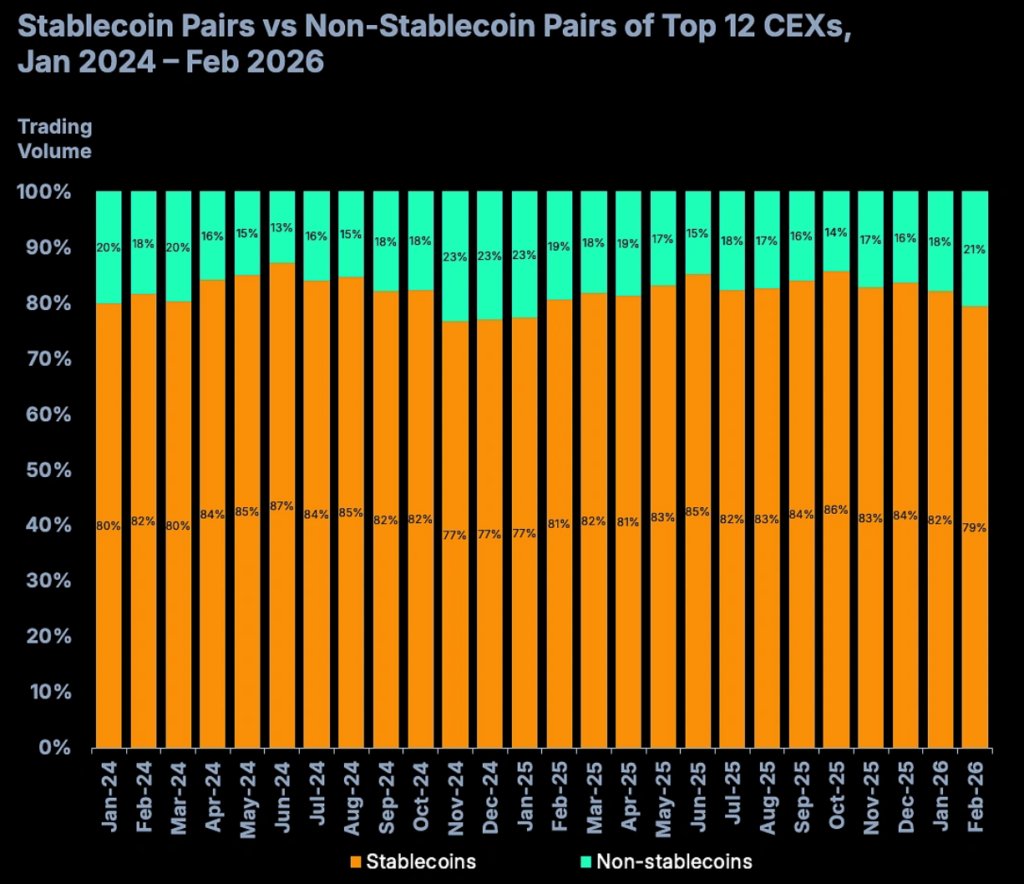
    Stablecoin vs non stablecoin pairs / Source: Coingecko 2026 CEX ReportThe report confirms a central development in the crypto market. It is no longer listings or platform size that determine success, but the actual utilization of capital.


    Share. Facebook Twitter LinkedIn Email Telegram WhatsApp

    About the author

    Editorial Office CVJ.CH
    • Website
    • Twitter
    • LinkedIn

    Since 2018, the editorial team at Crypto Valley Journal has been reporting from Zug - the heart of Switzerland’s Crypto Valley - on Bitcoin, cryptocurrency, blockchain, and regulatory developments in digital assets. Behind the publication’s collective editorial voice is a team of writers with backgrounds in financial markets, law, and technology.

    Related Articles

    CLARITY Act DeFi

    CLARITY Act: The year’s most important crypto deal heads for a decision

    Analysis by Bitget Research on Bitcoin quantum computing risks, ECDSA exposure, NIST post-quantum standards, and BIP-360 migration paths.

    Bitcoin quantum computing: What recent developments mean for network security

    XRPL validator analyzes quantum risk: only 0.03% of XRP supply is exposed, compared to up to 35% for Bitcoin. Google sets 2029 deadline.

    Quantum risk: Is XRP more secure than Bitcoin?

    cvj weekly review
    23. May 2026

    Weekly review CW 21: SpaceX reveals $1.5 billion Bitcoin investment

    Polymarket exploit on Polygon: the UMA CTF Adapter loses more than 520,000 USD to labelled exploiter addresses.
    22. May 2026

    Polymarket exploit: prediction market loses $520k to attackers

    Trump Media bitcoin holdings shrink: 2,650 BTC moved to Crypto.com, remaining 6.8k BTC sit 34% below the cost basis.
    22. May 2026

    Trump Media sells more bitcoin at a 34% loss

    twitter image button instagram image button linkedin image button youtube image button

    About Crypto Valley Journal
    About Crypto Valley Journal

    On the pulse of the movement

    • Academy
    • Contact
    • Advertising
    • About us
    • Partner
    • Imprint
    • Privacy
    • Disclaimer
    Search

    Type above and press Enter to search. Press Esc to cancel.