Since 2020, Uniswap has been the leading decentralized exchange (DEX) processing a daily cryptocurrency trading volume in the billions. A lawsuit filed by the US Securities and Exchange Commission (SEC) now accuses Uniswap Labs, the platform developer, of violating US securities laws.
Blockchain technology enables the programming of automatically executing protocols so-called "smart contracts". Developers can create applications in a decentralized manner that run independently on a distributed network. Today, there is an extensive ecosystem of such decentralized applications (dApps). Uniswap being the leading protocol for cryptocurrency trading. The application was developed by the U.S.-based company Uniswap Labs. According to the SEC, Uniswap Labs is providing an unregistered offering of securities to investors. Such an interpretation of the law could have devastating consequences for the entire decentralized finance (DeFi) sector.
Uniswap: a decentralized, independent cryptocurrency exchange
Uniswap allows users to trade different cryptocurrencies without the need for a traditional exchange. The platform was founded in November 2018 by Hayden Adams, inspired by the concept of Ethereum creator Vitalik Buterin. Uniswap stands out for its innovative use of automated liquidity protocols. This system allows the DEX to operate continuously, without the need for an order book or intermediaries. Users contribute to liquidity pools, and trading prices are algorithmically determined based on supply and demand within these pools.
Since its inception, Uniswap has grown significantly and has become a fundamental part of the DeFi ecosystem. The platform has undergone several upgrades from Uniswap V1 to the latest V4. History and differences between Uniswap versions can be found here. To date, users process approximately two billion USD of trading volume per day using Uniswap smart contracts.
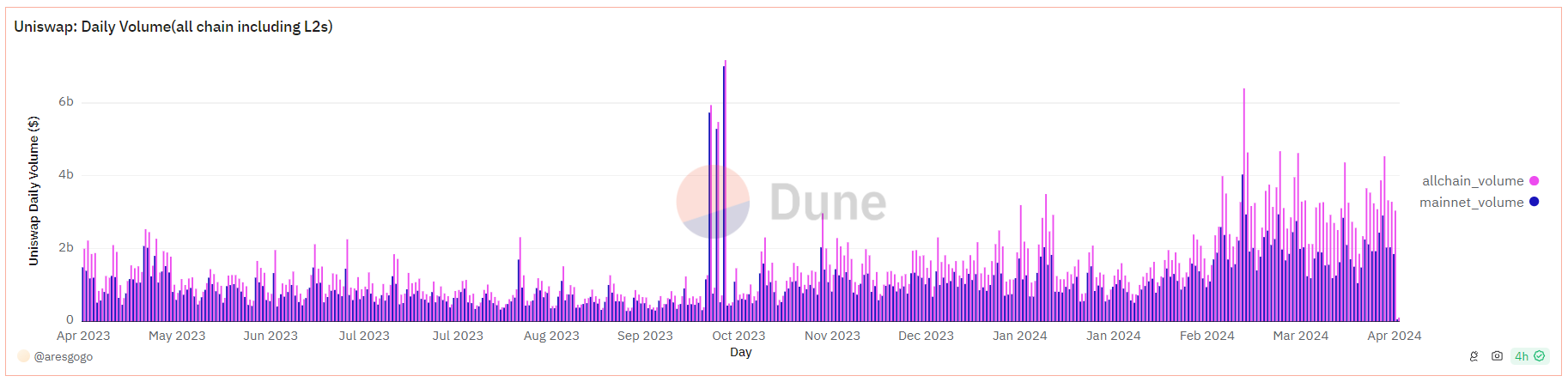
Daily Uniswap trading volume / Source: Dune
While Uniswap lags behind the world's largest centralized crypto exchange, Binance, with over ten billion USD in daily spot volume, the leading decentralized exchange would rank fifth in volume compared to other centralized exchanges. And everyone has access without restriction based on nationality, employment status or financial standing. The SEC apparently finds this open access to Uniswap troubling. After all, the regulator cannot require KYC checks or control the trading platform in other ways.

Regulatory pressure on the US company
Already in 2021, the SEC put pressure on the Uniswap development team. Although no lawsuit was filed, Uniswap Labs limited the number of tradable tokens through the U.S. company's front-end - the graphical user interface for interacting with the protocol. The move followed a statement by SEC Chairman Gary Gensler that DeFi protocols are also subject to securities laws.
"Whether it's an equity token, a securities-backed stablecoin, or any other virtual product that provides synthetic exposure to underlying securities, these platforms - whether in the decentralized or centralized financial space - are implicated by the securities laws and must operate within our securities system." - Gary Gensler, SEC Chairman
It's important to distinguish between the front-end and the protocol level. The Uniswap protocol is an immutable, open-source smart contract on the Ethereum blockchain. While Uniswap Labs has developed much of the program code, the company cannot implement changes to the smart contract, nor is Uniswap Labs involved in liquidity provision or market making in any way. The user interface may also be provided by other parties. A significant portion of Uniswap's volume is cleared through DEX aggregators.
Uniswap Labs receives SEC Wells Notice
Nevertheless, Uniswap Labs received a Wells Notice from the SEC last week. This is a formal notification from the regulator that an enforcement action has been initiated against the company. The exact allegations against Uniswap Labs are not yet known. The Chief Legal Officer of the US company posted his initial thoughts on X (formerly Twitter).
He once again called it an ideological abuse of power by the SEC. It is now known that the agency under Gensler takes a clear anti-crypto stance. Uniswap Labs is ready to defend itself in court. Neither the Uniswap protocol nor the user interface provided by Uniswap Labs constitutes a securities offering. Nor has the SEC been able to prove the status of most cryptocurrencies as securities. The Chief Legal Officer cited some devastating SEC losses in crypto cases.
If the SEC were to win against Uniswap Labs in court, all US-based DeFi protocol developers would have a massive problem. The result would be an exodus of innovation from the United States to more crypto-friendly jurisdictions. We are already seeing this trend today. Not least because many projects are based in Switzerland. US companies are subject to arbitrary regulation, with lawsuits instead of guidelines.