
Standard Chartered forecasts a massive capital outflow from the traditional banking sector. By the end of 2028, around $500 billion could migrate from banks in developed markets into stablecoins. The major bank also expects a trillion-dollar outflow from emerging markets over the same period.
The projection assumes stablecoin market capitalization will rise to two trillion dollars by 2028. One-third of this growth comes directly from bank deposits, according to Standard Chartered. This development hits US regional banks particularly hard. Their heavy reliance on interest margins makes them vulnerable to shrinking deposit bases.
Interest rate differential drives migration
The core problem lies in the interest rate differential between traditional savings accounts and stablecoins. While US banks typically pay 0.1 percent on savings deposits, stablecoins could offer yields of four percent. Bank of America CEO Brian Moynihan warned in mid-January during an earnings call of up to six trillion dollars in potential deposit outflows. This represents 30 to 35 percent of all commercial bank deposits in the United States.
Moynihan referenced a US Treasury study. According to this research, interest-bearing stablecoins would drain deposits from the banking system. Banks would then need to rely on more expensive wholesale funding instead of cheaper customer deposits. Credit costs for businesses and consumers would rise accordingly.
Bank of America itself ended 2025 with two trillion dollars in deposits. The potential loss of a significant portion of this base explains the CEO's strong words. Without cheap deposit funding, bank margins shrink considerably.
Regional banks in the crosshairs
Geoff Kendrick, Global Head of Digital Assets Research at Standard Chartered, identifies US regional banks as the most exposed. Their revenues depend disproportionately on net interest margin. The loss of retail deposits hits their balance sheets harder than diversified major banks or investment banks.
Standard Chartered specifically names Huntington Bancshares, M&T Bank, Truist Financial, and CFG Bank as particularly vulnerable institutions. Huntington Bancshares is currently completing its $7.4 billion acquisition of Cadence Bank. After the February merger, the new Huntington will have $276 billion in assets and $220 billion in deposits. This makes it a top-10 regional bank. At the same time, its exposure to deposit outflows increases.
Truist Financial missed revenue expectations in Q4 2025 with $5.25 billion versus the expected $5.31 billion. Loan growth guidance for 2026 stands at just three to four percent. Analysts rate this as weak.




Historical parallel: Money market funds in the 1970s
The current development recalls the rise of money market funds in the 1970s and 1980s. Back then, market interest rates exceeded permitted bank rates. Regulation Q capped savings rates at a maximum of five percent until 1986. When inflation rose above five percent in 1969, savers lost money in real terms.
Bruce Bent and Henry Brown founded the first money market fund in 1971. The industry grew rapidly: from 36 funds in 1975 to 90 funds in 1980 and 649 funds in 1990. By 1982, money market funds reached ten percent of bank deposit volume. Banks lost their status as primary intermediaries between savers and markets.
Merrill Lynch's Cash Management Account with automatic sweep into money market funds triggered a massive capital outflow from the banking sector in 1977. Banks only responded in 1982 with the Garn-St Germain Act. This enabled insured money market accounts with competitive rates. The substitution between bank deposits and money market funds continues today: a one percentage point increase in bank deposits means a 0.2 percentage point decline in money market funds, according to the Federal Reserve.
Regulatory framework in flux
The GENIUS Act took effect on July 17, 2025. It creates the first comprehensive federal framework for stablecoins in the United States. Stablecoin issuers must hold 1:1 reserves in low-risk assets. The Stablecoin Certification Review Committee, led by the Treasury Secretary, oversees implementation. Its implementation deadline is July 18, 2026.
The CLARITY Act remains under negotiation. A key point of contention is a potential ban on interest payments for stablecoins. The Senate Banking Committee released a 278-page draft on January 12, 2026. It prohibits Digital Asset Service Providers from paying interest to users for simply holding stablecoins.
Coinbase CEO Brian Armstrong subsequently withdrew his support for the CLARITY Act. The Senate Banking Committee postponed the markup as a result. Lobbyist Ron Hammond estimates the probability of passage at 40 percent. Standard Chartered still expects passage by the end of Q1 2026.
Tether launches regulated US stablecoin
Market leader Tether responded to the regulatory shift with the announcement of USAT on January 27, 2026. Anchorage Digital Bank issues the new stablecoin. The Office of the Comptroller of the Currency regulates the product. Bo Hines, former Executive Director of the White House Crypto Council, leads the project, while Cantor Fitzgerald manages the reserves.
USAT targets the US market, while USDT remains the global leader. Users can exchange both stablecoins one-to-one, according to CEO Paolo Ardoino. The goal: one trillion dollars in market capitalization within five years. This marks Tether's first direct challenge to Circle's USDC in the regulated US market.
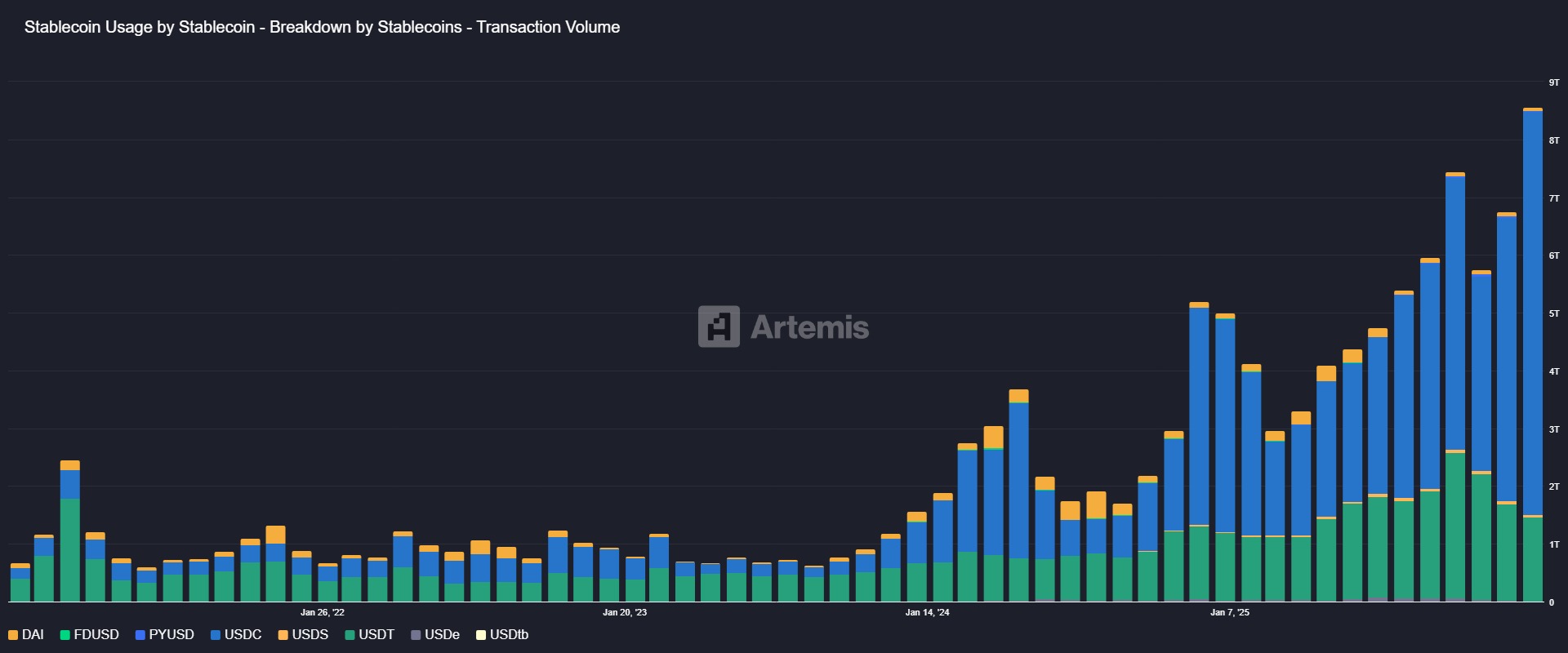
The current stablecoin market comprises around $318 billion. Tether dominates with $187 billion and 61 percent market share. Circle's USDC holds $76 billion. Transaction volume reached a record $33 trillion in 2025. USDC led with $18.3 trillion, ahead of USDT with $13.3 trillion.
Emerging markets as additional pressure point
Dynamics in emerging markets add further pressure to the traditional banking system. Latin America recorded 89 percent stablecoin growth in 2025, reaching $324 billion. Drivers include chronic inflation, currency instability, and a $142 billion remittance market.
Standard Chartered expects a trillion-dollar outflow from emerging market banks such as those in Pakistan and Egypt by 2028. An S&P Global simulation for 45 emerging markets shows: stablecoin values could rise from approximately $70 billion today to $250 to $730 billion.
Relative to GDP, stablecoins are most significant in Latin America and the Caribbean at 7.7 percent, and in Africa and the Middle East at 6.7 percent. India, Nigeria, and Indonesia lead in absolute user numbers. Argentina uses stablecoins to circumvent the legal limit of $200 per month for foreign currency purchases.
Tokenized deposits as counteroffensive
The banking industry is working on a response. Tokenized deposits could compete with stablecoins. They offer a decisive advantage: FDIC insurance. Uphold CEO Simon McLoughlin predicts: 2026 will be the year of the tokenized deposit, following 2025 as the year of the stablecoin.
Treasury Secretary Scott Bessent expects the stablecoin market to reach $3.7 trillion by the end of the decade. Monthly transaction volumes of one trillion dollars could become reality by late 2026. The question for regional banks is no longer whether disruption is coming. It is how quickly they can adapt their business models.