
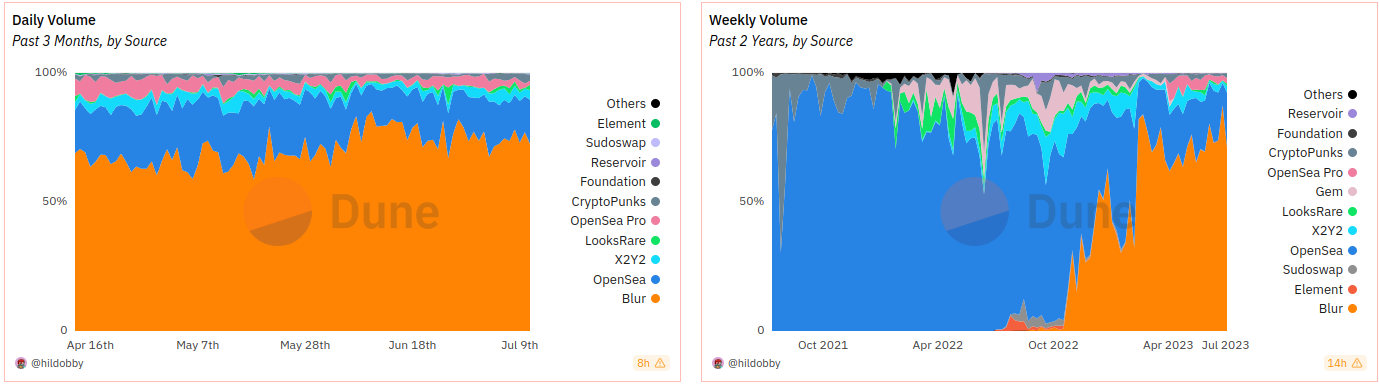
Since the explosive growth of NFTs over the past three years, OpenSea has maintained its position as the first and dominant NFT marketplace. Although some platforms attempted to challenge its dominance, they all failed in the long run. The NFT aggregator Blur is now challenging this dominance for the first time.
Blur, the NFT marketplace, was founded in October 2022 by a team of blockchain enthusiasts who identified a market gap for a comprehensive NFT aggregator. The developers aimed to create a platform that would simplify the trading process of non-fungible tokens (NFTs). Similar to decentralized token exchange aggregators (DEXes), Blur allows trading across various NFT marketplaces from a single platform. To incentivize native liquidity, token emissions are distributed to users, which propelled Blur to become the largest NFT marketplace by volume.

NFT market participants are looking for alternatives to OpenSea
Non-fungible tokens (NFTs) are unique digital assets that utilize blockchain technology to verify ownership and authenticity. They can represent various forms of digital or physical items, such as art, music, collectibles, or even real estate. However, during their rapid growth in 2021/2022, NFTs were primarily used as profile pictures and speculative assets. The most prominent example of an NFT collection is the Bored Ape Yacht Club (BAYC).
With weekly trading volumes in the hundreds of millions, the dominant NFT marketplace, OpenSea, has tapped into a lucrative market. OpenSea charges a 2.5% transaction fee on every secondary market transaction. Unlike decentralized token exchanges, this centralized company retains these fees. Platform users are not rewarded for their engagement, nor do they have a public stake in this lucrative business. Projects like LooksRare and x2y2, which rewarded active traders with token distributions and promised decentralized governance, gained temporary popularity. However, these OpenSea alternatives lost relevance again until the introduction of Blur in October 2022.
Blur: Skillful user acquisition through token airdrops
The NFT aggregator Blur aimed to differentiate itself from both OpenSea and other competitors through several features. Users of the platform can compare NFT prices across different marketplaces, manage portfolios with analysis tools, and buy NFTs on all major platforms. Additionally, active traders should be rewarded for their efforts through various phases of an "airdrop," and the marketplace charges no fees. For many market participants, the decision seemed easy, and just a few weeks after its launch, Blur surpassed the market leader, OpenSea.
The BLUR token itself was designed as a classic "governance token" to facilitate decision-making regarding the platform's future developments. Due to the absence of platform fees, there is no cash flow. However, speculation about future developments often suffices in the crypto world. After all, token holders govern the development direction of platforms with billions in trading volume.
Deep liquidity in an illiquid market
As each non-fungible token is unique and cannot be exchanged for another NFT, there are no highly liquid markets like cryptocurrencies. Although pooling models similar to DeFi's Automated Market Makers (AMMs) exist, they face their own challenges. Furthermore, the NFT market is relatively new, with a limited number of participants, which also contributes to its illiquidity. Blur entered the market with an innovative model to address this.
Instead of solely rewarding the trading of NFTs, the last phase of the BLUR airdrop incentivized "collection bids." These bids are comparable to traditional purchase orders. Collectors can easily sell their artwork at a minimum price instead of patiently waiting for a buyer. Thanks to the success of previous phases, "airdrop farmers" are still offering millions of USD below the floor price of the largest collections. New liquidity enters a historically highly illiquid market.


Loans for NFT holders: Blend
Unlike previous OpenSea competitors, Blur not only plays with incentivization but also actively develops new offerings for NFT traders. In May, the platform successfully introduced a peer-to-peer protocol for NFT loans, an unexplored market until then. Blur Lending, abbreviated as Blend, aimed to further enhance NFT liquidity by allowing expensive NFTs to be paid off through temporary loans.
The Blend protocol works similarly to conventional real estate transactions, where buyers make a down payment and finance the remaining amount over time. This model has been adapted to the NFT market, allowing collectors to make a partial payment of the full NFT price and repay the remaining balance over time. This enabled Blur to capture another subsector of the NFT markets but introduced new risks for collections due to potential liquidation spirals.