Decentralized exchange (DEX) platforms let people trade tokens directly with one another, without relying on banks, brokers, or big institutions. On a DEX, there’s no company sitting in the middle holding your money or approving your trades.
Instead, the process runs on smart contracts, self-executing pieces of code that automatically match buyers and sellers, transfer tokens, and settle trades in real time. This model sits at the heart of decentralized finance (DeFi), a movement that aims to rebuild traditional financial services, such as trading, lending, and payments, on open networks where anyone with an internet connection can participate.
Next generation exchanges
The evolution of DEXs has been gradual. In their early days, they were slow and plagued by low liquidity, meaning traders often struggled to convert assets into cash or other tokens quickly at a fair market price. The turning point came in November 2018, when a project called Uniswap introduced a new mechanism: the automated market maker (AMM). Instead of relying on traditional order books, AMMs used liquidity pools, shared pools of tokens deposited by users, to facilitate trades. This set off a wave of innovation across DeFi, laying the groundwork for the vibrant ecosystem of DEXs and liquidity protocols we see today.
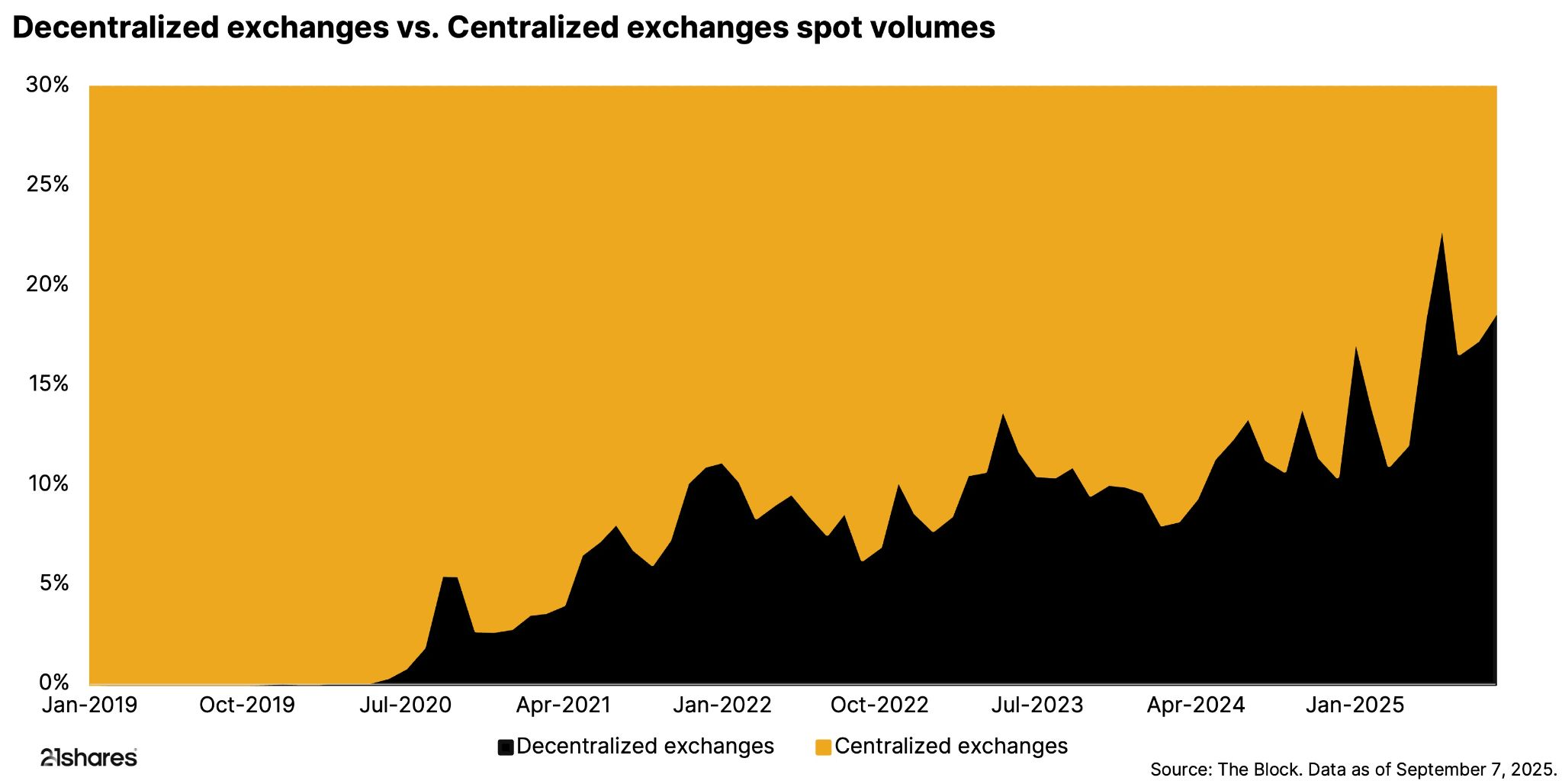
In the last five years, decentralized exchanges' spot volumes have grown significantly compared to centralized exchanges, as shown in the chart below.
How did liquidity become a challenge for DEXs?
As DeFi expanded, it became clear that liquidity was both limited and scattered. Instead of everyone trading in one big marketplace, liquidity was spread across hundreds of DEXs, each with its own token pools and prices. This is like walking into a city where every grocery store stocks only a few items; you’d need to visit multiple stores just to finish your shopping, and you might end up paying more than necessary.
This is where aggregators step in. They act like a price comparison tool for DeFi, automatically scanning dozens of DEXs at once to find the best route for your trade. By splitting or routing orders across different pools, aggregators help users get the lowest possible slippage (price impact when trading) and the best overall price, without the hassle of checking each exchange manually.



How Raydium and Jupiter are solving DeFi’s issues
On Solana, two platforms have emerged as the key players tackling DeFi’s challenges: Raydium and Jupiter. Think of Raydium as the fuel providing liquidity, and Jupiter as the GPS intelligently routing trades.
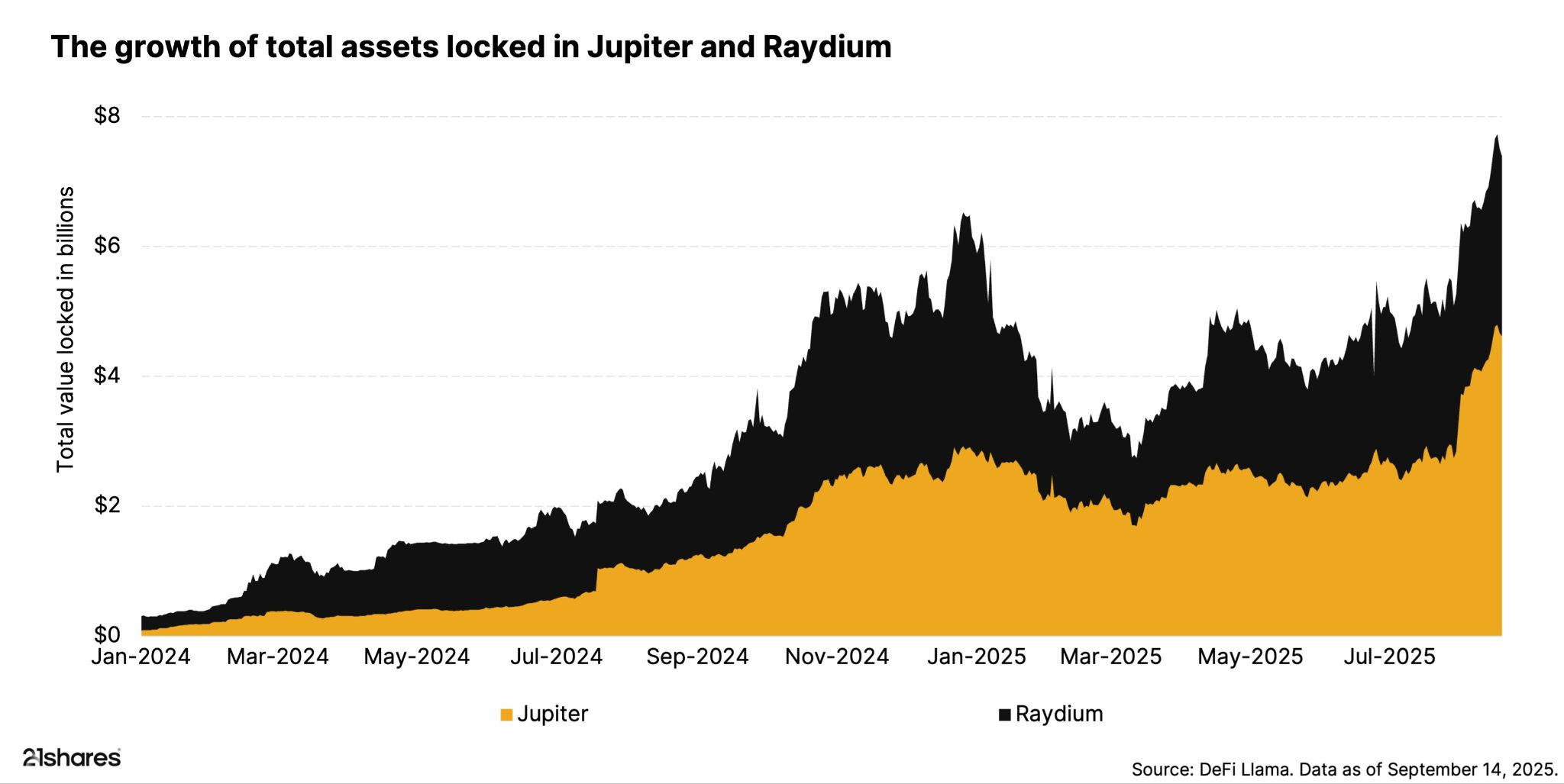
Raydium is one of Solana’s flagship decentralized exchanges and automated market makers (AMMs), designed to deliver both deep liquidity and fast execution. What sets Raydium apart is its direct integration with OpenBook, Solana’s decentralized order book protocol. By combining AMM-style pools with order book depth, Raydium blends the best of both worlds: simple swaps for everyday users and institutional-grade trading with tighter spreads and more efficient volume capture.
As a liquidity powerhouse, Raydium consistently drives over 25% of Solana’s DEX market share, with peak monthly volumes surpassing even Ethereum’s Uniswap. Beyond trading, Raydium powers yield farming, token launches, and real-world asset markets, positioning itself as Solana’s central liquidity hub.
Jupiter - the dominant aggregator
Jupiter has quickly established itself as one of the leading DEX aggregators on Solana, solving the fragmented liquidity issue. Instead of traders manually hopping between exchanges, Jupiter, as an aggregator, routes orders across multiple DEXs to secure the best prices, lowest slippage, and fastest execution, all in one place. It has processed over $1 trillion in lifetime volume, capturing more than 90% of aggregator activity on the network.
Jupiter has evolved well beyond its origins as a simple token swap platform. Today, it stands as a full-stack DeFi hub, offering a comprehensive suite of advanced trading tools, including limit orders, dollar cost averaging, and perpetual futures, that have propelled it to become the fourth-largest protocol by 30-day trading volume across all of crypto, not just Solana. With the addition of liquid staking, a launchpad, mobile app, portfolio tracker, and most recently, a lending market, Jupiter now unifies Solana’s trading ecosystem under one powerful platform.
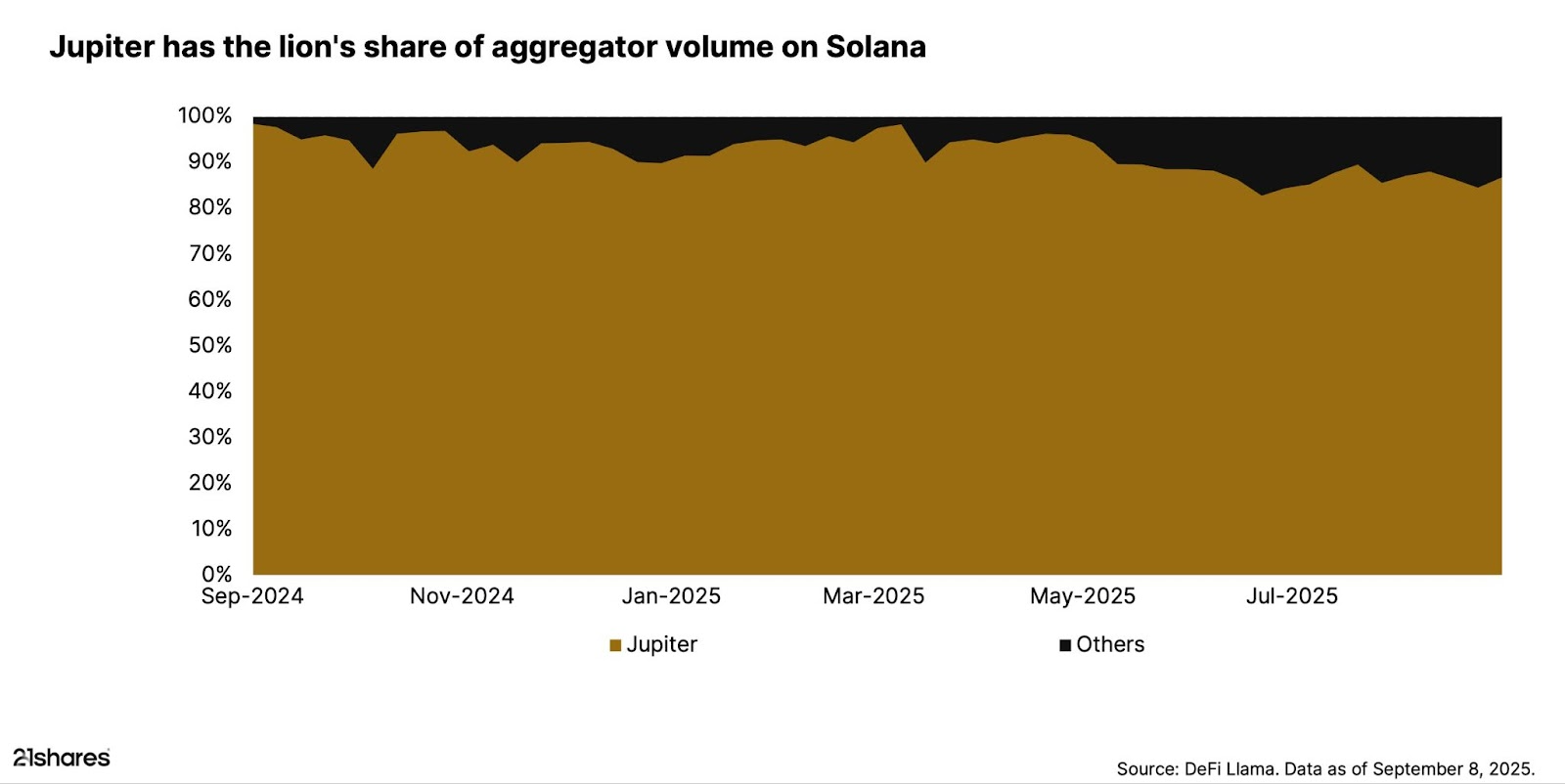
By lowering barriers to entry and improving the user experience, Raydium and Jupiter make crypto markets faster, cheaper, and more accessible. They’re not only strengthening Solana’s ecosystem but also paving the way for the future of decentralized finance.