
Without them, there would be no DeFi applications and no NFTs. "Smart contract-enabling Layer 1 Blockchains" (base layer) are the foundation of today's decentralized ecosystems. These projects are designed to process all transactions on the network and store them on the blockchain.
Unlike Bitcoin, smart contract platforms allow programs - also known as smart contracts - to be written. These applications (dApps) can be accessed globally and around the clock with the help of decentralized blockchains. To use the diverse applications, a user only needs a device with an internet connection. The largest areas of the application currently include the world of decentralized finance (DeFi) and the area around NFTs.
However, due to the increasing demand for those applications, the limitations of existing smart contract platforms also became apparent. High transaction costs and long waiting times demanded alternatives, either in the form of competing blockchains (layer 1) or multi-tier scaling solutions (layer 2).
New possibilities
The idea of smart contracts dates back to the invention of Bitcoin in 2010. But it wasn't until the introduction of Ethereum in 2014 and the possibility of programmable blockchain logic that the idea came to life. Now, this programmable logic - commonly referred to as a "smart contract" - allows blockchain technology to be used for a variety of use cases across different industries.
Smart contracts have made it possible for the first time to create any type of token without having to establish an entirely new blockchain. With Ethereum, a token became a piece of code - a smart contract - with certain functions that allow for the transfer of various digital assets, among other things.
It is possible to create escrow agreements or forward contracts that depend on certain conditions occurring in order to be released. For example, a smart contract could be programmed to release money each year on a person's birthday. Payment could be released once receipt of a delivered good has been confirmed. Or, it can be used to enforce certain rights for digital asset holders - for example, in the area of non-fungible tokens (NFTs).
Adoption of smart contracts
As adoption continues, scalability is the order of the day. Blockchain technology is complex in terms of configuration, programming and operation. However, transaction speed suffers when the network is busy, which can affect the user experience for certain types of decentralized applications (dApps).
The more congested the network, the higher the transaction fees become, as users try to outbid each other. This can make Ethereum very expensive to use. In this case, the fees are not only used to toll the transactions, but also pays for the miners' work.
Scaling trilemma
Even though blockchains are generally considered superior to traditional networks, no single blockchain is perfect. This is due to the difficulty of maximizing the components of scalability, security and decentralization - the so-called blockchain trilemma.
- Scalability is the ability of the blockchain to accommodate a higher volume of transactions
- Security is the ability to protect the data stored on the blockchain from various attacks, or defending the blockchain against double-spending.
- Decentralization is the redundancy in the network that ensures that a few entities do not completely control the network.
Not all components are equally important for their specific use cases and blockchains. Processing weekly payments can easily be done on a slow, but secure blockchain. Other sectors, however, such as gaming, require up to thousands of transactions per minute - an unimaginable feat without a scaling solution.
Alternative Smart Contract Platforms (Layer 1)
Layer 1 blockchains are the foundation of today's decentralized ecosystems. These projects are designed to settle every transaction on the network. This means that all transaction data is recorded and stored in the blockchain. An obvious scaling method used early on is to increase the number of transactions per minute combined with low transaction costs. Usually, this is done by compromising on decentralization and security.
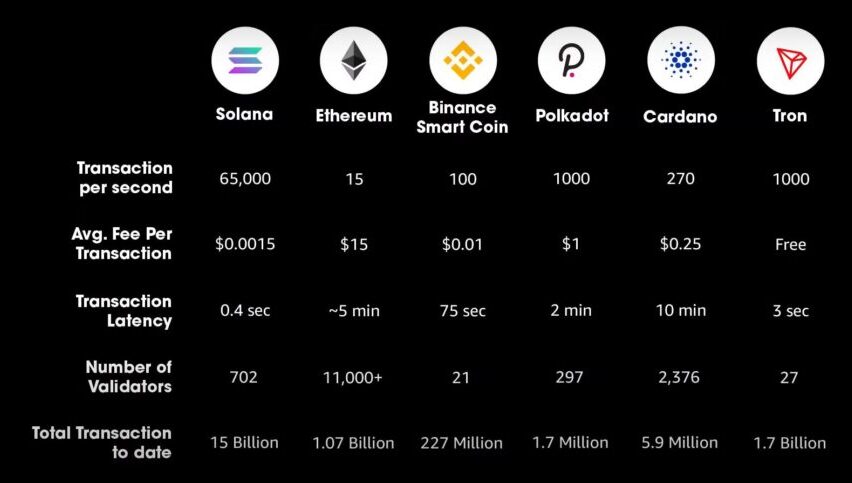
Various Layer 1 blockchains with smart contract capabilities have emerged that aim to compete with Ethereum in one form or another. Older examples like Tron and EOS used the classic approach with a change of consensus mechanism to proof-of-stake (PoS) and an increase in transactions per minute. Competitor Solana has implemented a new consensus protocol that enables even higher throughput. Projects such as Polkadot, Cardano and Avalanche also apply a multi-tiered architecture that uses a base tier and attached blockchains similar to Ethereum 2.0.
Multi-layered Ethereum scaling solutions (Layer 2)
So-called Layer 2 solutions, unlike alternative smart contract platforms, do not try to compete directly with Ethereum. Instead, they increase its transaction throughput in a layered manner. By outsourcing transactions to a connected blockchain - also known as a sidechain - with a final settlement on Ethereum, the network can be relieved to some extent.
A distinction is generally made between sidechains with their own validators and so-called optimistic rollups that fully access Ethereum's decentralization and security. Prominent examples of the first category are Polygon and Fantom. Both use a bridge to move assets between the Ethereum blockchain and a proof-of-stake-based sidechain. In this process, the native validators verify all transactions and settle them on Ethereum at a predefined interval.
In contrast, the scaling projects Arbitrum and Optimism use Optimistic Rollups. These enable the bundling of transactions and settlements on Ethereum without external validators. Instead of using a proof-of-stake sidechain, Optimistic Rollups fall back on the validation of Ethereum miners. While this leads to slightly higher transaction costs, it allows for scaling without compromising security and decentralization.