
Generally, a distinction is made between centralised exchanges (CEX) and decentralised exchanges (DEX) such as Uniswap. This report outlines how the two types of exchanges differ from each other and how they work in the first place.
Centralised crypto exchanges (CEXs) replicate traditional asset exchanges, maintaining a book of orders submitted by buyers and sellers. When orders are matched, the market price is determined and, in traditional markets, clearing and settlement houses ensure that transactions become effective. Generally, trades on crypto exchanges need to be prefunded which introduces complexity in managing fiat balances across exchanges, fragmenting market liquidity and reducing efficiency.
Decentralised exchanges (DEXs) introduce a different model, removing the need to trade through an intermediary by replacing order books with liquidity pools. In this way, DEXs facilitate the exchange of assets within a liquidity pool rather than acting as platform for exchange between parties.
Challenges facing decentralised exchanges (DEXs)
While DEXs introduce innovation in exchanging assets they pose a challenge for regulators because there is seemingly no responsible party to hold accountable in the event of market failure. However, definitions of “centralised” and “decentralised”, and the topic of regulation of DeFi is contentious. This was highlighted in recent news regarding Uniswap – which is widely thought of as the market-leading DEX.
SEC Chair Gary Gensler recently made comments which suggest that a number of digital asset tokens (e.g. tokens that provide synthetic exposure to an underlying security) should be considered security tokens. Thus regulation regarding securities trading should apply to these tokens and the exchanges on which they are traded should be registered (including DEXs). The immediate reaction might be that the statements are irrelevant for DEXs because there is no entity to be registered or regulated.
Unsurprisingly, Binance (a centralised exchange) removed a number of trading pairs from its platform. However, Uniswap Labs also removed access to tokens from the Uniswap’s user interface (tech savvy users still have access via the underlying protocol).
This raises a number of questions such as:
- If Uniswap is a DEX, is “Uniswap Labs”, which is often referred to as a software “studio” for developers, a central body which could be regulated?
- Why are changes being made to Uniswap in response to the SEC comments and who is behind these decisions?
These are topics we will address in a follow-up article on regulation and compliance in crypto markets. For today, we will simply provide an overview of Uniswap and so that you can decide for yourself.
Uniswap – a decentralised trading protocol
Uniswap is a decentralised exchange that allows users to trade Ethereum ERC-20 tokens directly without any third-party involvement, fund liquidity pools and generate profits from trading fees. It was created in 2018 by a young independent developer, Hayden Adams. Since its launch, the project has raised over USD 10 million from multiple seed rounds and is considered the most popular decentralised exchange so far.
Key metrics
- USD 302+ billion all time volume
- 72'000+ liquidity providers
- 58+ million all time trades
- 200+ DeFi integrations
- USD 6+ billion total value locked
What are decentralised exchanges?
DEXs are part of the decentralised finance (DeFi) ecosystem, where traditional financial services such as exchanges, lending services, and insurances have been decentralised through the use of blockchain technology. They aim to tackle the challenges that impede centralised structures by building peer-to-peer marketplaces directly on the blockchain; thereby allowing traders to remain custodian of their assets (i.e. trade directly from their own wallets).
Unlike a centralised exchange that requires a controlling company and centralised servers to operate, a DEX consists of a set of smart contracts deployed on a blockchain and it never takes control of user’s assets. There is no orderbook, no centralised party and no central facilitator of trades. Instead, they strive to leverage the technology behind crypto assets themselves to enable a safer and more transparent trading experience. A key difference a DEX has from a centralised exchange is in the way transactions are conducted and how the price is determined.
How decentralized exchanges work
Within the centralised set-up, a trade is conducted when a seller and buyer reach an agreement through matching an order in the exchange order book. At that point the price of the asset is determined until another trade is executed at a different price. In other words, the price of the most recent trade is considered the current price on the exchange.
A decentralised exchange such as Uniswap on the other hand, does not have an order book. Users do not trade with one another; they trade within a liquidity pool. In order to determine the price a mathematical formula, or a pricing algorithm, called Automated Market Maker (AMM) is used. Investors are incentivized to fund liquidity pools by receiving a share of trading fees, which are used to execute all trades at the set market prices.
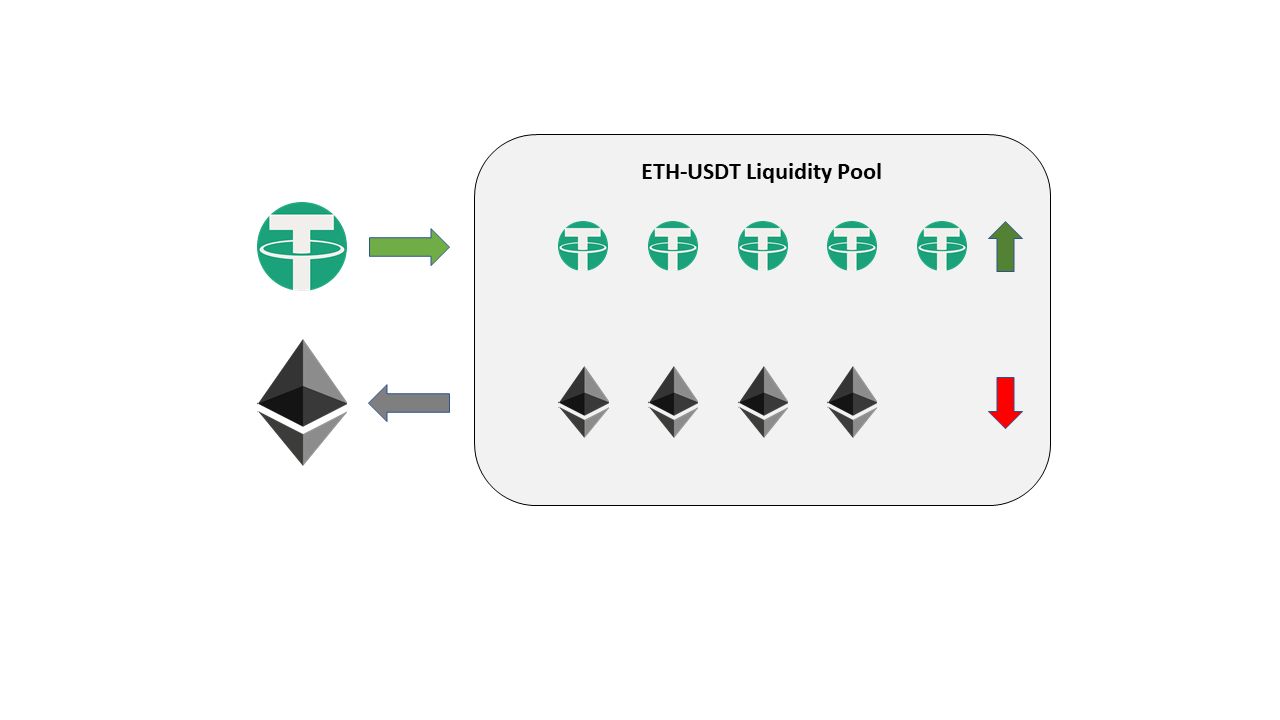
Uniswap uses an AMM called “Constant Product Market Maker Model” to determine the price of assets on its exchange. Prices are determined by the amount of each token in a pool following a simple formula. During each trade a certain amount of one token is removed from the pool for an amount of the other token. To maintain a constant reserve ratio, the balances held by the smart contract are adjusted during the execution of the trade, therefore changing the price.
Most popular DeFi protocol
Uniswap is one of the most forked projects in the DeFi space, meaning people use its code to build additional applications. The first version of Uniswap, which allowed trading of any ERC-20 token to Ether and back, started out in November 2018. In May 2020, Version 2 was released and the trading of ERC-20 tokens directly between one another without first having to trade with Ether became available.
In September 2020, Uniswap introduced the UNI token through an airdrop. Each person who previously used Uniswap received 400 UNI tokens for free. The UNI token however, despite its rise in value, was not designed to serve as a currency. Rather its value is derived from its use as a governance token for the Uniswap protocol, allowing whoever holds it to influence (the more tokens, the more voting power) and vote on the future development of the protocol. The idea behind the UNI token is for the Uniswap team to gradually fade out their involvement and leave the management of the project to the token holders.
Overall Uniswap is one of the most promising projects in DeFi. With over $6bn locked into liquidity pools it currently stands at position 6 of the largest DeFi projects in terms of total value locked (TVL). With further adoption of ERC-20 tokens Uniswap will be able to capitalize on increased trading volumes.