Binance now enables commission-free trading in over 7,000 US stocks and ETFs for users outside the US, with funding available from as little as USD 5 via stablecoins. The exchange also announced bStocks: a feature that will convert stock holdings into tokenized assets on the BNB Chain in the coming weeks.
Binance is the world's largest crypto exchange by trading volume and serves more than 250 million registered users according to its own figures. Until now, the platform specialized exclusively in digital assets, and the move into traditional securities follows only now. Since January 2026, the company has run a regulated operation under the framework of the Abu Dhabi Global Market (ADGM); the full license granted in December 2025 covers exchange, clearing house, and broker-dealer activity under the brand name "Nest". This license forms the regulatory basis for stock trading and therefore marks the decisive difference from the failed 2021 program, which was discontinued after warnings from BaFin and Hong Kong's SFC. Execution, clearing, settlement, and custody are handled instead by Alpaca Securities LLC of New York, so that users hold direct ownership rights to the shares. Trading runs 24/5, funded through USDC, USDT, BNB, and other digital assets.
US stocks on Binance: fee structure and technical settlement
Trading itself is free of charge; Binance levies only a minimal platform fee. This amounts to USD 0.35 per order as a minimum, but shifts to a tier of 10 basis points once an order volume of USD 350 is reached. Fractional purchases are moreover possible from as little as USD 5, which keeps even expensive individual stocks within reach for retail investors. Funding runs through USDC, USDT, BNB, and other cryptocurrencies, with trading available around the clock from Monday to Friday in 24/5 mode.
Settlement is split across two regulated partners. Nest Trading Limited, the broker-dealer authorized under ADGM, acts as the introducing broker and arranges the stock purchases. Alpaca Securities LLC of New York handles execution, clearing, settlement, custody, as well as dividend payments and corporate actions. Users therefore hold direct ownership rights to the shares through the US-regulated clearing broker. Consequently, this is not a loose crypto feature but a fully regulated brokerage product.
Co-CEO Richard Teng justifies the step with reference to market structure: US stocks represent well over half of the global stock market, yet for many investors in overseas markets they come with considerable costs and friction.
bStocks: shares on BNB Chain with DeFi access
Alongside direct stock trading, Binance announced bStocks. The feature allows users to convert their stock holdings into tokenized assets on the BNB Chain, with the launch planned for the coming weeks. Unlike traditional stock trading with T+1 settlement, bStocks enable near-instant settlement. Furthermore, the tokens can be deployed on-chain in DeFi applications such as lending or liquidity provision.
Legally, bStocks are classified as "Certificates representing certain Financial Instruments" under paragraph 92, Schedule 1 of the Financial Services and Markets Regulations (FSMR). Holders therefore possess neither voting rights nor a direct claim to the underlying value, but only a securitized certificate on the respective financial instrument. As a result, no direct dividend flows to them. According to reports, BTECH Holdings Ltd, regulated under ADGM, acts as the issuer, though regulatory approval is still pending.
Binance nevertheless stresses one difference from competitors: with Kraken and Robinhood the platform controls the tokenization, whereas users initiate the process themselves with bStocks. Control over the conversion thus shifts from the provider to the holder, who can make holdings available on-chain independently.




Failed in 2021, regulatorily secured in 2026
Back in April 2021, Binance had launched stock tokens through the German partner company CM-Equity AG, including Apple, Tesla, Coinbase, Microsoft, and MicroStrategy. However, the program remained small and reached a total volume of just under 73 million USD. In July 2021, discontinuation followed under regulatory pressure: BaFin classified the tokens as securities, Hong Kong's SFC warned of missing licensing, and regulators in Brazil, Lithuania, and Italy joined in.
Today's step, by contrast, rests on several years of regulatory groundwork. In December 2025, Binance became the first crypto exchange to receive a full ADGM license from the FSRA, covering three separate Nest entities. These cover exchange, clearing house, and broker-dealer activity, with Nest Trading Limited arranging the stock purchases as the authorized broker-dealer. The regulated operation started in early January 2026, followed by a first stage in February 2026: at that point, the exchange introduced ten tokenized US stocks and ETFs through Ondo Finance on Binance Alpha. The full rollout with direct stock ownership now marks the next step in this sequence.
Competition among crypto exchanges for global stock investors
Binance enters a market in which a race among crypto exchanges is already emerging. Kraken launched its xStocks product in June 2025 with 60 stocks, acquired the Swiss issuer Backed Finance in December 2025, and now lists 100 tokenized stocks and ETFs at over 25 billion USD in total volume since launch. Robinhood likewise brought tokenized stocks to EU customers in mid-2025, while MEXC recently launched "RealStocks" with direct stock ownership through broker partners. Coinbase, meanwhile, is building an "Everything Exchange" for multi-asset trading.
In the tokenized stock segment itself, Ondo Finance dominates, the same partner through which Binance launched its first stage in February. The provider held around 60% market share in early 2026 at over 550 million USD in TVL under management. The market dimension has moreover long reached institutional scale: in mid-May 2026, tokenized stocks recorded a record daily volume of 3.57 billion USD, driven by Binance, Hyperliquid, Kraken xStocks, Ondo, and Bitget.
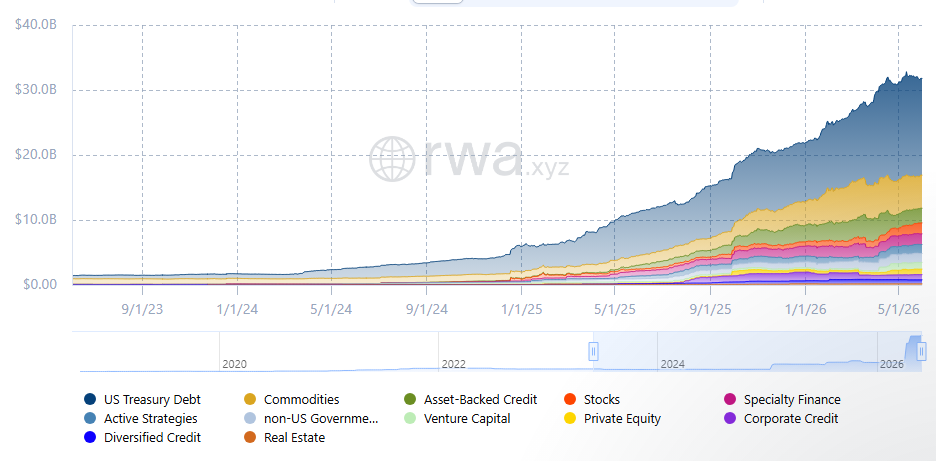
The overall market for tokenized real-world assets furthermore grew from around 6 billion USD in early 2025 to over 34 billion USD in May 2026. Ethereum claims the largest share of this volume at around 33%, while the BNB Chain, the XRP Ledger, and Solana each hold about 6%. Planned DTCC pilots for tokenized securities in the second half of the year additionally signal growing TradFi momentum. Binance ultimately enters this environment with 250 million users as a distribution channel, pursuing the stated goal of becoming a "multi-asset financial super app".