
A week ago, Jupiter, the leading aggregator of decentralized exchanges on the Solana blockchain, distributed hundreds of millions of USD worth of its own JUP tokens to over a million active users. What some celebrated as the largest "airdrop" in blockchain history also revealed the dark side of the industry.
A decentralized exchange (DEX) is a blockchain-based platform that allows users to trade cryptocurrencies directly, bypassing traditional central financial intermediaries such as banks or brokerage firms. There are numerous decentralized exchanges on different blockchain networks that aggregate them into a single interface. Jupiter is the leading DEX platform on the Solana blockchain. Here's a look at the events of the past few weeks.
Jupiter establishes itself as the leading DEX aggregator
Decentralized exchanges were first implemented on the Ethereum blockchain. In the first few years after the launch of the smart contract blockchain, various projects attempted their own versions of decentralized liquidity provision. The breakthrough came with the Uniswap protocol in 2019, with the automated market maker (AMM) model. Since then, DEXs have become a cornerstone of any blockchain network. Without their own decentralized exchange, users would be completely dependent on centralized players, whose risks should be more evident than ever after the FTX collapse.
Following the launch of the Solana blockchain in mid-2020, competition in the DEX space was correspondingly fierce. Uniswap was already generating hundreds of millions of USD in daily trading volume, and due to the different programming languages (Ethereum: Solidity, Solana: Rust), it could not be easily transferred to the new network. Raydium, Bonfida, Saber, Orca and many others launched their own decentralized exchanges. It wasn't until a year later that the aggregator Jupiter was launched, able to pool the liquidity of all the marketplaces. To date, Jupiter processes approximately $500 million in daily volume, surpassing all of its Ethereum-based competitors.
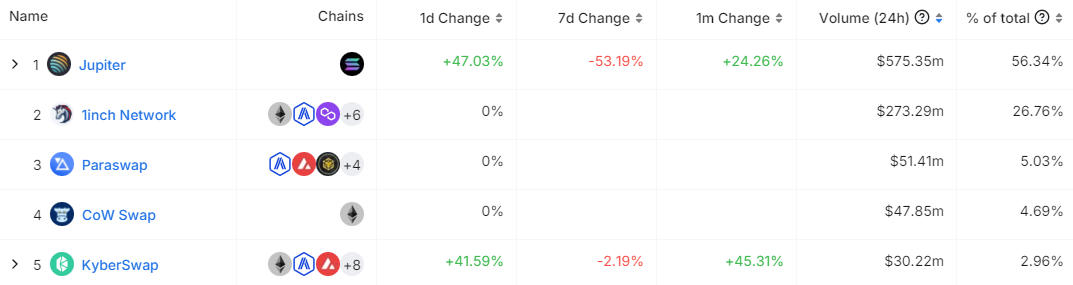
Ranking of the top five DEX aggregators by volume / Source: DeFi Llama
JUP airdrop preparations took three months
Similar to all the leading decentralized exchanges, Jupiter unveiled its own governance token in November 2023: JUP. The native cryptocurrency would be distributed to active users of the aggregator and used for future decisions on the future of the protocol. The exact details were not disclosed by the development team. It wasn't until January 2024 that users were informed of the details of the JUP airdrop. Throughout January ("Jupuary"), the team launched experimental test coins. The peak of the airdrop was the JUP launch on January 31st.



The first token, mockJUP ("pseudo-JUP"), served as a test of the airdrop mechanism. On January 16th, the team distributed tokens to active Solana users. Within minutes, participants created a liquidity pool, and the "worthless test coin," according to founder Meow, could be traded on decentralized exchanges. The team itself did not provide any liquidity in order to confidently refute accusations of fraud. However, it was predictable that users would speculate on the price of mockJUP. At one point, the test coin traded with a market capitalization of over $200 million USD. Since its peak, the price has dropped by -80%.
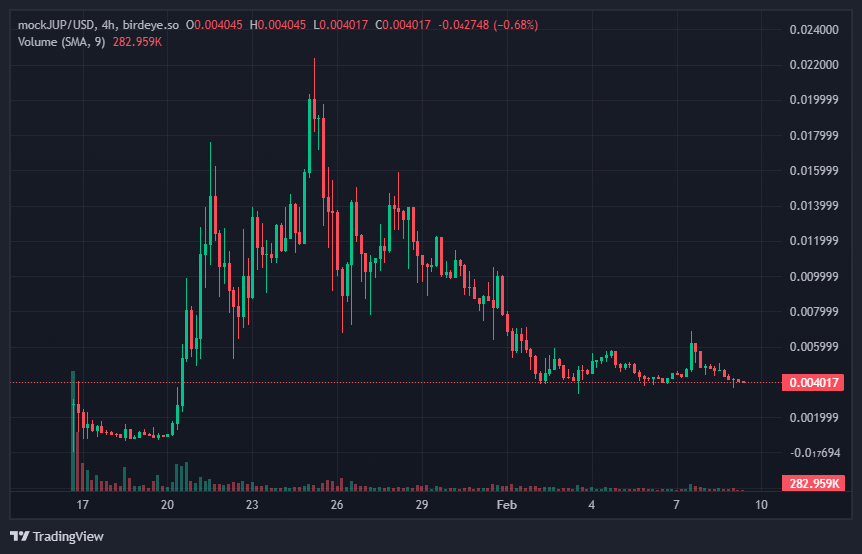
mockJUP chart against USD / Source: Birdeye
Ten days later, the Jupiter team launched the next token. The "WEN" Memecoin (crypto jargon for "when") was the first real token from the development team to test its own launchpad. As a meme coin, WEN had no utility, but was intended to have value. Instead of a classic two-sided liquidity pool of WEN and USDC, the Jupiter launchpad used a one-sided pool. The development team provided only WEN tokens. User purchases filled the token pair with USDC. Since its peak, WEN has also fallen by -75%.
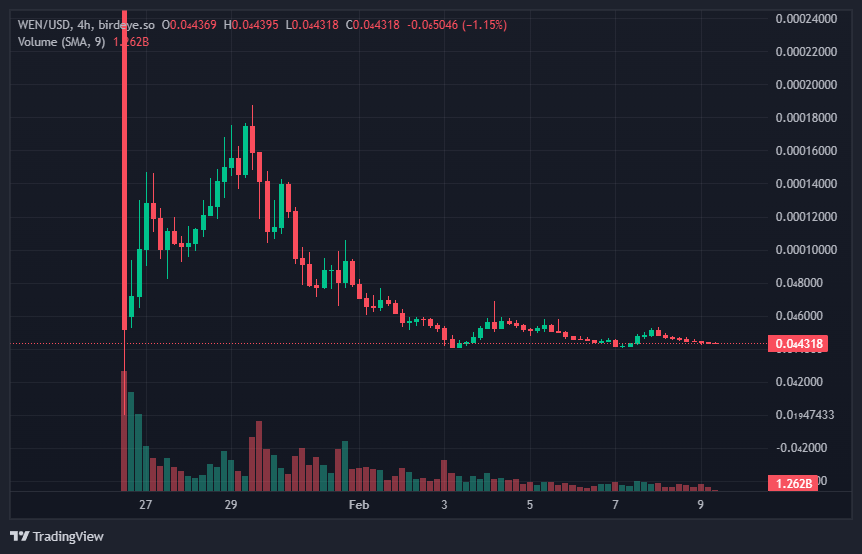
WEN Chart vs. USD / Source: Birdeye
Jupiter team makes hundreds of millions with JUP airdrop
After two successful test runs, it was finally time for the JUP governance token. Over one million individual wallets qualified for the airdrop. Half of the tokens went to active Jupiter users, while the other half was managed by the development team. The breakdown was as follows: 50% airdrop, 20% team members, 20% team strategic reserve, 10% for initial liquidity. For the launch, the team used the same one-sided pool mechanism that was tested with the WEN Memecoin.
The team made 10% of all tokens available as a one-sided pool within a certain price range. Again, all USDC came from users. However, unlike previous token initiatives, JUP's liquidity was not locked up. Just seven days after launch, the development team was allowed to remove liquidity - both JUP and USDC - from the pool. Behind the innovative launchpad mechanism was a simple token sale at a valuation of four to seven billion USD. The unilateral liquidity netted the development team over $100 million USD. What many did not know was that prior to Jupiter, the same development team had launched two tokens for the Meteora (formerly Mercurial Protocol) liquidity platform.
Team only sold 250m ?? 💀 pic.twitter.com/kTFd0flRQO
— veH👁️rny 🐇 (@veH0rny) February 1, 2024
On the other hand, all parameters were disclosed before the launch. Nevertheless, users had to sift through numerous blog posts, tweets and Discord messages from the founder to find this information. However, it is always wise to refrain from investing in projects or mechanisms that are not fully understood. Despite the controversial launch of the token, Jupiter remains the leading decentralized exchange on the thriving Solana blockchain.